

Most toy store owners already feel the pressure to go greener. Parents ask about it. Suppliers push "eco" lines. And somewhere in the back of your mind, you know the mailer bags and foam inserts you've been reordering for years are both expensive and wasteful. The problem isn't motivation. The problem is that sustainability decisions made badly can quietly eat 2–4 points of margin, and nobody notices until the quarter closes.
The stores that get this right treat packaging the same way they treat inventory: decisions tied to margin gates, tested one swap at a time, with a clear rule for when to pull back. The stores that get it wrong replace everything at once, discover the compostable mailer tears in transit, eat a wave of damaged-item returns, and then swear off sustainability for two years.
This article is about building the decision system — not the moral argument. If you want the environmental case, you already know it. What you need is a way to make swaps that hold margin while actually reducing waste.
Why packaging decisions break at a toy store specifically
Toys are an awkward category for packaging. You've got lightweight plush that ships cheap but looks sad in a flimsy box, fragile collectibles that need real protection, oversized ride-ons that defy any standard mailer, and tiny blind-box items where the packaging is the product experience. One packaging standard almost never fits the whole catalog.
The pattern that shows up across small retailers chasing sustainable packaging: they find one hero product — usually a recycled kraft mailer — switch their whole fulfillment flow to it, and feel great for about three weeks. Then the damage claims start. A ceramic-based playset arrives cracked. A board game box gets crushed because the new mailer has no rigidity. Returns and reships spike, and the "cheaper, greener" mailer ends up costing more per shipment than the bubble mailer it replaced once you factor in the failures.
The second failure mode is perceived-value collapse. A $90 collectible that arrives in a thin compostable sleeve feels cheaper, even if it's perfectly intact. Gift buyers especially notice this. You didn't lose margin on materials — you lost it on the next purchase that didn't happen.
So the real question is never "is this packaging sustainable?" It's "does this swap hold up across my specific product mix, shipping lanes, and customer expectations without increasing failure cost?"
The cost/benefit scoring framework
Before you swap anything, score each candidate swap. This stops you from making emotional decisions about materials and forces you to look at total landed cost, not just the sticker price of the packaging.
Never run out of bestsellers again.
GoToyvio helps you monitor inventory and sales to keep your shelves stocked and customers happy.
- Real-time stock tracking
- Automated reorder alerts
- Sales and promotion analytics
No credit card required
-
Unit cost delta — cheaper gets a higher score; more expensive gets a lower one
-
Protection reliability — how well it protects across your fragile SKUs
-
Perceived value impact — does it maintain or hurt the unboxing feel
-
Waste reduction — real reduction in material volume or non-recyclable content
-
Operational fit — does it work at your packing station without slowing people down
Then weight them. Protection and operational fit matter more than most people assume, because those two factors drive your hidden costs — returns, reships, and labor.
| Swap candidate | Unit cost | Protection | Perceived value | Waste reduction | Ops fit | Weighted score |
|---|---|---|---|---|---|---|
| Recycled kraft mailer (plush/soft goods) | 4 | 4 | 3 | 4 | 5 | High |
| Paper void fill (replacing plastic air pillows) | 3 | 4 | 4 | 5 | 3 | High |
| Compostable poly mailer (general) | 2 | 2 | 2 | 4 | 4 | Medium/Low |
| Molded pulp inserts (fragile collectibles) | 2 | 5 | 5 | 4 | 2 | Medium |
| FSC-certified gift boxes (premium items) | 2 | 5 | 5 | 3 | 3 | Medium |
The scoring exercise almost always surfaces the same insight: the cheapest sustainable option is rarely the best one. Recycled kraft mailers and paper void fill tend to win because they're genuinely cheaper, protect well for the right products, and drop right into an existing packing flow. Compostable poly often scores poorly because it costs more and protects less — a bad combination that looks good on an Instagram post and bad on a P&L.
This connects directly to how you've set up your fulfillment economics. If you've already done the work of standardizing pack sizes and negotiating carrier rates, you've got the baseline cost data to score swaps accurately. Without that baseline, you're guessing.
The phased swap plan tied to margin gates
Never swap everything at once. Phase it, and tie each phase to a margin gate — a rule that says "we only move to the next phase if margin held within tolerance."
Here's the phased sequence that tends to work:
-
Phase 1 — Zero-risk swaps. Start with the packaging that touches your most durable, least fragile products. Plush, apparel, soft goods. Swap to recycled kraft mailers here first. The downside risk is almost nothing, and you build real data.
-
Phase 2 — Void fill and internal materials. Replace plastic air pillows and foam with paper void fill across general orders. This is invisible to the customer but meaningfully reduces waste, and protection stays comparable for most items.
-
Phase 3 — Mid-value fragile items. Introduce molded pulp inserts for collectibles and glass or ceramic-containing products. This is where protection scoring matters most. Test on a limited SKU set before expanding.
-
Phase 4 — Premium and gift presentation. Only after the first three phases hold do you touch the premium unboxing experience. FSC-certified boxes, branded recycled tissue, that sort of thing. Highest perceived-value risk, so it goes last.
Here's a quick visual of that phased workflow.
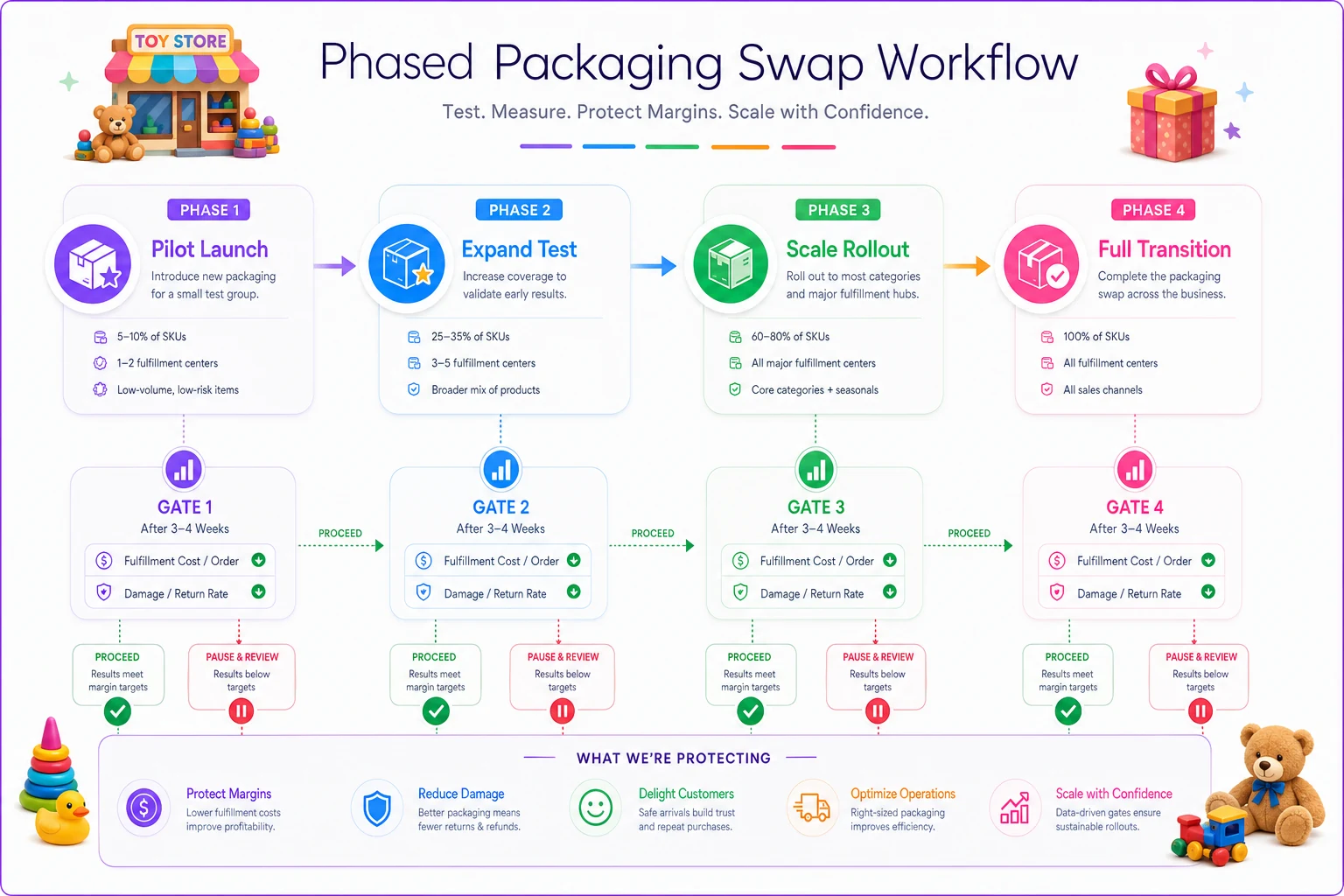
The margin gate rule: after each phase runs for 3–4 weeks, compare your fulfillment cost per order and your return/damage rate against the pre-swap baseline. If fulfillment cost per order rose more than roughly 1.5% or damage-related returns ticked up noticeably, you pause and fix before advancing. No gate passed, no next phase.
This is the same discipline you'd apply to promotions. The profit-first cashflow approach of gating decisions on ROI works identically here — you're just gating on margin impact instead of promo return. Good intentions don't bypass the numbers.
The returns-exception matrix
Returns are where sustainability swaps actually get tested, because that's where failure shows up. You need a matrix that tells your team exactly how to handle a damage or packaging complaint and whether the new packaging caused it. Otherwise you'll never know which swap is quietly bleeding you.
| Return reason | Likely cause | Action | Flag for review? |
|---|---|---|---|
| Item arrived damaged, fragile SKU | Insufficient protection from new insert | Reship + refund shipping | Yes — protection score failed |
| Item arrived damaged, durable SKU | Carrier handling, not packaging | Reship, standard claim | No |
| "Packaging looked cheap" complaint | Perceived-value drop | Note for perceived-value score | Yes — if repeated |
| Mailer torn open in transit | Material strength failure | Switch SKU back to prior mailer | Yes — immediate |
| Customer kept item, wanted partial refund | Minor cosmetic | Partial credit per policy | Track frequency |
The thing most stores miss: you have to separate carrier-caused damage from packaging-caused damage. If you lump them together, a swap that's actually fine looks like a disaster, and a swap that's genuinely failing hides inside your normal damage noise. Tag the cause at the point of return. Three or four tagged packaging failures on the same SKU is your signal to roll that swap back.
Tag the cause at the point of return so packaging failures don't hide in carrier noise.
If your returns are already getting tangled across online, in-store, and pickup channels, fixing that coordination first matters — because you can't read packaging data cleanly when fulfillment is chaotic across channels. Clean channel flow is a prerequisite for clean swap data.
Customer messaging that protects margin (and tested wording)
This is the part people skip and then wonder why their sustainable packaging push didn't move the needle. If you swap to greener packaging silently, customers either don't notice — so there's no benefit — or they notice the downgrade in presentation and you lose. The messaging is what converts a cost into a value signal.
-
Frame the material choice as intentional, not cheaper. A small printed card that says "We switched to recycled, plastic-free packaging to cut waste" turns a thinner mailer into a deliberate choice rather than a cost cut.
-
Attach the message to the product, not a banner. A line at checkout and a note in the box both outperform a generic website badge, which nobody reads.
-
Be specific about what changed. "This box is FSC-certified and fully recyclable" beats "eco-friendly packaging" — vague green language reads as marketing, specifics read as commitment.
A messaging line worth testing: "Your order ships in plastic-free, recyclable packaging — one small change we made to reduce waste without raising your price." That last clause matters. It reassures the price-conscious buyer that going green didn't come out of their pocket, which quietly defends your conversion rate.
Test two versions against a plain control for a few weeks. Watch whether perceived-value complaints in your returns matrix go up, stay flat, or disappear. The right message often erases the "this looks cheap" problem entirely — same packaging, different customer reaction.
A real scenario
A single-location toy store doing roughly 300–350 online orders a month wanted to cut packaging waste. Their first instinct was to replace every mailer and insert with compostable alternatives in one shot.
Instead, they phased it. Phase 1 moved all plush and apparel to recycled kraft mailers — no issues, and material cost actually dropped slightly. Phase 2 swapped air pillows for paper void fill; damage rate held steady. Phase 3 introduced molded pulp inserts for the fragile collectible line, and that's where the gate caught something: damage-related returns on a glass-based playset ticked up over three weeks. They rolled that single SKU's packaging back, kept the pulp inserts for everything else, and the damage rate normalized.
Net result after a full quarter: packaging waste down meaningfully, fulfillment cost per order roughly flat — slightly down on the soft-goods lines, slightly up on fragile — and a small lift in repeat-purchase rate they credited partly to the in-box sustainability note. No margin collapse, no sustainability whiplash. The gates caught the one swap that would've hurt them.
When this makes sense — and when it doesn't
When phased sustainable swaps make sense:
-
You ship enough online volume that packaging is a real line item
-
You have baseline fulfillment cost and return data to measure against
-
Your customers actually care (surveys, direct feedback, your market)
When it's a bad idea to rush:
-
Your return/damage tracking can't separate packaging failures from carrier damage — fix that first
-
You're in peak season; never run packaging experiments during your highest-volume weeks
-
Your margins are already thin enough that a single bad swap could hurt — go slower, smaller phases
Stores still fighting basic fulfillment chaos, or ones without clean per-order cost numbers, should wait. You'll be flying blind, and sustainability decisions made blind are how margin quietly disappears.
Making the system hold as you grow
At one location, you can almost track packaging swaps in your head. At two or three, you can't. The swap that worked at your flagship might fail at a store on a different shipping lane with a different product mix, and if you're not tagging returns by cause and tracking cost per order per location, you won't catch it until it's expensive.
This is where keeping your packaging decisions inside the same operational system you use for inventory and fulfillment actually pays off. When return reasons are tagged consistently, per-order costs are visible across channels, and your margin gates are rules the system actually checks — rather than something you remember to look at — the whole thing scales. Good operational software handles the coordination quietly: flagging when a SKU's packaging-related returns cross a threshold, keeping cost-per-order visible per phase, making sure the data you need to pass or fail a gate is there when you need it.
The goal isn't to automate the decision. It's to make sure the numbers that inform the decision never get lost in the day-to-day noise. Sustainable packaging for a small retailer isn't a moral leap — it's a sequence of small, measured swaps, each one earning its way to the next. Score it, phase it, gate it on margin, and let the returns data tell you when to stop. Do that, and you reduce waste without ever having to choose between your values and your margin.
The goal isn't to automate the decision. It's to make sure the numbers that inform the decision never get lost in the day-to-day noise. Sustainable packaging for a small retailer isn't a moral leap — it's a sequence of small, measured swaps, each one earning its way to the next. Score it, phase it, gate it on margin, and let the returns data tell you when to stop. Do that, and you reduce waste without ever having to choose between your values and your margin.
Ready to elevate your toy store operations?
Join 500+ toy retailers using GoToyvio to increase sales, reduce stockouts, and enhance customer loyalty.