


Running a toy store means managing cash across extreme seasonal swings. Unlike most retail where revenue flows somewhat evenly, toy stores see 35-45% of annual revenue compressed into November and December. Then January hits like a brick wall—returns pile up, foot traffic drops 70%, and you're sitting on leftover holiday inventory while needing cash for Valentine's Day and Easter orders.
Most toy store owners handle this by gut feel. They order when vendors push new catalogs, run promotions when competitors do, and adjust staffing based on how busy the floor looks. That reactive approach destroys profitability. You end up cash-strapped in March when hot spring releases drop, overstaffed in February when nobody's shopping, and running margin-killing promotions that barely move inventory.
The stores that survive—and actually grow—run their operations through specific decision rules that protect cash, maximize profitable periods, and prevent the February-March crunch that kills so many independents.
Why standard retail advice fails toy stores spectacularly
Generic retail wisdom tells you to maintain 2-3 months of inventory, staff based on sales per square foot, and run promotions to clear slow movers. Apply this to a toy store and you'll be closed within two years.
Toy retail operates on completely different physics. A board game that sits for eight months suddenly becomes a must-have gift in December. LEGO sets hold value differently than clothing—they don't "go bad" seasonally. Collectibles and trading cards follow hype cycles that have nothing to do with traditional retail seasons.
The cash patterns are brutal. In November you might turn inventory three times. In February you're lucky to turn it once. Your landlord still wants the same rent. Your two key employees still need their hours. The electric bill doesn't care that nobody's buying anything.
Standard retail cash management assumes relatively stable monthly flows. When 40% of your annual cash generation happens in eight weeks, every financial decision needs different timing, different buffers, and different triggers.
The three pillars of toy store cash management
The stores that survive these cycles all manage three interconnected systems: ordering windows tied to cash position rather than vendor schedules, promotion gates based on actual ROI rather than calendar dates, and payroll rules that flex with true demand patterns rather than last year's schedule.
Never run out of bestsellers again.
GoToyvio helps you monitor inventory and sales to keep your shelves stocked and customers happy.
- Real-time stock tracking
- Automated reorder alerts
- Sales and promotion analytics
No credit card required
Each pillar supports the others. Smart ordering windows ensure you have cash for payroll. Disciplined promotion gates protect margins during peak selling periods. Flexible payroll rules prevent burning cash on labor when customer patterns shift.
These aren't theoretical frameworks. They're specific, measurable rules you can implement immediately.
Ordering windows that protect cash position
Traditional ordering follows vendor release schedules. The Hasbro rep shows up in January with the spring catalog. You place orders because that's when ordering happens. By March you're cash-strapped and can't grab the hot releases that actually drive traffic.
Better stores reverse this completely—ordering windows based on cash position, not vendor timing.
Peak Season Cash Reserve Rule Never enter October with less than 45 days of operating expenses in cash. If your monthly operating cost is $22,000, you need $33,000 liquid on October 1st. Not inventory value—actual cash available.
The 20-50-30 Ordering Pattern Your annual inventory investment should follow this split:
-
20% spent January through May
-
50% spent June through September
-
30% spent October through December
This seems backwards. Why spend the least during the holiday season? Because that's when you're converting September's inventory investment into cash. December ordering should only cover proven sellers moving faster than expected.
The Tuesday Morning Rule Place all orders on Tuesday mornings when you're fresh and have weekend sales data. Never order on Fridays when you're tired, and definitely never during vendor visits when you're being sold to.
Use your Tuesday morning ordering window to reconcile weekend returns so ordering reflects net sales, not gross.
One store I worked with shifted from reactive vendor-driven ordering to this window system. They went from borrowing $15,000 every March to carrying $28,000 in reserve entering the slow season.
Setting promotion ROI gates based on real math
Most toy stores run promotions because it feels like they should. Back-to-school sale in August. Black Friday deals in November. After-Christmas clearance in January. These calendar-driven promotions destroy margins without actually driving incremental sales.
The math on toy store promotions is unforgiving. Unlike apparel where you're clearing inventory that'll be worthless next year, most toy inventory holds value. That LEGO set you discount 20% in January would have sold at full price in November.
The 3X Coverage Rule Only run promotions on products where you have more than 3X the expected weekly sell-through in stock. If a board game typically sells 3 units per week and you have 15 units, you can promote. If you have 6 units, hold price.
Revenue Per Square Foot Gates
| Month | Minimum $/sqft to Run Promos | If Below, Do This Instead |
|---|---|---|
| January-February | $12/sqft | Reduce hours, hold price |
| March-May | $18/sqft | Focus on events, not discounts |
| June-August | $22/sqft | Birthday party packages only |
| September-October | $28/sqft | Preorders and reservations |
| November-December | Never promote | Hold price, extend hours |
The Tuesday Test Track every promotion by measuring Tuesday-to-Tuesday sales (avoiding weekend noise). If a promotion doesn't generate at least 2.5X the discount value in incremental sales, don't run it again.
A small chain in the Midwest implemented these gates and ran 60% fewer promotions but increased gross margin by 8 points. Turns out their customers weren't actually price-sensitive—they'd just been trained to wait for sales by predictable calendar promotions.
Payroll decision rules that match actual patterns
Standard retail staffing says to schedule based on last year's patterns. This kills toy stores because customer behavior shifts faster than annual data captures. The store that needed six employees for a Pokemon release last year might need two this year if the meta has shifted to Disney Lorcana.
The payroll approach that actually works uses current signals, not historical data.
The 48-Hour Rule Make all staffing decisions based on the last 48 hours of actual traffic, not last year's calendar. If Tuesday and Wednesday are dead, cut Thursday's mid-day coverage. If Saturday was slammed, add Sunday morning.
Core vs Flex Staffing Model
-
Core hours
You and one other person, 5 days a week
-
Flex hours
Additional staff triggered by specific metrics
-
Add staff when hourly revenue exceeds $200
-
Add second register when line exceeds 4 customers
-
Add floor coverage when event bookings exceed 15 people
The November Exception In November and December, reverse the model. Staff up by default and only cut if specific conditions are met. It's better to be slightly overstaffed when customers have alternatives than to lose sales because checkout takes too long.
Real-world example: How Toy Town survived the 2023 collapse
Toy Town (name changed) is a 2,400 square foot store in a strip mall outside Columbus. In 2023, they faced a rough combination: their anchor tenant left in January, foot traffic dropped 40%, and their main competitor started aggressive discounting.
Their ordering windows:
-
Stopped all discretionary ordering in January
-
Only ordered items with confirmed preorders
-
Built cash reserves through February and March
-
Resumed normal ordering in April with $31,000 in cash
Their promotion gates:
-
Ignored the competitor's January clearance
-
Held prices on all LEGO and core games
-
Only promoted damaged packaging items
-
Maintained 38% margin through the downturn
Their payroll rules:
-
Cut from 4 employees to 2.5 FTE
-
Owner worked register during peak hours
-
Added staff back only for confirmed events
-
Saved roughly $4,200 monthly in labor costs
By June, their competitor had closed. Toy Town picked up the customer base and finished 2023 up 12% despite the rough start.
The Monday morning cash dashboard
Every Monday, successful toy store owners review the same five numbers:
-
Days of cash on hand
Cash divided by daily operating expenses
-
Inventory weeks of supply
Current inventory divided by last 4 weeks of sales
-
Promotion ROI
Last week's discount dollars vs incremental sales
-
Labor efficiency
Sales per labor hour for last week
-
Order coverage
Next 30 days of orders vs cash available
Visualize the Monday review as a simple workflow you run each week.
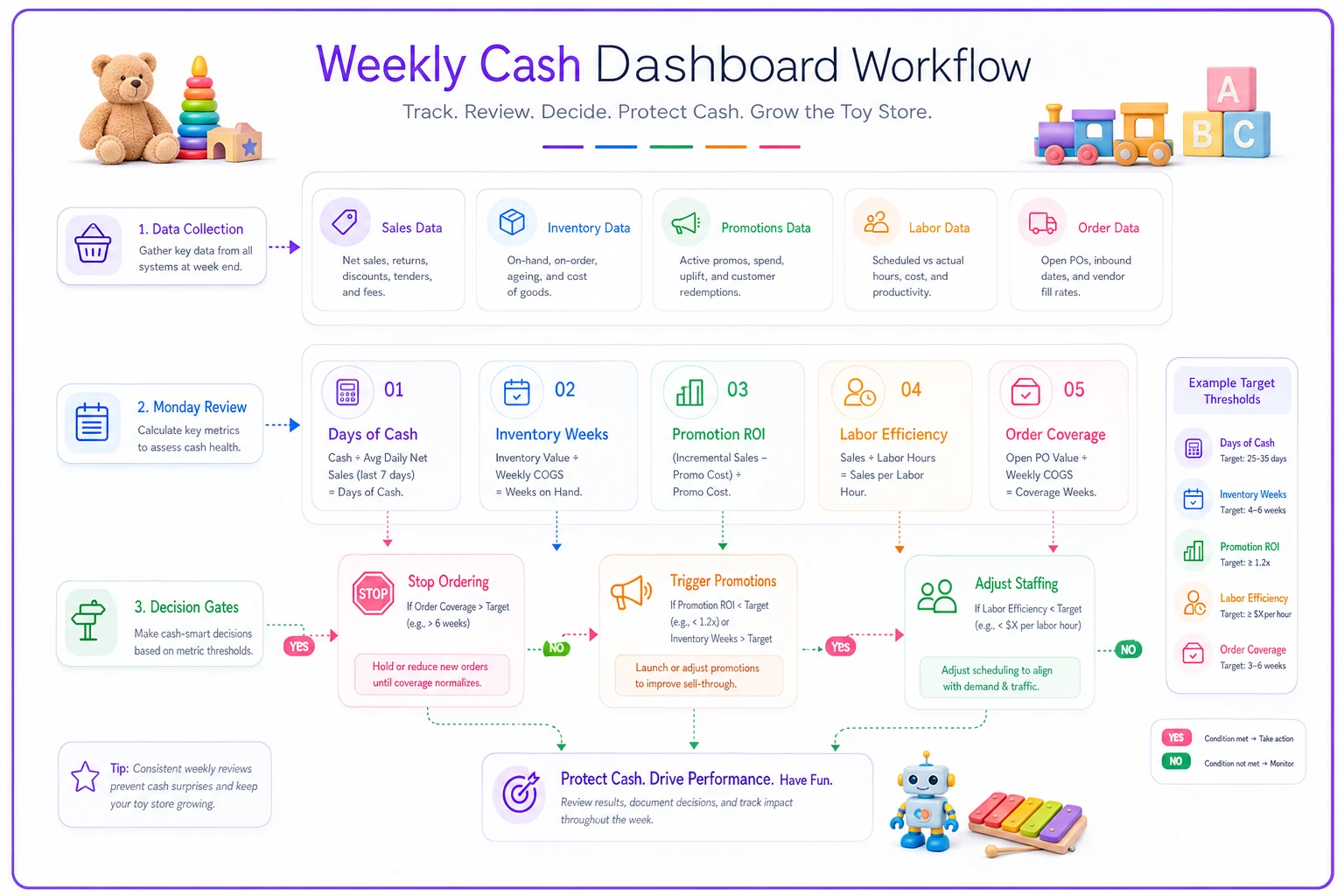
Takes about 15 minutes but drives every major decision for the week. When cash drops below 35 days, ordering stops. When inventory weeks exceed 12, promotions trigger. When labor efficiency falls below $85/hour, schedules adjust.
The stores that make it consistently decide based on current cash position, not calendar dates or vendor pressure.
Building your cash buffer system
The hardest part of implementing a cashflow playbook isn't understanding the concepts—it's maintaining discipline when vendors push new products, competitors run sales, and customers ask for discounts.
Start with the cash buffer. Most toy stores need 45-60 days of operating expenses in reserve entering the slow season. This feels impossible when you're turning every dollar into inventory for the holidays.
Year 1: Survival Mode
-
Target
20 days cash reserve
-
Method
Skip one January order cycle
-
Result
Tight but manageable February-March
Year 2: Building Strength
-
Target
35 days cash reserve
-
Method
Reduce December ordering by 30%
-
Result
Comfortable slow season, opportunistic buying power
Year 3: Strategic Position
-
Target
50 days cash reserve
-
Result
Can weather any downturn, grab closeout deals
The progression takes discipline but it genuinely transforms how the business feels. Instead of white-knuckling through March hoping customers show up, you're investing in April releases that drive summer traffic.
When traditional retail math stops working
Toy stores break traditional retail math in three specific ways that affect every cash decision.
The December Distortion Traditional retail spreads risk across 12 months. Toy stores concentrate risk into 8 weeks. If December disappoints, you can't make it up in January. That concentration means your cash buffer needs to be roughly 2X what general retail formulas suggest.
The Inventory Paradox Most retail inventory depreciates—fashion goes out of style, food expires. Many toys appreciate. That LEGO set that didn't sell might be worth 20% more next year when it's retired. Aggressive clearance pricing often loses money long-term.
The Event Dependency General retail depends on foot traffic. Toy stores increasingly depend on events—Pokemon tournaments, birthday parties, craft sessions. These have upfront costs but delayed revenue recognition. Your cash management needs to account for that timing gap.
Understanding these differences explains why so many toy stores fail using standard retail practices. You're not running a normal retail business. You're running a highly seasonal, inventory-appreciating, event-driven operation that needs completely different financial rules.
Automation points that actually matter
The complexity of managing cash across extreme seasonality creates natural places where operational software helps. Not buzzword stuff about digital transformation—actual workflow improvements that prevent costly mistakes.
Tracking daily cash position manually works fine until you're juggling multiple ordering windows, promotion gates, and payroll decisions at the same time. The stores that scale beyond a single location invariably systematize these decision points through software that enforces their rules automatically.
The areas where this prevents expensive errors:
Order timing enforcement: Software that blocks orders when cash reserves drop below thresholds, preventing the "exciting new product" purchases that quietly destroy cash position
Promotion gate tracking: Systems that calculate actual ROI on every promotion and flag when you're discounting just to feel like you're doing something
Payroll modeling: Platforms that show the cash impact of staffing decisions before you commit to the schedule
These aren't revolutionary systems making decisions for you. They're operational guardrails that prevent the momentary lapses in discipline that sink businesses during stressful periods.
The financial discipline that separates survivors from statistics
Every January, another wave of toy stores closes. The pattern is predictable—great December sales convince them to order aggressively for spring, February disappoints, March rent comes due without the cash to cover it.
The stores still operating after five years all share the same trait: they follow their cash management rules especially when it's hard. When competitors slash prices, they hold margins. When vendors push "can't miss" products, they check cash position first. When December is booming, they resist the urge to overstaff January.
This discipline feels overly conservative during good times. You'll watch competitors seem to grab market share with aggressive promotions. You'll see them staff up impressively for the holidays. You'll wonder if you're being too cautious.
Then February comes. Their doors close. Yours stay open.
The math is unforgiving but simple. Protect cash position, maintain margin discipline, and match costs to actual demand patterns. Do these three things consistently and you'll still be here when the next hot toy craze hits. Break them chasing short-term growth and you'll join the majority of toy stores that don't make it past year three.
The framework here—ordering windows, promotion gates, and payroll rules—isn't complex. It just requires something harder than complexity: the discipline to follow your rules when every instinct says break them. That's ultimately what separates the stores that last from the ones that become cautionary tales.
Ready to elevate your toy store operations?
Join 500+ toy retailers using GoToyvio to increase sales, reduce stockouts, and enhance customer loyalty.