


Most toy stores lose money on weekend events without realizing it. You count the $10 class fees, maybe track some same-day purchases, then call it a success because kids had fun. Meanwhile, you've burned through $400 in staff hours, allocated $600 worth of inventory that sits untouched in the event room, and missed three opportunities to turn attendees into regular customers.
The math gets uglier when you dig deeper. That Pokemon tournament last month? After factoring in two staff members for four hours, the prize support, the demo products, and the space you couldn't use for regular retail—you're down $280. The LEGO building class that "sold out" with 12 kids? Lost $165 once you account for the master builder you hired, the bulk bricks you had to order, and the register backup caused by parents arriving simultaneously for pickup.
Stores that actually make money on events typically see attendees spend 3.2x more over the following 90 days compared to regular walk-ins. These owners run events as integrated profit centers, not standalone activities.
The Real Cost of Running Events (And Why Most Stores Get It Wrong)
Pull up your last month's event schedule. Calculate the actual cost per event, not just the obvious expenses. Include staff scheduling overlaps, the inventory you couldn't sell because it was tied up in demos, the customer service issues from confused pickup times, and the sales floor coverage gaps during event setup.
A typical Saturday morning LEGO class actually runs you:
-
Two staff members (one running, one supporting)
$120
-
Demo sets and build materials
$85
-
Lost selling space for 3 hours
$180 in potential sales
-
Setup and breakdown time
$45
-
Registration management and communications
$30
-
Total real cost
$460
Against that, you're collecting maybe $120 in class fees from 12 kids. The break-even point requires $340 in additional sales—which most stores never track, let alone achieve.
Profitable stores structure differently. They treat events as merchandise showcases, not entertainment. Every activity connects directly to products on your shelves. Every demo includes a "take-home" component that drives sales. Every class registration captures family data for targeted follow-up.
Staffing Templates That Protect Both Events and Sales Floor
Your biggest controllable cost is labor allocation. Most stores either overstaff events (killing margins) or understaff them (creating terrible experiences). The sweet spot requires role clarity and overlapping coverage zones.
Never run out of bestsellers again.
GoToyvio helps you monitor inventory and sales to keep your shelves stocked and customers happy.
- Real-time stock tracking
- Automated reorder alerts
- Sales and promotion analytics
No credit card required
Base Staffing Model for 10-15 Attendee Events:
Primary instructor handles:
-
Activity leadership
-
Safety monitoring
-
Parent questions during event
Float staff member covers:
-
Registration/check-in (first 15 minutes)
-
Sales floor backup
-
Product recommendations to waiting parents
-
Photography for social media
-
Emergency bathroom breaks
Register staff maintains:
-
Normal checkout operations
-
Quick demo product pulls
-
Parent shopping assistance
-
Event overflow questions
This structure costs roughly $90 in labor for a two-hour event, compared to the typical $160 when you dedicate two people fully. The float position is crucial—they're technically scheduled for the floor but available for event surge moments.
For larger events (20+ attendees), add a dedicated "parent specialist" who works the waiting area. Parents dropping kids at a two-hour Pokemon tournament represent your highest-value browsing opportunity. Someone needs to actively engage them, not hope they wander the aisles randomly.
Inventory Allocation Rules That Prevent Lost Sales
The worst feeling is watching a parent want to buy the exact LEGO set their kid just built with, only to realize your last three boxes are sitting in the event room as demos. Or discovering your Pokemon tournament prize wall depleted your booster pack inventory right before a weekend sales rush.
Smart allocation follows the 70-20-10 rule:
70% Floor Stock: Never touch this for events. These products stay sellable no matter what happens with your demo. Set up your POS to flag these as "floor only" if you track inventory digitally.
20% Demo Pool: Dedicated event inventory that rotates monthly. Buy these specifically for demonstration, often taking advantage of vendor demo programs or damaged box discounts. Mark them clearly as demo units.
10% Floating Buffer: Products that can swing either way based on demand. If Saturday looks slow, they become demo units. If you're selling strong, they stay on the shelf.
Track allocation by SKU, not just dollars. That Pokemon Elite Trainer Box might be worth $40, but if it's your last one and three customers asked for it this week, it shouldn't become a tournament prize.
Build a simple allocation tracker:
| Product | Floor Stock | Demo Pool | Buffer | Event Assignment |
|---|---|---|---|---|
| LEGO City Police Station | 8 units | 2 units | 1 unit | Sat AM building class |
| Pokemon ETB | 12 units | 3 units | 2 units | Fri night tournament |
| Catan Junior | 4 units | 1 unit | 1 unit | Sunday game demo |
| Playmobil Horse Stable | 6 units | 1 unit | 0 units | Tues afternoon demo |
Update this weekly, not monthly. Event inventory needs change based on what's selling, what's arriving, and which events actually drove purchases.
Pricing Models That Drive Profit, Not Just Attendance
Free events feel generous but often attract families with zero purchase intent. Premium pricing scares away potential customers. The profitable middle ground uses tiered pricing that self-selects for buyers.
Three-tier structure that works:
Basic Registration ($8-12): Covers absolute minimums. Includes activity participation and basic materials. No takeaways, no discounts, no perks. This tier mostly exists to establish value and filter out complete non-buyers.
Standard Package ($18-25): Includes a small retail item takeaway (trading cards, mini-figure, small craft kit worth $5-8 retail). Plus a 15% same-day purchase coupon. This tier typically breaks even on direct costs but drives merchandise sales.
Premium Experience ($35-45): Includes larger takeaway product ($12-15 value), 20% same-day coupon, advanced registration for next event, and a "birthday party" info packet. This tier generates actual profit while identifying your highest-value families.
Price based on perceived value, not actual cost. That LEGO mini-figure might cost you $2.50, but parents see $7 value. The same-day discount feels generous but actually increases basket size by pushing fence-sitters to buy today instead of "thinking about it."
Test different price points by event type. Building activities can charge more than passive demos. Tournaments with prizes command premiums. Story times with basic crafts stay lower-priced to drive foot traffic during slow periods.
Display Blueprints That Convert Browsers to Buyers
Every event needs three distinct display zones, each with different conversion goals. Random product placement around your event space just creates visual chaos that overwhelms parents and kids.
Zone 1: Entry Showcase (First 8 feet inside door)
Set up your "wow" display here. The large sets, exclusive items, or new releases that make people stop. These aren't necessarily what you expect to sell today—they're what create the "we need to come back" feeling. Keep it to 5-7 items max, clearly priced, with "ask about our layaway" signs.
Zone 2: Activity Adjacent (Within eyeline of event space)
Everything here directly relates to what kids are doing. Running a Pokemon tournament? Display trainer boxes, card sleeves, binders, and battle stadiums where parents can see them while watching. LEGO building class? Show the sets kids are working with plus logical next-difficulty builds. Keep prices in the $20-60 range—impulse territory for engaged parents.
Zone 3: Checkout Corridor (Path from event to register)
Small wins here. Trading card packs, blind bags, fidget toys, candy. Sub-$10 items that kids can successfully negotiate for. Also where you position your "take-home" versions of whatever craft or activity just happened. Made slime? Sell slime kits. Built with blocks? Offer small building sets.
Rotate displays based on event type, not season. Your Pokemon tournament setup looks completely different from your American Girl tea party layout, even if they happen the same week.
Pre-Event Communication That Actually Gets Read
Nobody reads your three-paragraph email about parking instructions and what to bring. But they'll definitely complain when they show up unprepared. The fix isn't more information—it's better-timed, bite-sized communication.
Build this sequence:
-
10 days out Simple confirmation with one key detail. "Sarah's registered for LEGO Builders this Saturday! We'll send parking tips next week."
-
3 days out Logistics plus upsell. "Saturday's LEGO class is confirmed! Park in the back lot for easy access. Want to pre-order the Fire Station set Sarah will build? Reply YES for 10% off."
-
Day before Final reminder with excitement builder. "Tomorrow at 10am! Sarah will build the Police Chase set. Siblings can play in our demo area. See you then!"
-
2 hours before Text reminder (if opted in). "LEGO class starts in 2 hours! Back door is open for easy drop-off."
Keep each message under 50 words. One topic per message. Include exactly one call-to-action. This format gets 3x the engagement of traditional event emails.
Build templates for common situations: weather contingency, waitlist promotion, last-minute availability, sold-out status with next date, change in instructor or format.
Post-Event Sequences That Drive Return Visits
The money isn't in the event—it's in the relationship you build afterward. Most stores send maybe a thank you email. Profitable ones run systematic follow-up that turns single-event families into regulars.
Set up this automated sequence:
-
Immediately after Photo sharing opportunity. "Thanks for joining today's Pokemon tournament! Photos are on our Facebook page—tag us if you share!"
-
Day 3 Soft product push. "Hope Alex enjoyed the tournament! This week only: buy 2 booster packs, get the 3rd free. Perfect for practicing before our next event."
-
Day 10 Next event invitation with insider perks. "Our LEGO Minecraft workshop is June 15th. As a recent attendee, you can register 2 days early. Reply SAVE to hold spots."
-
Day 21 Different event category. "You loved Pokemon! Try our Sunday board game demos. Different fun, same friendly crowd."
-
Day 45 Birthday party pitch. "It's been great having Alex at our events! Did you know we do private Pokemon parties? Here's our summer special..."
-
Day 90 Loyalty program invitation. "The Martinez family has attended 3 events! Join our Toybox Club for exclusive event pricing and early registration."
Automate this sequence but personalize key touchpoints. Mention the specific event they attended. Reference their child by name when possible. Include photos from their actual event, not stock images.
ROI Measurement Beyond Basic Sales Tracking
Tracking event success requires more than counting heads and same-day sales. The real ROI shows up in customer lifetime value, family engagement patterns, and merchandise velocity changes.
Build this simple event scorecard:
Direct Revenue:
-
Registration fees collected
-
Same-day purchases by attendees
-
Pre-event merchandise orders
-
Add-on activity sales
Indirect Revenue (30-day window):
-
Follow-up purchases by families
-
New customer acquisitions
-
Birthday party bookings
-
Loyalty program sign-ups
Operational Costs:
-
Staff hours (including setup/breakdown)
-
Materials and supplies
-
Demo product depreciation
-
Opportunity cost of space
-
Marketing and communication
Hidden Value Metrics:
-
Email/SMS list growth
-
Social media engagement
-
Review generation
-
Referral program activations
-
Vendor relationship points
A genuinely profitable event might look like this:
-
Saturday LEGO Robotics Workshop (12 kids)
-
- Direct revenue
$276
-
- 30-day indirect revenue
$847
-
- Total revenue
$1,123
-
- Full operational cost
$412
-
- Net profit
$711
-
- ROI
172%
The indirect revenue is where you win or lose. Stores not tracking this think their events lose money. Stores measuring properly realize events are customer acquisition engines that happen to cover their own costs.
Warning Signs Your Events Are Bleeding Money
You're constantly pulling floor staff to help with events. This means you haven't built proper role separation. Event staff and floor staff need distinct responsibilities, even if they're the same people wearing different hats at different times.
Parents drop and run without browsing. Your physical layout isn't encouraging shopping. Rethink where parents wait, what they see, and who engages them.
The same 8 families attend everything. You're running a club, not a business driver. Great for community, terrible for growth. Events should constantly bring new faces while keeping regulars happy.
Post-event sales don't spike. Your product placement and follow-up sequences aren't connecting. Kids leaving excited should translate to parents buying products within days.
You can't explain why certain events exist. Every event needs a clear purpose: customer acquisition, inventory movement, community building, or premium revenue. "We've always done it" isn't a strategy.
Building Your Profit-First Event System
Start with one event type and perfect it before expanding. Pick something with clear product tie-ins, manageable group sizes, and repeatable format. Pokemon tournaments, LEGO building clubs, and craft workshops typically work well.
Design your staffing model first. Who does what, when, and where? Write it down. Train it. Refine based on actual events, not theoretical planning.
Set up inventory allocation before your next event. Tag products in your system. Create physical demo storage separate from sellable stock. Build the discipline to not raid floor inventory for last-minute event needs.
Price for profit, not just participation. Test raising prices 20% on your next event. You might lose 2 attendees but gain margin on the other 10. Premium pricing also attracts families more likely to purchase.
Create your follow-up sequence templates now. Don't wait until after the event to figure out what to say. Pre-write, schedule, and automate where possible.
Here's a simple workflow visualization.
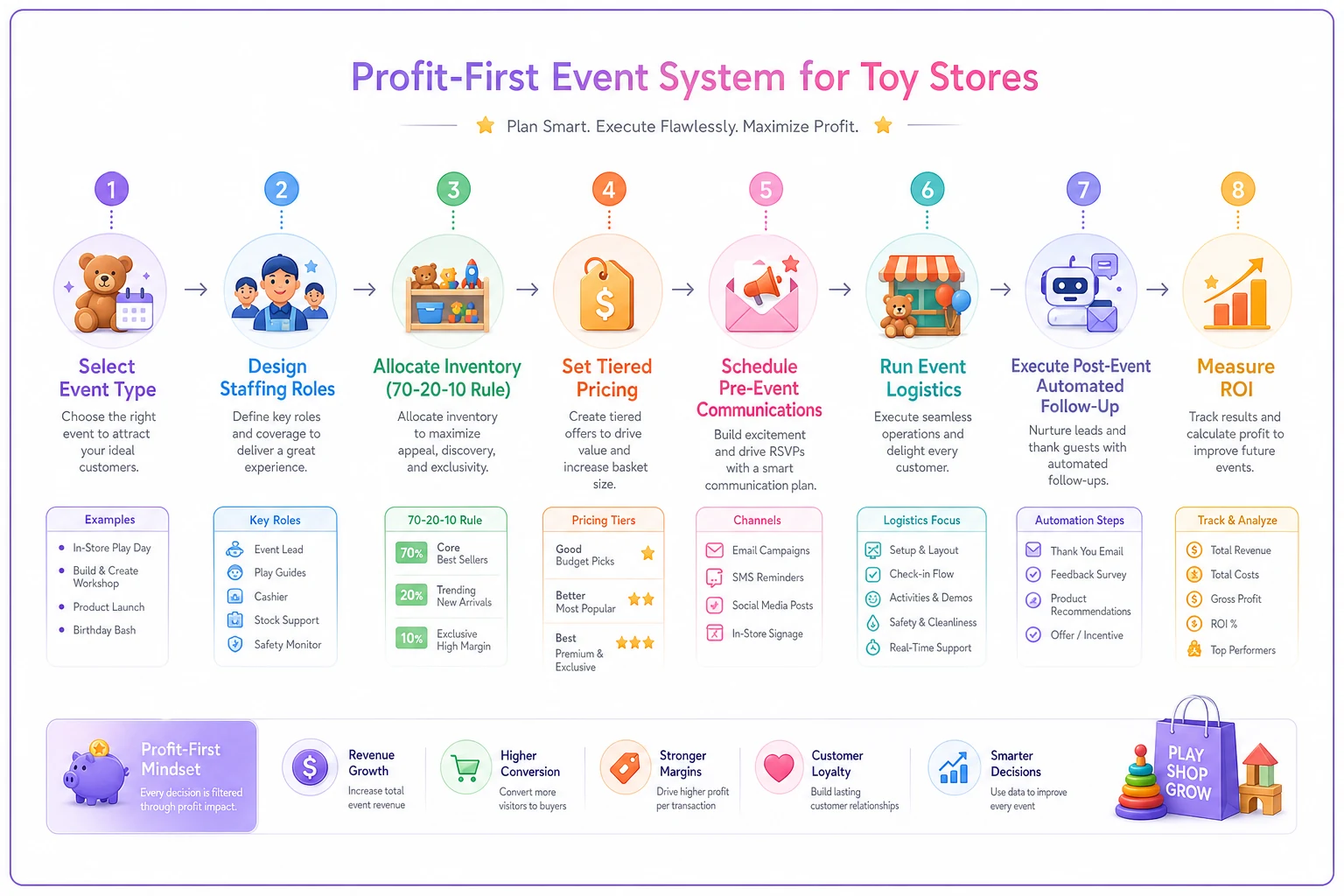
Use this workflow to train your team and check steps before each event.
Stores absolutely crushing it with events run them as integrated parts of their retail operation, not separate activities. Every decision—from which demo products to feature to how you arrange parking spots—should drive toward the same goal: turning event participation into ongoing customer relationships that generate sustained revenue.
That Pokemon tournament shouldn't just fill your Saturday afternoon. It should identify your next birthday party customers, create social media content for the week, move stale inventory, and build your email list for the next product launch.
The operational discipline makes the difference. A solid toy store event checklist isn't about making events perfect—it's about making them consistently profitable while creating experiences families actually value. Get the operations right, and the community building happens naturally. Focus only on fun, and you'll wonder why your events feel successful but your bank account doesn't agree.
Track everything for 90 days. Measure the full cycle from registration through follow-up purchases. Adjust based on data, not feelings. The events that seem most successful might be your biggest money drains, while that "boring" monthly demo might be your highest-ROI activity.
Most importantly, stop treating events as marketing expenses. They're revenue opportunities that happen to build community. Structure them that way, measure them that way, and watch them transform from necessary evils into profit centers that differentiate your store from big-box competitors who could never provide the same curated, personal experience.
Ready to elevate your toy store operations?
Join 500+ toy retailers using GoToyvio to increase sales, reduce stockouts, and enhance customer loyalty.