

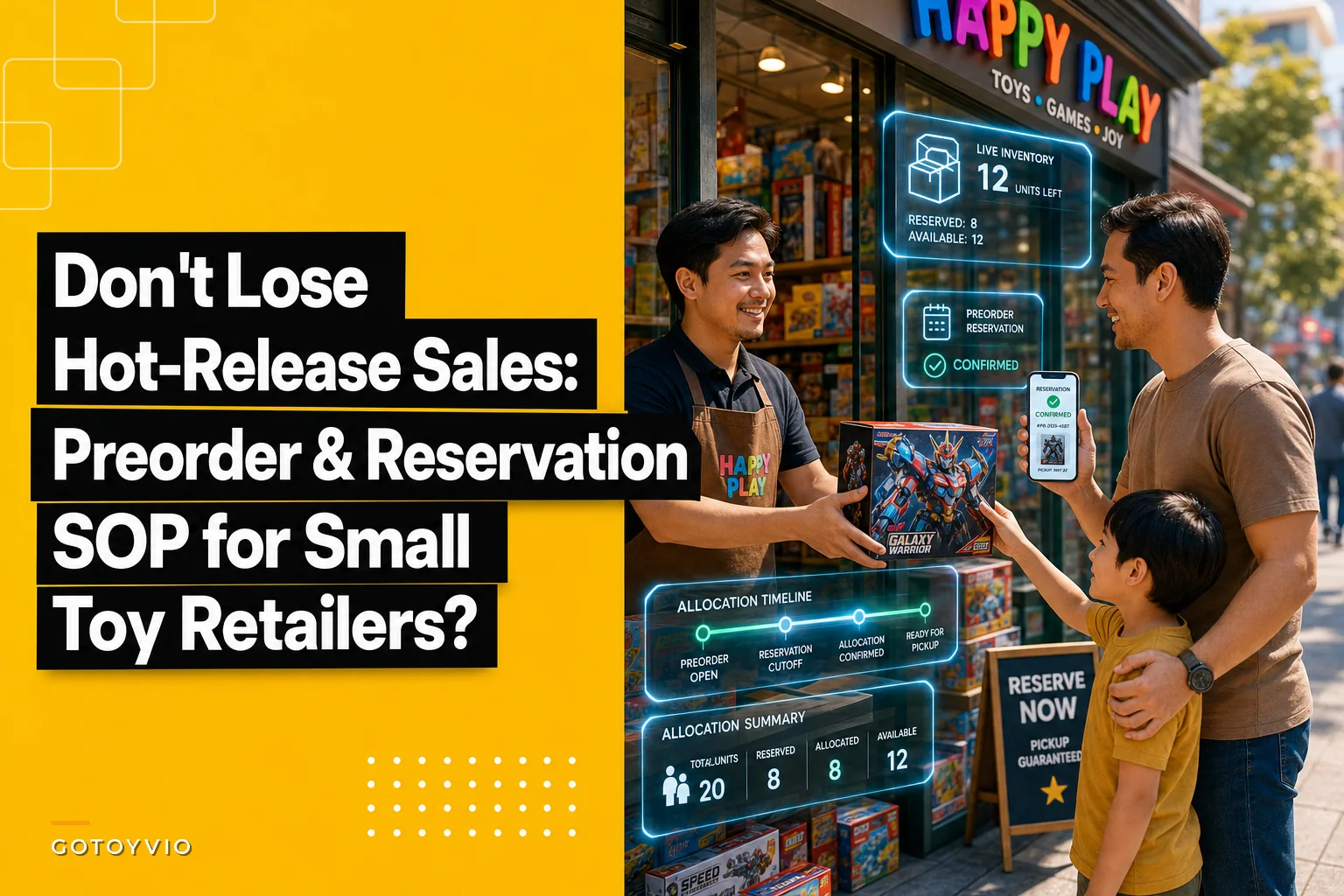

The Jellycat Bartholomew Bear drops next week. You've got 47 customers asking about it, your distributor promised 20 units, and you're taking deposits from everyone who calls. Three weeks later, you receive 11 bears instead of 20, have to refund 36 angry customers, and watch your best collectors start shopping elsewhere because they couldn't trust your reservation system.
This exact scenario killed $14,000 in December revenue for a toy store in Portland last year. Not from the bears themselves—from the customers who stopped shopping there entirely after getting burned on preorders.
Most independent toy stores handle preorders with sticky notes, spreadsheets, and good intentions. Works fine until you're juggling Squishmallow drops, LEGO exclusive sets, collector Barbies, and limited Pokemon cards all arriving in the same month with different deposit rules, allocation limits, and cancellation windows.
The difference between stores that nail preorders and those that hemorrhage customers comes down to having clear operational rules before the chaos hits.
Why toy stores botch preorders (and it's not about the tracking system)
The spreadsheet isn't the problem. Your POS system's reservation module probably works fine too.
Preorder failures happen because stores try to manage four different commitment levels with one process. A parent putting their name down for the next Gabby's Dollhouse playset operates completely differently than a collector dropping $300 deposits on exclusive Transformers. Most stores treat them identically, then wonder why their reservation list turns into a customer service nightmare.
Your Funko Pop collector who reserves everything but only picks up 30% creates phantom demand that blocks real sales. The grandparent who wants to reserve a specific Tonies character for Christmas gets the same treatment as someone casually interested in "whatever new Pokemon stuff comes in." Your staff takes a $20 deposit on a $200 LEGO set from someone they've never seen before, while your weekly regular who spends $400/month can't reserve anything because you're "full."
Things get messy fast. That Excel list with 78 names for the Dune LEGO set? Half those people forgot they even asked about it. The sticky note system for Calico Critters? Nobody remembers if those were firm commits or maybes. Meanwhile, legitimate collectors who would've bought everything stopped asking because your allocation system feels arbitrary.
One store owner in Ohio lost her entire Magic: The Gathering prerelease crowd—about $8,000 quarterly—because her reservation system couldn't distinguish between serious players and casual browsers. The serious players kept showing up to find their reserved boxes sold to walk-ins who seemed more interested in the moment.
Setting deposit thresholds that actually work
Forget percentage-based deposits across the board. Different product categories need different commitment levels.
Never run out of bestsellers again.
GoToyvio helps you monitor inventory and sales to keep your shelves stocked and customers happy.
- Real-time stock tracking
- Automated reorder alerts
- Sales and promotion analytics
No credit card required
For items under $50 (most Squishmallows, small LEGO sets, standard action figures), you want accessibility. These customers often buy impulsively and won't drop deposits weeks in advance. For items $50-$150 (larger building sets, collector dolls, board games), a $10-20 flat deposit works better than percentages. It's enough to show intent without creating barriers. Above $150, you need real commitment—either 30% down or $50 minimum, whichever is higher.
Deposit rules should change based on scarcity certainty.
If Pokemon announces a special release and you know you're getting 5 boxes maximum, those need 50% deposits regardless of price. If Ravensburger confirms you'll receive your full order of Disney puzzles, you might skip deposits entirely for known customers. The deposit isn't really about the money—it's about matching customer commitment to inventory certainty.
Some stores waive deposits for customers who've successfully picked up their last three reservations. This rewards reliability without complex tracking. Your customer who always follows through on Jellycat reserves shouldn't need to prove commitment every time. The random caller asking about "that viral TikTok toy" absolutely should.
Track pickup rates by deposit amount for three months and you'll see clear patterns. One Vermont store found $15 deposits had an 85% pickup rate while $5 deposits sat at 41%. They adjusted to $15 minimum and virtually eliminated abandoned reserves while barely impacting initial interest.
Pro-tip: Track pickup rates by deposit amount for three months to find the right thresholds for your store.
Track pickup rates by deposit amount for three months and you'll see clear patterns. One Vermont store found $15 deposits had an 85% pickup rate while $5 deposits sat at 41%. They adjusted to $15 minimum and virtually eliminated abandoned reserves while barely impacting initial interest.
The allocation sequence that prevents your best customers from leaving
When that shipment arrives with 60% of what you ordered, who gets their preorder fulfilled?
Most stores go chronological—first reserved, first served. Seems fair until your customer who spends $3,000 annually loses out to someone who called two hours earlier and never shops with you otherwise.
An allocation system that balances fairness with business reality:
-
First 40% of inventory Customers with 100% pickup history in the last 6 months who placed deposits. These are your absolutely reliable buyers.
-
Next 30% Regular customers (visit monthly minimum) with deposits, ordered by reservation date.
-
Next 20% Any remaining deposits by date order.
-
Final 10% Hold for potential issues, returns, or walk-in opportunities.
Inside each tier, go chronological. But the tiers protect relationship value while still respecting the reservation queue.
For ultra-scarce items (those exclusive Star Wars figures, limited Pokémon releases), modify this further. Cap reservations at 80% of your minimum expected quantity. If your distributor says "10-15 units," cap reservations at 8. That buffer saves you from the nightmare scenario of fulfilling only a third of your list.
Some stores overthink this with complex point systems or lifetime value calculations. You don't need that. A simple three-tier system with deposit requirements handles 95% of situations while being explainable to angry customers when allocation gets tight.
Customer communication templates that prevent reservation disasters
Bad news delivered badly destroys customer relationships permanently. But the same bad news delivered properly often strengthens loyalty.
When you can't fulfill a preorder, timing matters more than the message itself. Contact customers within 24 hours of knowing there's a problem. Not when the shipment arrives short—when you know it will arrive short.
Initial shortage notice (sent immediately when you know): "Hi [Name], Quick update on your [product] reservation. Our distributor just informed us we're receiving fewer units than ordered. You're currently position [X] on our list. We should know final allocation by [date]. Your deposit remains fully refundable, or we can transfer it to another item. I'll update you as soon as we know more. - [Your name]"
Confirmation they're getting the item: "Great news! Your [product] is confirmed and will arrive approximately [date]. I'll text you the moment it's ready for pickup. Your balance due is $[amount]. Thanks for your patience with the allocation process."
Confirmation they're NOT getting the item: "Hi [Name], Unfortunately, we won't be able to fulfill your [product] reservation from this shipment. We're receiving [X] units and you were position [Y] on our list. Your options: 1) Stay on the list for next shipment (expected [date]), 2) Transfer deposit to [similar item], or 3) Full refund processed today. Let me know your preference, and I'm sorry we couldn't accommodate this time."
Never bulk email these messages. Individual texts or calls, even if they're template-based, maintain the relationship. One Louisiana store sends shortage notifications via bulk email and wonders why customers ghost them. Another store two towns over makes individual calls and has customers thanking them for transparency even when missing out on products.
The 48-hour rule is critical: any reservation without contact for 48 hours after notification becomes available to the next person. Don't hold inventory for ghosts.
Pickup windows and cancellation rules by product type
Standard pickup window across everything? That's how you end up with Hatchimals sitting in your back room for three months while Christmas shoppers can't find any on your shelves.
Different product types need different pickup windows:
Hot releases and limited editions: 72 hours maximum. These items have immediate demand, and holding them longer costs real sales. Send notification when item arrives, reminder at 48 hours, final notice at 72 hours.
Seasonal items: 7 days if more than 30 days before the season peak, 48 hours during peak season. That Halloween costume reserved in September can wait a week. The same costume on October 28th needs to move.
Collector items over $100: 7-10 days. These customers often coordinate multiple pickups or need to arrange payment. But cap it there—collector items tie up significant capital.
Standard toys: 5 days for deposits, 48 hours for no-deposit holds.
The cancellation component most stores miss entirely: charge different cancellation fees based on timing.
| Cancel When | Fee |
|---|---|
| More than 14 days before arrival | Full refund |
| 7-14 days out | Lose 25% of deposit or $10, whichever is less |
| Less than 7 days | Lose 50% of deposit or $20, whichever is less |
| Item arrives, no pickup | Deposit converts to store credit only |
This isn't about profiting from cancellations—it's about behavior modification. Customers think harder about reserving when there are consequences for changing their minds.
Building a simple tracking system without complex software
You don't need fancy toy store preorder software to track this properly. A basic spreadsheet with the right columns beats expensive software used wrong.
Essential columns for any tracking system:
-
Customer name and phone
-
Item reserved
-
Date reserved
-
Deposit amount and payment method
-
Expected arrival date
-
Customer tier (regular/new/collector)
-
Pickup history (simple percentage)
-
Notes
The notes column is where the magic happens. "Always bundles with books," "Calls grandmother before purchasing," "Collects only mint-condition boxes"—these details matter more than complex data fields.
Weekly maintenance takes 20 minutes:
-
Flag any reservations older than 60 days without updates
-
Check upcoming expected arrivals against actual distributor communications
-
Review pickup rates from last week
-
Archive completed transactions
Print your active reservation list every Monday. Sounds primitive, but that physical list at the register catches issues your digital system misses. Staff naturally scan it during slow moments and catch problems like duplicate reservations or forgotten followups.
Color-coding helps quick scanning. Yellow for "arriving this week," red for "overdue pickup," green for "deposit paid." Visual systems work better than text notes when you're managing dozens of active reservations.
Pro-tip: Color-code the spreadsheet so staff can quickly spot arriving, overdue, and fully paid items.
Color-coding helps quick scanning. Yellow for "arriving this week," red for "overdue pickup," green for "deposit paid." Visual systems work better than text notes when you're managing dozens of active reservations.
Here's a simple workflow visualization to help staff understand how the spreadsheet, weekly maintenance, and pickup reminders fit together.
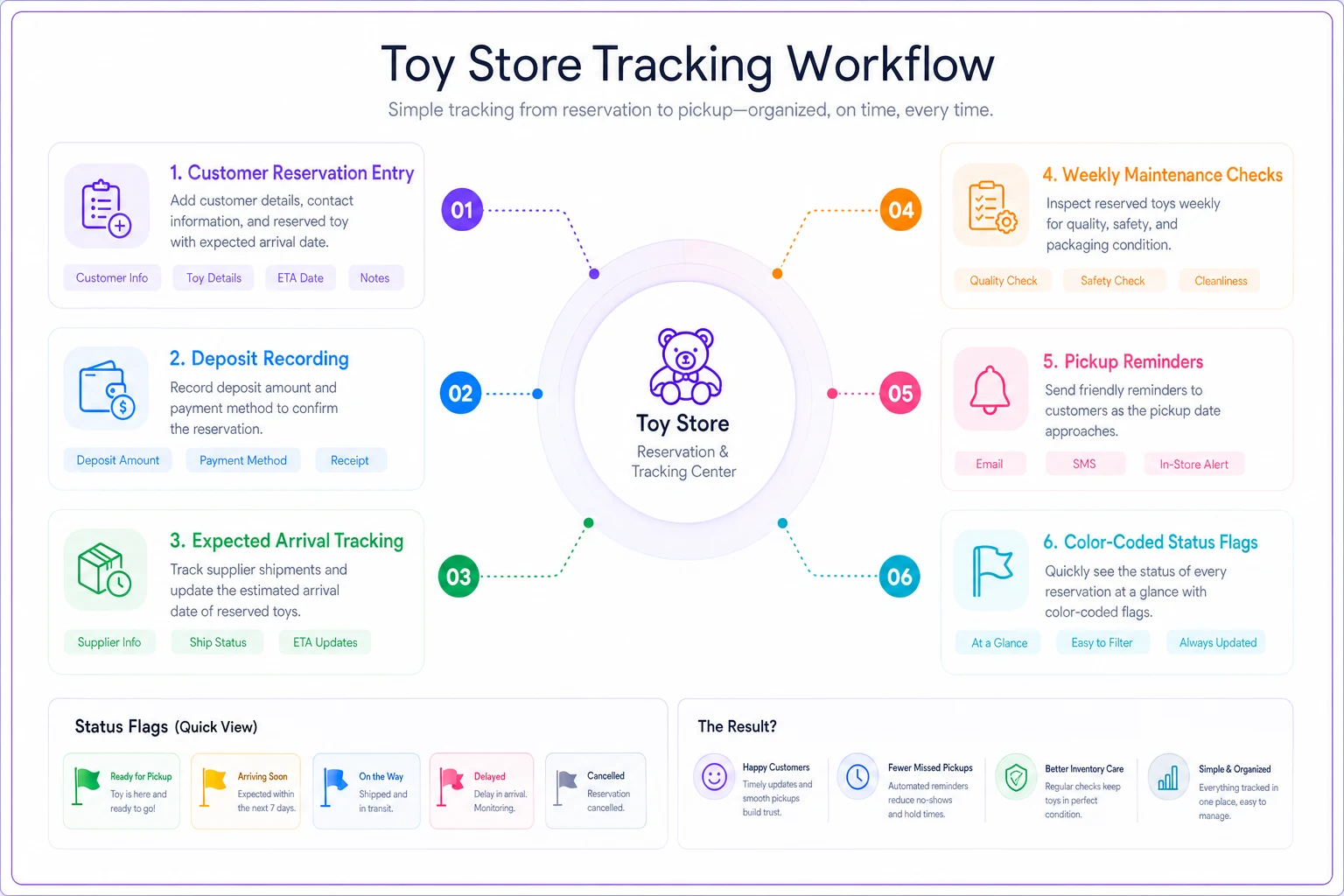
Use this as a staff-facing diagram near the register so everyone follows the same steps.
What happens when your manual tracking hits its limit
Manual tracking works fine until about 30 active preorders. Past that point, human memory fails and details slip.
The breakdown usually shows up as staff spending 10+ minutes searching for a reservation, the same customer on the list multiple times for one item, deposits taken but never recorded, pickups that happen but don't clear from the list, or lost sticky notes with critical customer preferences.
When you hit this point, resist the urge to just "try harder" with the manual system. That's when expensive mistakes happen—double-selling limited items, losing track of deposits, or worst of all, telling a good customer their reserved item was sold to someone else by mistake.
This is where proper operational software starts making sense. Not because manual systems can't work, but because the mental overhead of managing complex preorders manually pulls your attention from actually running the store. Every minute spent reconciling reservation lists is a minute not spent with customers on the floor.
AI-powered operational platforms can track all these moving parts while automating the communication sequences. The system remembers to send pickup reminders, tracks deposit amounts, manages tier-based allocation, and prevents the double-booking disasters that kill customer trust. More importantly, it learns your patterns—which customers actually pick up their reserves, what products need shorter pickup windows, when to alert you about potential problems.
But even with great software, the rules and structure matter most. Automation just makes good processes consistent. Bad processes automated just fail faster.
A preorder success story worth copying
Small toy store in Burlington, Vermont. December 2022, complete reservation chaos. Sticky notes everywhere, angry collectors, and $7,000 in deposits they couldn't properly track.
January 2023, they implemented every rule in this system. Clear deposit tiers. Allocation sequence posted publicly. Automated confirmation texts. Strict pickup windows.
By December 2023: preorder revenue up from $22,000 to $31,000. But more importantly, abandoned reservation rate dropped from around 35% to under 10%. Customer complaints about allocation went from weekly to virtually none. Their collector community grew by 40+ active members who trust the system even when they don't get every item they want.
The owner told me the biggest change wasn't the revenue—it was how much calmer December felt. Staff knew exactly what to tell customers. Customers knew exactly what to expect. The reservation list became a tool for building relationships instead of destroying them.
That's the real value of proper preorder operations. Not just capturing more sales, but building a predictable system customers trust. When collectors know your allocation rules, understand your deposit structure, and believe you'll communicate honestly about shortages, they keep coming back even when things don't go perfectly.
Making this work starting Monday
Don't overhaul everything at once. Start with deposit rules for new reservations going forward. Add allocation tiers next month. Build communication templates when you have time.
The immediate moves:
-
Define your deposit structure today
-
Write down your allocation sequence
-
Create the three essential communication templates
-
Start a simple spreadsheet if you don't have one
-
Set pickup window rules for next week's arrivals
Most importantly, tell your customers about the new structure. Post it. Email it. Explain it when they call. Transparency about your rules builds more trust than perfect execution with hidden processes.
Your toy store preorder system doesn't need to be complex. It needs to be consistent, fair, and clear. Get those three elements right, and you'll capture more revenue from hot releases while keeping the customers who matter most.
The stores winning at preorders aren't the ones with the best software or the most inventory. They're the ones where customers know exactly what to expect, every single time. Build that predictability into your operations, and watch both revenue and customer satisfaction climb.
Ready to elevate your toy store operations?
Join 500+ toy retailers using GoToyvio to increase sales, reduce stockouts, and enhance customer loyalty.