


Walk into any independent toy store in early November and you'll find the same disaster: shelves packed with fidget spinners nobody wants, while parents desperately search for this year's hot Pokémon cards that sold out three weeks ago. The owner's frantically calling distributors, burning cash on expedited shipping, watching profit margins evaporate.
Toy retail is brutal. Your inventory isn't just products — it's a web of movie release dates, licensing windows, viral TikTok trends, and holiday panic buying that can destroy your cash flow in weeks. Miss the window on a Bluey plush when the new season drops, and you're sitting on dead inventory. Overorder the wrong LEGO set, and you've tied up $8,000 that should've gone toward restocking board games.
Most toy store owners approach seasonal inventory like gambling. They look at last year's December sales, add 20%, and pray. Then reality hits: Disney moves a movie release, Mattel has supply chain issues, and your perfectly planned Q4 becomes a cash flow nightmare.
Why toy stores break differently than other retail
Toy retail operates on completely different rules than clothing stores or bookshops. Your products don't just have seasons — they have cultural moments. A Marvel movie drops in May, and you need specific action figures on shelves within a 6-week window or miss 70% of potential sales. Nintendo announces a new Zelda game, and suddenly every parent wants related merchandise.
You're managing three inventory timelines simultaneously. There's your baseline inventory (board games, craft supplies, educational toys), your seasonal rotation (summer outdoor toys, back-to-school, holiday items), and your event-driven stock (movie tie-ins, viral trends, collector releases).
Traditional retail systems assume predictable seasonality. Spring means swimsuits, fall means sweaters. But toys? August could mean back-to-school STEM kits, dinosaur excavation sets because of a new documentary, or suddenly everyone needs mini-brands because some influencer made them trendy.
What destroys small toy stores is the cash conversion cycle. You're ordering Halloween costumes in July, paying suppliers in August, hoping they sell in October. Meanwhile, Christmas inventory needs ordering in September, payment due in October, with sales hopefully coming in December. One wrong bet and you're stuck with $15,000 in Batman costumes when everyone wanted Spider-Man this year.
The coordination problem that bankrupts stores
Picture this happening right now across thousands of toy stores: The owner checks their POS system and sees Squishmallows are selling well. They place a reorder. What they don't see: their assistant manager just noticed the same thing and called the distributor yesterday. The seasonal buyer saw social media buzz and ordered a different size range from another supplier.
Never run out of bestsellers again.
GoToyvio helps you monitor inventory and sales to keep your shelves stocked and customers happy.
- Real-time stock tracking
- Automated reorder alerts
- Sales and promotion analytics
No credit card required
Three separate orders, zero coordination. Suddenly you've got $12,000 in plush animals arriving when you needed that cash for holiday board games.
This coordination failure scales exponentially as stores grow. A single-location store might waste $20,000 annually on duplicate orders and missed opportunities. Add a second location, and the problem doesn't double — it quadruples. Different stores see different demand signals, place competing orders, and nobody has visibility into the total cash commitment.
Toy stores operate on 25-35% margins, but seasonal inventory mistakes can eat 10-15% of annual revenue. You're running two businesses — your regular toy store and a complex futures market where you're betting on which characters kids will love three months from now.
Your supplier relationships fragment. Hasbro requires $5,000 minimum orders with 60-day payment terms. LEGO offers better margins but needs 90-day lead time. Smaller specialty suppliers have great products but unreliable delivery. You end up with seven different ordering systems, five payment schedules, and zero unified view of what's coming when.
Staff disconnection makes everything worse. Your floor staff knows exactly what customers are asking for — they hear "do you have that new Gabby's Dollhouse playset?" fifteen times before you notice the trend. But that information never makes it to ordering decisions. By the time you realize demand exists, your competitors have already secured inventory.
Building systems that actually prevent disasters
Forget "just-in-time" inventory or "lean retail." Toy stores need intelligent buffer systems — structured approaches that protect cash while capturing opportunity.
Start with demand signal capture that actually works. Every "we don't have that" interaction needs documentation. Not complex forms — simple tally sheets by the register. Customer asks for PAW Patrol? Mark it. Someone mentions a YouTube toy channel? Write it down. After two weeks, patterns emerge that no algorithm would catch.
Create supplier scorecards that reflect reality:
-
Actual lead time (not promised)
-
Minimum order requirements
-
Return/exchange policies for unsold inventory
-
Historical accuracy on delivery dates
-
Flexibility on order modifications
Most stores discover their "reliable" suppliers actually deliver late 40% of the time, completely breaking their seasonal planning.
Use tiered reorder triggers based on cash position, not just stock levels. Instead of "reorder when down to 5 units," use "reorder when down to 3 weeks of sales IF cash reserves exceed $X." This simple modification prevents the death spiral of overordering during cash crunches.
Make the register tally sheet obvious and five lines long so staff actually use it between transactions.
Map your Hollywood calendar religiously. Every Marvel movie, Disney release, and major gaming launch affects your inventory needs. A Spider-Man movie in June means costume demand in May, action figure surge in June-July, and clearance pressure by August. Missing these windows means dead inventory.
The practical seasonal framework that works
Here's the actual system that keeps stores profitable through seasonal chaos:
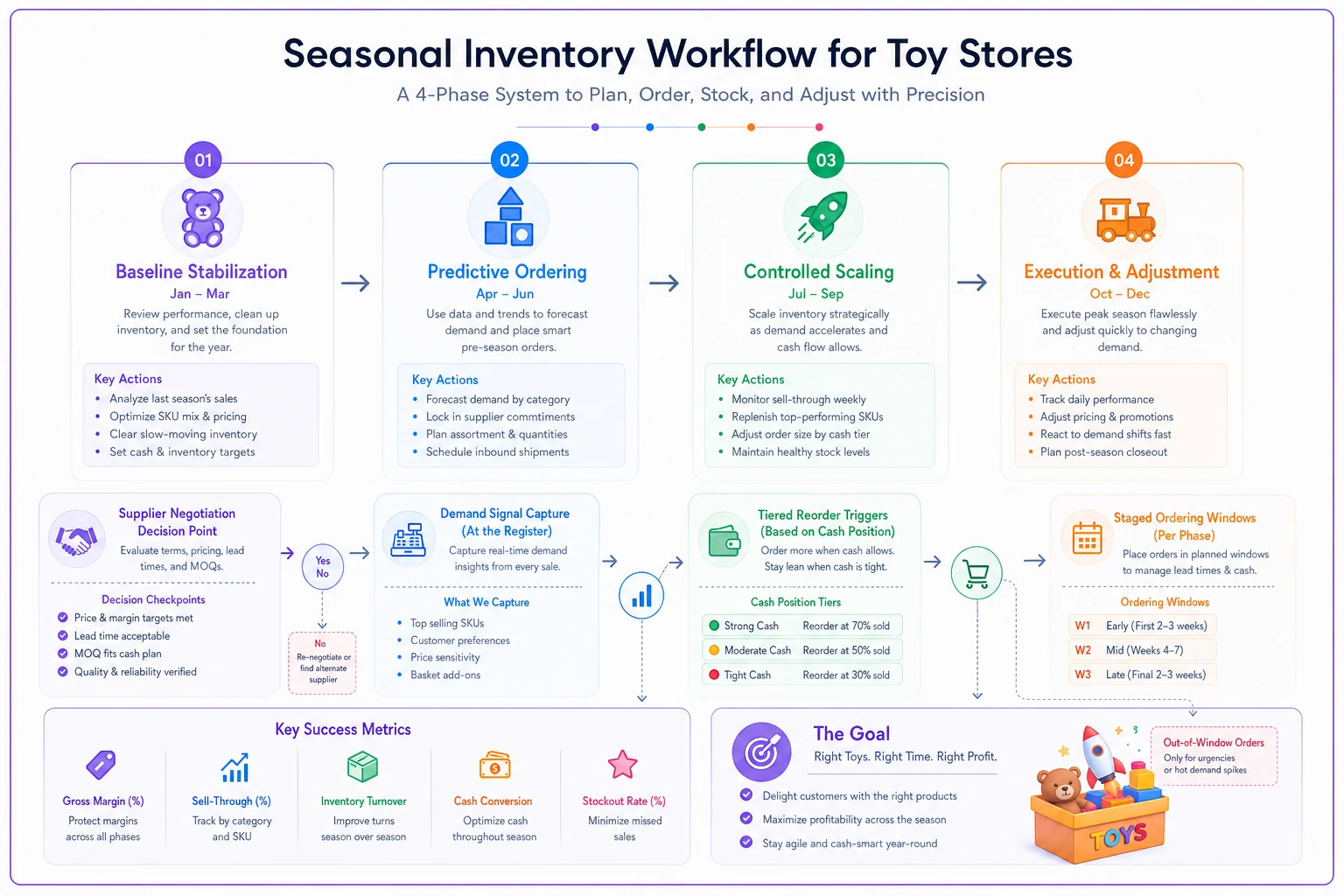
Phase 1: Baseline Stabilization (January-March)
Lock in your evergreen inventory — items that sell year-round regardless of trends. Classic board games, art supplies, puzzles, baby toys. These should represent 40% of inventory investment but provide predictable cash flow between seasonal peaks.
Calculate your true carrying cost per square foot. Most toy store owners think they know this number but miss hidden costs. That shelf of slow-moving science kits? It's not just the $800 inventory cost — it's preventing $2,400 in faster-turning items from occupying that space.
Phase 2: Predictive Ordering (April-June)
Start capturing holiday demand signals in spring. When parents buy birthday gifts, they mention what their kids want for Christmas. Document everything. That random request for a specific manga character in May becomes crucial data for October ordering.
Build supplier relationships during slow season. Visit showrooms, negotiate payment terms, establish backup suppliers. The deals you make in May determine your profit margins in December.
Phase 3: Controlled Scaling (July-September)
Most stores fail catastrophically here. They see back-to-school demand, Halloween approaching, and Christmas on the horizon, then panic-order everything.
Instead, use cascading order windows:
-
July 1-15
Lock in proven Halloween sellers
-
July 16-31
Place 60% of Christmas orders (basics only)
-
August 1-15
Assess Halloween pre-sales, adjust if needed
-
August 16-31
Place remaining 40% Christmas orders based on emerging trends
-
September
Fill gaps only, no major commitments
Phase 4: Execution and Adjustment (October-December)
Stop ordering new products after October 15th unless you have confirmed demand and 14-day delivery. The temptation to chase trends in November destroys profits.
Here’s a simplified workflow for the four phases.
Stop ordering new products after October 15th unless you have confirmed demand and 14-day delivery. The temptation to chase trends in November destroys profits.
Real numbers from actual seasonal inventory management
A typical $400,000 annual revenue toy store:
| Approach | Traditional | Systematic |
|---|---|---|
| August inventory investment | $65,000 | $48,000 |
| Dead stock by January | $18,000 | $6,000 |
| Expedited shipping costs | $3,200 | $400 |
| Lost sales from stockouts | $22,000 | $8,000 |
| Total seasonal loss | $43,200 | $14,400 |
The difference: $28,800 in improved profit, or about 7% of annual revenue. That's the difference between barely surviving and actually growing your business.
Technology and systems that prevent operational collapse
The manual approach breaks around $300,000 in annual revenue. You can't track movie releases, monitor viral trends, coordinate orders, and manage cash flow using spreadsheets and memory. This is where operational software becomes essential — not as luxury, but as survival tool.
Modern inventory platforms designed for specialty retail can automate demand signal capture, flag reorder points based on cash position, and coordinate ordering across multiple suppliers. The key is finding systems that understand toy retail's unique challenges — the intersection of entertainment licensing, seasonal spikes, and viral trends.
Look for platforms that integrate:
-
POS data for real-time sales tracking
-
Supplier catalogs with actual lead times
-
Entertainment release calendars
-
Cash flow forecasting
-
Multi-location inventory visibility
The best systems now include AI automation that can identify emerging trends from sales patterns, suggest reorder quantities based on cash constraints, and predict which movie tie-ins will drive demand based on social media sentiment.
Common failure points and how to avoid them
The Nostalgic Trap
Owners order based on what they loved as kids, not what sells now. Your personal attachment to vintage Star Wars doesn't mean customers want it. Track actual sales, not feelings.
The Distributor Salesperson Problem
They call in September pushing "hot holiday items" with special pricing. These are usually items that aren't selling elsewhere. If it was truly hot, it wouldn't need pushing in September.
The January Clearance Disaster
Stores slash prices 50% on December 26th, training customers to wait. Instead, use graduated markdowns: 15% off December 26-31, 25% off January 1-7, 40% off January 8+. Preserve margins while moving inventory.
The Exclusive Product Gamble
Target gets exclusive Pokémon cards. Walmart has special LEGO sets. You can't compete on exclusives, so don't try. Focus on selection, knowledge, and experience.
When seasonal inventory systems make sense (and when they don't)
This approach works when:
-
Your store has at least $200,000 annual revenue
-
You carry 500+ SKUs
-
Seasonal sales represent 40%+ of annual revenue
-
You have consistent cash flow from baseline products
-
Multiple staff members influence ordering decisions
Skip this system if:
-
You're primarily selling through online marketplaces
-
Your focus is vintage/collectible toys with different dynamics
-
You're in a tourist area with different seasonal patterns
-
Cash flow is so tight you can't hold any buffer inventory
Decide based on your revenue, SKU count, and how much seasonality drives your sales rather than hoping a one-size-fits-all system will work.
Adapting as your operation grows
Single store challenges revolve around cash flow and prediction. The systems above handle those well. Multi-location operations face different problems.
Two stores means inventory imbalances — Store A has excess Barbies while Store B has customers asking for them daily. Manual transfers waste time and money. You need systems that show real-time inventory across locations and automate transfer suggestions.
Three or more locations require centralized ordering with store-specific adjustments. The flagship store in the mall needs different inventory than the suburban location near schools. Ordering separately for each breaks supplier minimums and multiplies complexity.
The solution: hub-and-spoke ordering where 70% of inventory follows standard patterns, 30% adjusts for local demand. This maintains economies of scale while serving different customer bases.
The path forward
Seasonal inventory in toy stores isn't about predicting the future — it's about building systems that respond quickly while protecting cash. Every store that survives more than three years figures this out, usually after expensive mistakes.
Start simple. Pick one category (maybe board games) and implement systematic reordering for just that section. Document what works, what breaks, what surprises you. Then expand gradually.
The stores thriving today aren't necessarily better at predicting trends. They're better at building operations that can handle being wrong without catastrophic consequences. They stage orders, maintain visibility, protect cash reserves, and adjust quickly when reality doesn't match predictions.
Your seasonal inventory system should feel boring by next summer — automatic reorder points, staged purchasing windows, clear supplier relationships. The excitement should come from serving customers and growing your business, not from frantically calling distributors in November wondering where your inventory is.
The difference between stores that survive and stores that thrive isn't luck or perfect prediction. It's systems that turn seasonal chaos into manageable, profitable operations. Build those systems now, before next season's chaos arrives.
Ready to elevate your toy store operations?
Join 500+ toy retailers using GoToyvio to increase sales, reduce stockouts, and enhance customer loyalty.