

Most small toy stores don't lose money on shipping because their carrier rates are bad. They lose it because their packing process is chaotic, their box sizes are all over the place, and nobody's ever picked up the phone to actually negotiate anything. Those three things quietly bleed cash on every order, and because it's a few dollars at a time, nobody catches it until the yearly numbers look ugly.
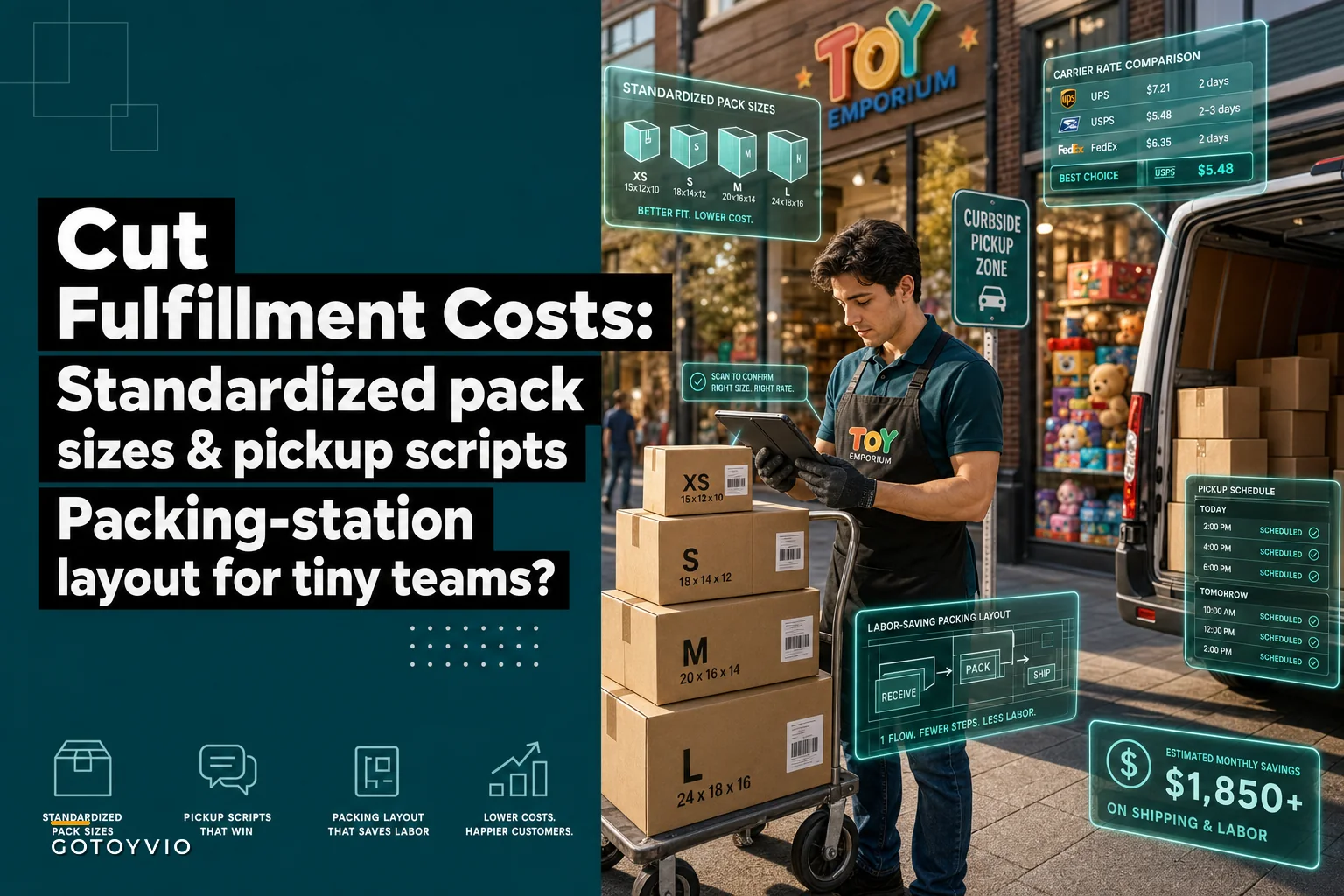
This post isn't a broad "how to ship" guide. It's a tight look at three levers that actually move the needle for a two- or three-person shop: pack size standardization tied to your real SKUs, carrier pickup negotiation you can script, and a packing station laid out so one person moves faster. These are some of the most overlooked shipping cost hacks small retailers have available, and none of them require volume you don't have.
Why your box drawer is costing you money
Walk behind the counter of most independent toy stores and you'll find a shelf of random boxes — leftover vendor cartons, a stack of mismatched mailers, three sizes of bubble mailer that someone bought once. When an order comes in, whoever's packing grabs whatever "looks about right."
That guessing is the expensive part. Carriers charge on dimensional weight, meaning a light-but-big box gets billed like it weighs a lot more than it does. A wooden puzzle that weighs 14 oz thrown into an oversized 12x12x8 box can get rated like a 3-pound package. You're paying for air.
The second cost is time. When a packer has to size-match every order by eye, tape a box that's too big, then stuff it with filler, you're burning 60–90 seconds per order. That adds up fast during a holiday rush. Labor is the shipping cost nobody puts on the invoice, but it's real.
Something worth noticing: stores that ship the same 40–50 SKUs over and over almost never standardize their packaging around those SKUs. They treat every order like a fresh puzzle even though 80% of what goes out fits into three or four box profiles.
Step one: build pack profiles from your actual SKUs
You don't need a packaging engineer. You need to look at what actually ships and group it.
Never run out of bestsellers again.
GoToyvio helps you monitor inventory and sales to keep your shelves stocked and customers happy.
- Real-time stock tracking
- Automated reorder alerts
- Sales and promotion analytics
No credit card required
Pull your last 200–300 shipped orders. Most of them will fall into a handful of shapes: small boxed items (card games, small figures), medium boxed toys (board games, building sets), soft or light stuff (plush), and the occasional awkward one (ride-ons, large playsets). Assign each of your top SKUs to a pack profile — a specific box or mailer plus the void fill it needs.
Here's a simplified version of what that mapping looks like:
| Pack profile | Fits these SKUs | Box/mailer | Typical fill | Avg. shipped cost |
|---|---|---|---|---|
| P1 – Small rigid | Card games, small figures, dice sets | 8x6x4 box | 1 air pillow | ~$5.50 |
| P2 – Bubble soft | Plush, apparel, light bagged items | Poly bubble mailer | none | ~$4.20 |
| P3 – Medium boxed | Board games, mid building sets | 12x10x6 box | 2 pillows | $8–9 |
| P4 – Large/awkward | Large playsets, ride-ons | Reused vendor carton | vendor packaging | varies |
Once you've got this, packing stops being a decision and becomes a lookup. The packer sees the SKU, sees the profile code, grabs that box. No measuring, no guessing, no oversized-box waste.
The insight most people miss: you should buy boxes in fewer sizes than you think you need. Four well-chosen sizes beat twelve "just in case" sizes almost every time, because volume on a single box size gets you better per-unit pricing and your packer never has to think.
Prioritize buying larger quantities of your chosen four box sizes to secure better per-unit pricing.
If your inventory system already tags SKUs, a lot of stores are now using an AI-assisted operational platform to attach the pack profile right to the SKU record, so the pick ticket prints with the box code already on it. That's the difference between a new seasonal hire being useful on day one versus day four.
Step two: actually negotiate a carrier pickup (with a script)
Small stores assume pickup negotiation is only for warehouses shipping thousands of packages a week. Not true. Once you're consistently shipping even 15–25 packages a day, a scheduled pickup is worth calling about — both for the labor you save (no one driving to the drop-off) and because a pickup commitment gives you a reason to ask for better rates.
The first rate a rep quotes is never the floor. Reps have discretion, especially if you can show consistent volume and drop a competitor's name.
A pickup + rate negotiation script that works for tiny teams
Call your account rep (or the small-business line) and work through this:
-
Anchor with volume, not begging. "We're shipping around 400–500 packages a month right now and it's growing into Q4. I want to set up a daily scheduled pickup and lock in better rates."
-
Ask directly about the pickup fee waiver. "With that volume, can the weekly pickup charge be waived or discounted?" Many carriers will waive it above a modest weekly count.
-
Name the competition. "I'm also getting a quote from [other carrier]. What can you do on our medium-box zone rates?" You don't need a real competing quote to say you're getting one — but it helps if you actually have one.
-
Ask for the DIM divisor. This one's underused. The dimensional divisor determines how much you get charged for box size. A better divisor on your account can quietly save more than a headline discount.
-
Get it in writing and a review date. "Can you send that in an email and schedule a rate review in 90 days?" Rates drift; a review date keeps them honest.
A realistic outcome: a store shipping around 450 packages a month gets the pickup fee waived, picks up a modest discount on their two most-used zones, and the owner gets back roughly 4–5 hours a week from not driving parcels around. That labor recovery alone often beats the rate savings.
When negotiating pickup is a bad idea
If you're shipping fewer than roughly 10 packages a day and they're spread unevenly, a daily pickup fee can cost more than drop-off. In that case, negotiate rates only, or use a hybrid — drop off on light days, pickup during seasonal peaks. Don't lock into a daily pickup for volume you only hit two months a year.
Step three: lay out the packing station so one person flows
This is the lever with the fastest payback and it costs almost nothing. A packing station laid out badly forces the packer to pivot, walk, and reach constantly. Fix the layout and the same person packs noticeably more per hour.
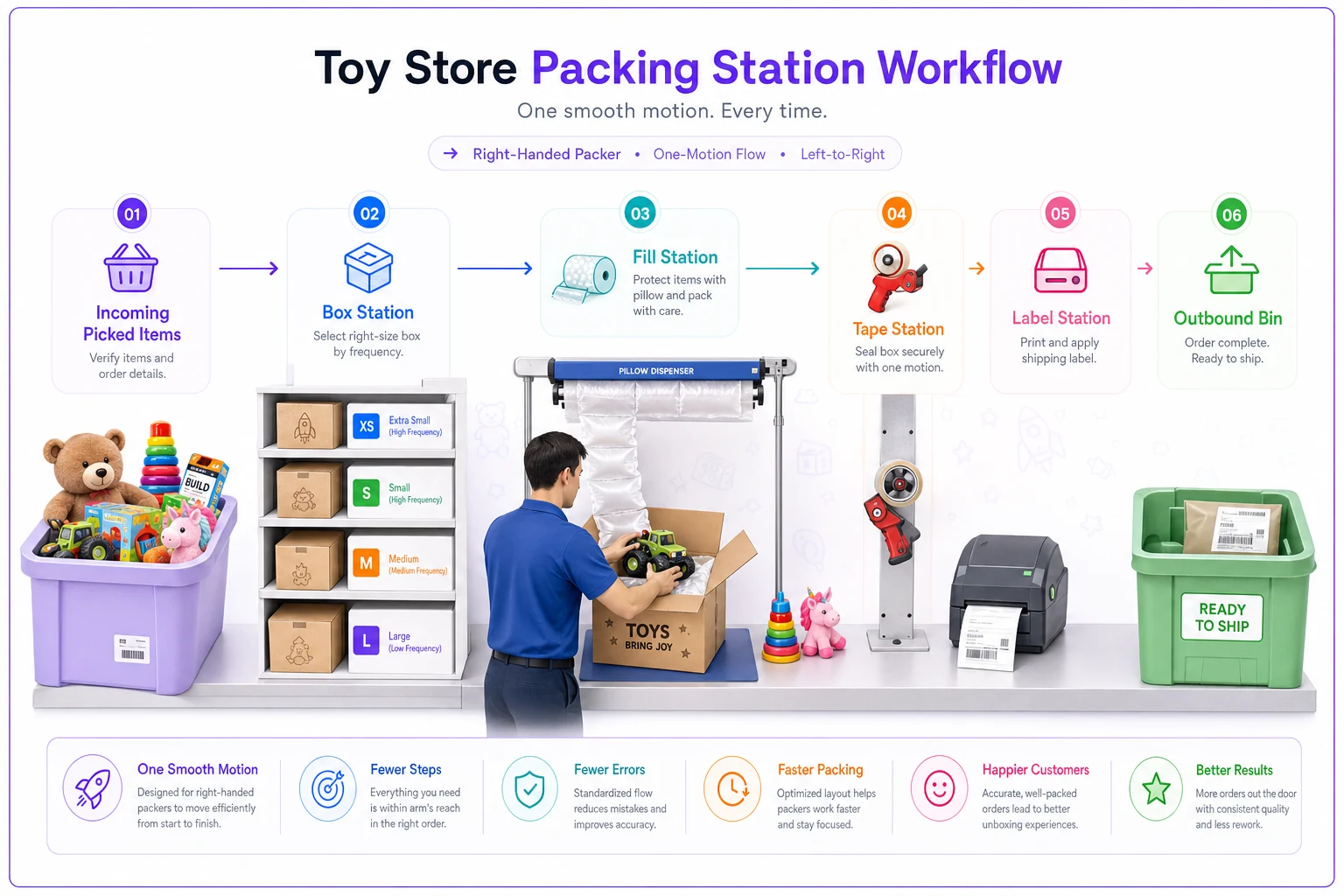
The principle is straightforward: everything the packer touches should be within arm's reach, in the order they use it. Left to right for a right-handed packer: incoming picked items → box station (your 4 standard sizes, stacked by frequency) → fill station (pillows or paper) → tape and label → outbound bin.
Here's a quick visual of the one-motion packing flow.
Small layout mistakes that quietly kill speed
-
Tape gun living somewhere different every shift. Mount it. One fixed spot.
-
Boxes stored flat under the table so the packer bends for every order. Store them upright in slots at chest height.
-
Printer across the room. If labels don't print at the station, you've added a walk to every single order. Move it.
-
Fill material in a giant bag on the floor. Put pillows in an overhead bin or wall dispenser so they drop into reach.
-
No dedicated outbound zone, so packed boxes pile on the same surface used for packing. Give outbound its own bin or cart.
None of these are dramatic on their own. Together they're the difference between packing an order in roughly 45 seconds versus 90. Over a Q4 where you're doing 60–80 orders a day, that gap is hours.
A real scenario: what this looks like added up
Take a three-person shop doing both in-store and online, shipping around 450–500 orders a month outside the holidays and spiking to maybe 1,500 in December.
Before: twelve random box sizes, everything hand-measured, no pickup (owner driving to drop-off most days), packing station with the printer across the room and boxes stored flat under the table. Average shipped cost per order sat around $8.90 once you factored in oversized-box surcharges, and packing ate roughly two labor-hours a day.
After standardizing to four pack profiles, negotiating a pickup with the fee waived and a divisor improvement, and rebuilding the station for one-motion packing:
-
Average shipped cost dropped to roughly $7.20–$7.50 per order, mostly from killing DIM surcharges.
-
Packing time fell by close to a third.
-
The owner got back about 4 hours a week from not doing drop-off runs.
On around 500 monthly orders, the per-order savings alone comes out somewhere in the $800–$900/month range, and that's before counting the reclaimed labor. It's not a dramatic transformation — it's a bunch of small leaks sealed at once, which is usually how shipping savings actually happen.
Who should hold off on all this
If you ship fewer than a handful of packages a week, skip the pickup negotiation and the four-box system. Just standardize on two mailer sizes and move on. The overhead of maintaining pack profiles isn't worth it below real volume.
And if your shipping mix is genuinely unpredictable — lots of oversized, one-off collectibles with no repeat pattern — pack profiles help less, because there's no repeated shape to standardize around. Focus on rate negotiation and station layout instead, where the payback holds regardless of what you're shipping.
Tie it back to the rest of your operations
Shipping cost isn't a standalone problem. If your inventory allocation is messy, you'll ship the wrong item, eat a return, and pay to ship it twice — which wipes out every dollar these tactics save. Getting your allocation rules solid first is worth doing, and it feeds directly into cleaner fulfillment. The same goes for keeping your channels straight so a packer never has to chase down which order goes where; stores that have already worked on how they handle fulfillment across online, in-store and pickup will find these packing changes slot in easily.
The pattern across small toy shops that ship well is boring on purpose: fewer box sizes, one negotiated pickup, a station where the packer never takes a step. None of it is clever. It just gets done consistently, and the savings show up in the quarter you stop thinking about it.
The pattern across small toy shops that ship well is boring on purpose: fewer box sizes, one negotiated pickup, a station where the packer never takes a step. None of it is clever. It just gets done consistently, and the savings show up in the quarter you stop thinking about it.
Ready to elevate your toy store operations?
Join 500+ toy retailers using GoToyvio to increase sales, reduce stockouts, and enhance customer loyalty.