


The owner of a 1,200-square-foot toy store near Philadelphia showed me her fulfillment setup last month. Three iPads, two laptops, sticky notes everywhere. She'd just oversold a Pokémon set that was supposed to be held for in-store pickup because her online system showed it as available. The customer drove 20 minutes to find out the item was gone.
This wasn't a technology problem. It was an omnichannel fulfillment operations problem that breaks down the same way across every small toy retailer trying to serve customers through multiple channels.
Most toy stores now handle sales through at least three channels — walk-in, online ordering, and buy-online-pickup-in-store. Add in special orders, holds, and ship-from-store, and you've got seven different ways inventory moves through your business. The complexity isn't the channels themselves. It's that each channel creates different operational demands on the same limited inventory pool.
Why traditional retail SOPs fail for small toy operations
Standard retail operating procedures assume you have dedicated fulfillment staff, separate inventory pools, or sophisticated warehouse management systems. Small toy stores have none of these. You've got maybe 2-3 people working any given shift, 800-1,500 active SKUs, and inventory that needs to serve every channel simultaneously.
Your morning person handles online orders while opening the store. Afternoon staff juggles walk-ins while pulling pickup orders. Everyone shares the same inventory, the same backroom, the same shipping station. Traditional SOPs that separate these functions create more problems than they solve.
A toy store in Vermont tried implementing big-box retail procedures for their omnichannel operations. They designated specific inventory for online sales, created separate pick lists for each channel, assigned channel-specific responsibilities to staff. Within two weeks, they had inventory sitting unsold in "online only" bins while turning away in-store customers. Staff spent more time managing the system than serving customers. They abandoned the whole approach after a month.
The fundamental mismatch happens because small toy retail operates on different physics than large retail. You don't have the volume to justify channel separation. You don't have the staff to specialize roles. You don't have the space to maintain separate inventory pools. You need procedures built for your actual operational constraints.
The inventory visibility breakdown that creates most problems
Morning shift updates the physical count but forgets to sync the online inventory. A customer places an online order for in-store pickup at 11 AM. Store gets busy at lunch, nobody sees the order until 2 PM. By then, the item sold to a walk-in customer. Now you're calling the online customer to cancel their order after they've already left to pick it up.
Never run out of bestsellers again.
GoToyvio helps you monitor inventory and sales to keep your shelves stocked and customers happy.
- Real-time stock tracking
- Automated reorder alerts
- Sales and promotion analytics
No credit card required
Holiday season hits. You're moving 40-50 items daily across all channels. Someone puts a high-demand LEGO set on hold for a regular customer. That hold doesn't reflect in your online inventory. Website shows one available. Customer in another state orders it for shipping. Your regular customer arrives to find their hold was sold. You've just damaged a relationship worth hundreds of dollars annually to fulfill a one-time $65 order.
The core issue isn't tracking inventory — it's maintaining real-time visibility across channels when your tools and processes weren't designed to work together. Your POS system tracks in-store sales. Your e-commerce platform manages online inventory. Your pickup orders live in email or a separate app. Holds get recorded on paper or in a spreadsheet. Each system has its own version of truth, and they diverge more with each transaction.
Small toy stores typically lose visibility at four critical points:
The moment between pulling an item for pickup and marking it fulfilled creates a window where that inventory appears available in other channels. During busy periods, this window stretches from minutes to hours.
The gap between receiving a hold request and updating available inventory means items can be double-sold before anyone notices the conflict.
The delay between processing a return and restocking it into available inventory creates phantom stockouts where you have product but can't sell it.
The lag between physical counts and system updates means your online inventory drifts from reality until someone manually reconciles.
Building pickup and hold rules that actually work
Most toy stores default to first-come-first-served for all orders. Seems fair, except it ignores the operational cost of different fulfillment types. A local customer picking up a single item costs you almost nothing to serve. An out-of-state shipping order for that same item costs packaging, shipping materials, labor to pack, and ties up the item longer.
Better approach: Create channel priority based on operational efficiency, not just order timing.
-
For in-store pickup orders during store hours, implement a 2-hour ready window
-
If the item hasn't been pulled within 2 hours, it releases back to available inventory
-
For hold requests, establish value tiers based on customer history
-
Regular customers spending more than $400 annually get 48-hour holds
-
New or occasional customers get 24 hours
-
Holiday season, everyone gets 24 hours maximum
Document every hold with customer name, contact, item, and expiration time in a central location visible to all staff.
Holds and pickups need different operational treatment. Pickups are confirmed sales — the customer already paid. These get pulled immediately and staged in a designated pickup area. Holds are potential sales. These stay in regular inventory but get tagged with removal date. This distinction prevents you from sitting on inventory that might not actually sell.
A Massachusetts toy store implemented tiered hold rules based on customer history and item demand. High-demand items (anything selling more than 3 units weekly) get maximum 24-hour holds regardless of customer tier. Slow movers can be held up to 72 hours for good customers. Special orders follow different rules entirely — full prepayment required, no general inventory allocation.
Ship-from-store guardrails for limited inventory
Ship-from-store sounds efficient until you're packing orders while customers wait in line. Or worse, selling your last in-stock item to ship while a local customer stands in your store asking for it.
The operational sweet spot for small toy stores: limit ship-from-store to slow-moving inventory and off-peak processing times. Items that haven't sold in 30+ days become eligible for shipping. Fast-movers stay store-only unless you have 3+ units in stock.
| Item Velocity | Shipping Eligibility | Stock Threshold |
|---|---|---|
| Fast-moving (3+ weekly sales) | Store/pickup only | N/A |
| Medium velocity (1-2 weekly) | Ship if 3+ in stock | 3 units |
| Slow-moving (30+ days) | Always eligible | 1 unit |
| Holiday restricted items | Pickup only | N/A |
Set hard guardrails on shipping availability. During November-December, disable ship-from-store entirely for items with less than 3 units in stock. You'll lose some online sales but protect your higher-margin, lower-cost local sales. The math usually works in your favor — local sales avoid shipping costs, reduce return rates, and build customer relationships that drive repeat business.
For age-restricted or licensed products, shipping adds compliance complexity. Collectible card games, certain action figures, and mature-rated items need age verification that's harder to manage remotely. Some stores restrict these to in-store or pickup only, eliminating the compliance risk entirely.
Returns processing that doesn't create new problems
Returns in omnichannel retail create unique operational challenges. An online order returned in-store needs to credit the original payment method, update online inventory, and potentially trigger a restocking process. An in-store purchase returned via mail needs inspection, processing, and inventory reconciliation across systems.
The hidden cost comes from processing delays. A returned item sitting in your back room for three days during peak season represents lost sales. That Frozen playset returned on December 15th needs to be back on the shelf by December 16th, not sitting in a returns bin until after Christmas.
-
Zone 1
Perfect condition, high-demand items go straight back to floor after quick inspection
-
Zone 2
Items needing repackaging or minor cleaning get processed within 24 hours
-
Zone 3
Damaged items requiring vendor return or disposal get weekly batch processing
Returns processing becomes nobody's specific responsibility when "everyone handles returns." Returns pile up until someone finally deals with the backlog. Better approach: assign returns processing to whoever opens or closes. Morning person handles all previous day's returns before customers arrive. Or closing person processes returns after doors lock. The consistency matters more than the specific timing.
For online orders, implement a return initiation window. Customers must start the return process within 30 days, but physical return can happen within 45 days. This gives you visibility into pending returns without indefinitely holding inventory. A toy store in Oregon found that 35% of customers who initiate returns never actually complete them — knowing this prevented them from over-ordering replacements.
Staffing trade-offs between specialization and flexibility
Small toy stores face an impossible choice: train everyone to do everything (reducing efficiency) or specialize roles (reducing flexibility). The answer isn't choosing one — it's creating conditional responsibilities based on store traffic.
During slow periods (typically weekday mornings), your staff can specialize. One person handles all online fulfillment while another manages the floor. During busy periods (weekends, evenings), everyone shifts to general support with fulfillment becoming a shared background task.
Saturday afternoon, store packed with customers, but your "online fulfillment specialist" keeps packing shipments in the back while the floor person drowns. Customer service degrades, sales drop, and the specialized efficiency gains disappear under operational stress.
Create primary and overflow responsibilities. Sarah primarily handles fulfillment but overflows to floor support when more than 4 customers are in store. Mike primarily works the floor but processes pickup orders when Sarah's overwhelmed. Everyone knows the trigger points for role shifting.
This requires uncomfortable trade-offs. Ship-from-store orders might not go out same-day during busy periods. Pickup orders might take 3 hours instead of 1 hour to ready. Online inventory updates might lag. Accept these delays rather than sacrificing in-store customer service, which drives 60-75% of small toy store revenue.
Technology coordination without enterprise systems
You're not getting an enterprise inventory management system. They cost more than your annual profit and require more training than your staff has time for. Instead, you need coordination protocols that work with the tools you actually have.
The simplest effective approach: single source of truth with multiple update points. Your POS system becomes the master inventory record. Every other system pulls from or pushes to this central source. Online sales decrement POS inventory via API or manual update. Holds get recorded in POS as provisional sales. Pickups process through POS before staging.
Manual coordination works if you establish clear update windows.
For stores without API connections between systems, batch processing prevents constant interruptions. Online orders download once at 10 AM and once at 3 PM. Shipping labels print in batches. Inventory updates happen in blocks, not piecemeal. This reduces error rates and context-switching costs.
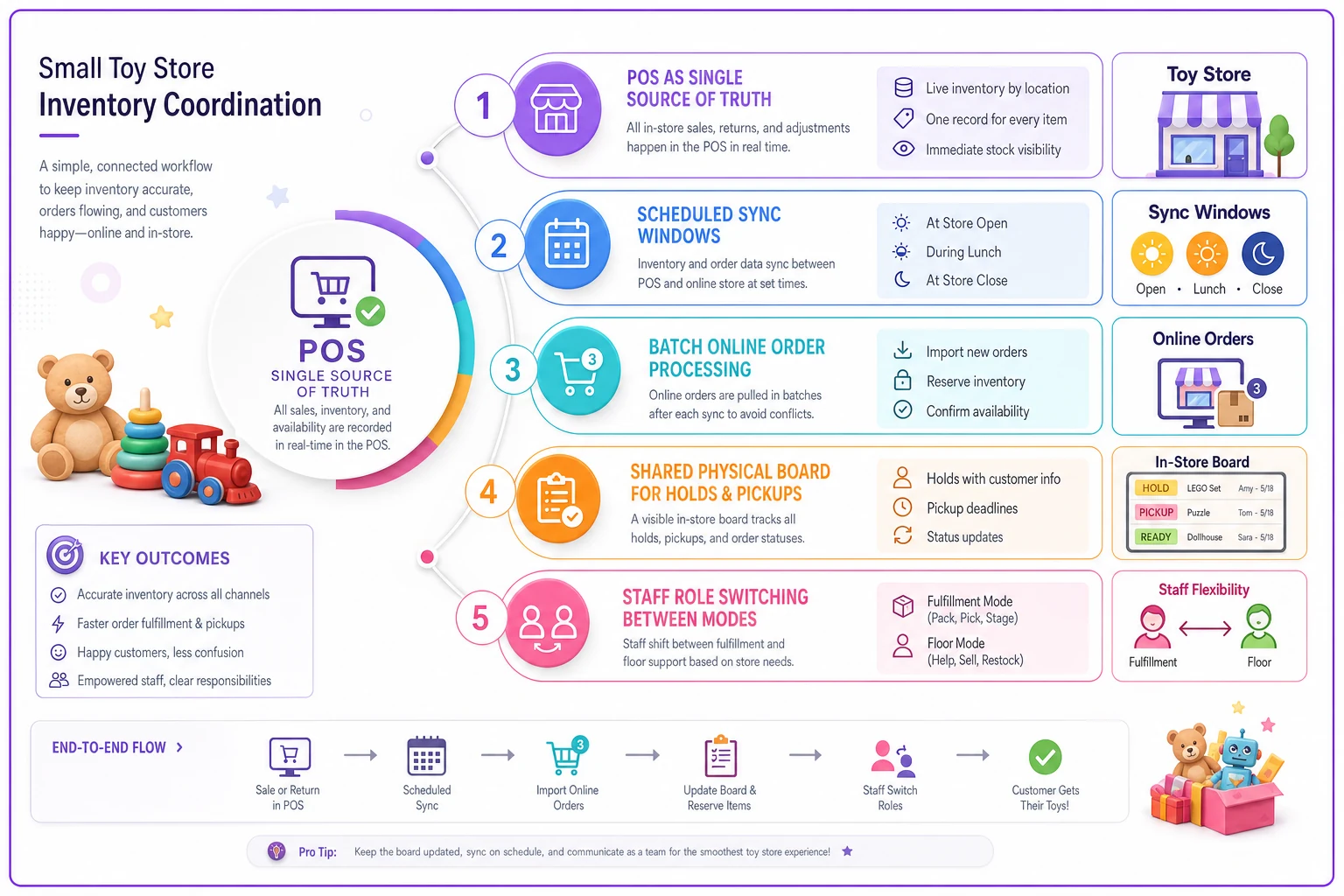
A shared physical board showing holds, pickups pending, and shipping queue keeps everyone aligned without checking multiple systems. A group chat for inventory conflicts ("Anyone know where the last Catan Junior went?") prevents duplicate searching.
For businesses needing more sophisticated coordination, AI-powered operational software can automate many of these sync processes while maintaining the flexibility small toy stores require. These platforms centralize inventory visibility across channels and automatically update availability as items move through your fulfillment workflow.
Measuring what matters (not everything)
Small toy stores drown in metrics that don't drive decisions. Average ship time, channel attribution, cross-channel conversion rates — these matter for large retailers with dedicated analysts. You need three to five numbers that tell you if your omnichannel operation is working.
Channel conflict rate: How often do you cancel/delay orders because inventory wasn't where systems said it was? More than 3-4 per week indicates process breakdown. Track this weekly, not daily. Daily noise obscures real patterns.
Pickup abandonment: What percentage of pickup orders never get collected? Over 15% means your ready times are too long or communication is failing. This directly impacts cash flow since abandoned pickups tie up inventory and require refund processing.
Returns processing time: How long from return arrival to resale availability? During peak season, anything over 24 hours costs sales. During slow seasons, even 72 hours might be acceptable. Measure median, not average — one complex return shouldn't skew your metrics.
Staff time allocation: Roughly what percentage of staff hours go to fulfillment versus customer service? If fulfillment takes more than 25% of floor staff time during store hours, your processes need optimization or your staffing model needs adjustment.
Skip the channel-specific conversion rates, customer lifetime value by channel, and other metrics that require perfect data to be meaningful. Your operational data will never be clean enough to make these reliable. Focus on operational health indicators you can actually see and influence.
When chaos is actually acceptable
Perfect omnichannel operations might not be your goal. A toy store doing 80% of revenue through walk-in traffic shouldn't optimize for online fulfillment. The operational investment won't generate sufficient return.
Some level of channel conflict is acceptable, even healthy. If you never have inventory conflicts, you're probably over-investing in inventory management. During peak gift-buying seasons, deliberately simplify operations even if it reduces channel options. Better to do three things well than seven things poorly.
Many successful toy stores disable ship-from-store during December, limit holds to 24 hours, and process pickups only during set windows. Customers understand seasonal limitations if you communicate clearly.
Where does operational complexity pay for itself? Usually in customer retention and average order value, not in new customer acquisition. A smooth pickup experience for your regular customers matters more than perfect shipping for one-time buyers. A reliable hold system for collectors drives more long-term value than aggressive online inventory expansion.
Building your actual SOP document
Your standard operating procedure document needs to be usable during chaos. Not a 50-page manual but a 2-3 page quick reference that answers immediate questions.
Page 1: Decision trees for common conflicts. "Customer wants item that's on hold" — check hold expiration, check customer tier, make decision. "Online order for last item in stock" — check foot traffic, check item velocity, make decision.
Page 2: Channel priorities and timing windows. Pickup ready times by day/season. Hold durations by customer type. Shipping cutoffs and restrictions. Update windows for inventory syncs.
Page 3: Escalation paths and override authority. Who can break hold policies? Who approves shipping high-demand items? Who decides when to disable specific channels?
Keep physical copies at point-of-sale, fulfillment station, and manager desk. Digital copy in shared drive for remote access. Update quarterly or after major incidents. Date each version so everyone knows they're working from current procedures.
The SOP should answer the "what do I do when" questions that eat up time and create inconsistency. It shouldn't explain why (training covers that) or system how-to (separate guides for that). Just decision criteria and operational flow.
The reality check
Your omnichannel fulfillment will never be perfect. Amazon sets customer expectations you can't meet with 2-3 staff and a single location. Your advantage is personal service, product curation, and community connection — none of which require perfect operational efficiency.
Some days that means telling an online customer their order will take an extra day because your small team is swamped. Some days it means calling a regular customer to offer them first shot at a returned item before it goes back online.
Small toy stores succeed through relationships and reliability, not operational perfection. Build processes that support those strengths rather than chasing operational metrics that matter more to Wall Street than Main Street.
The stores thriving with omnichannel aren't the ones with the most sophisticated systems. They're the ones with clear priorities, consistent execution, and grace under pressure. They know when to follow the SOP and when to make the human decision that keeps customers coming back.
Your fulfillment operation should cost less stress than it generates in revenue. When it doesn't, it's time to simplify channels, not add more technology. Sometimes the best omnichannel strategy is admitting which channels you can't serve well and focusing on the ones you can.
Ready to elevate your toy store operations?
Join 500+ toy retailers using GoToyvio to increase sales, reduce stockouts, and enhance customer loyalty.