

Running a toy store with 3-4 employees means every operational decision lands on your desk. Yesterday's reorder decisions, today's promotional setup, tomorrow's event planning—it all flows through you. And what usually breaks first isn't the product mix or the foot traffic. It's the reporting. Most owners end up drowning in data that tells them what happened last month instead of what needs to happen today.
The dashboard trap that kills most toy store operations
The worst part? You're probably already capturing everything you need through your POS and online channels. Sales velocity, category performance, customer patterns—it's all there. But between your Shopify dashboard showing one thing, your Square reports showing another, and that inventory spreadsheet you update twice a week when you remember, actual decisions get made on gut feel at 9pm when you're exhausted.
Most owners end up drowning in data that tells them what happened last month instead of what needs to happen today.
Why traditional retail reporting breaks for tiny teams
Single-location retail reporting fails when it treats a toy store like a miniature version of Target. You don't need 47 KPIs and a weekly business review meeting. You need three things: what to reorder today, what to promote this week, and whether that upcoming Pokemon release is worth betting inventory dollars on.
Never run out of bestsellers again.
GoToyvio helps you monitor inventory and sales to keep your shelves stocked and customers happy.
- Real-time stock tracking
- Automated reorder alerts
- Sales and promotion analytics
No credit card required
Most POS systems pump out these beautiful reports—daily sales summaries, category breakdowns, year-over-year comparisons. Looks professional. Feels important. Then Monday morning rolls around and you're still asking yourself whether to reorder those Squishmallows or wait another week. The reports tell you Squishmallows sold 14 units last week. Great. But they don't tell you that 11 of those were one specific SKU that's now sold out, and the remaining inventory is mostly unpopular characters sitting there for two months.
The governance piece gets even messier. Who decides when to mark down slow movers? What triggers a reorder? When do you pull the trigger on event inventory? Without clear decision rules, everything becomes a lengthy back-and-forth—or worse, nothing happens until you're already in crisis mode.
I've watched stores with $400k in annual revenue spend more time generating reports than actually using them. One owner showed me her Monday routine: export from Square, update Excel, check Shopify, review QuickBooks, then make ordering decisions based on walking the floor anyway. Four hours of "reporting" that led to the same decisions she would've made without any of it.
The enforcement problem nobody talks about
Operational software for small businesses typically misses one thing: enforcement mechanisms. You can have the world's best reorder rules, but if they require someone to remember to check three different places and manually calculate reorder points, those rules won't get followed when things get busy.
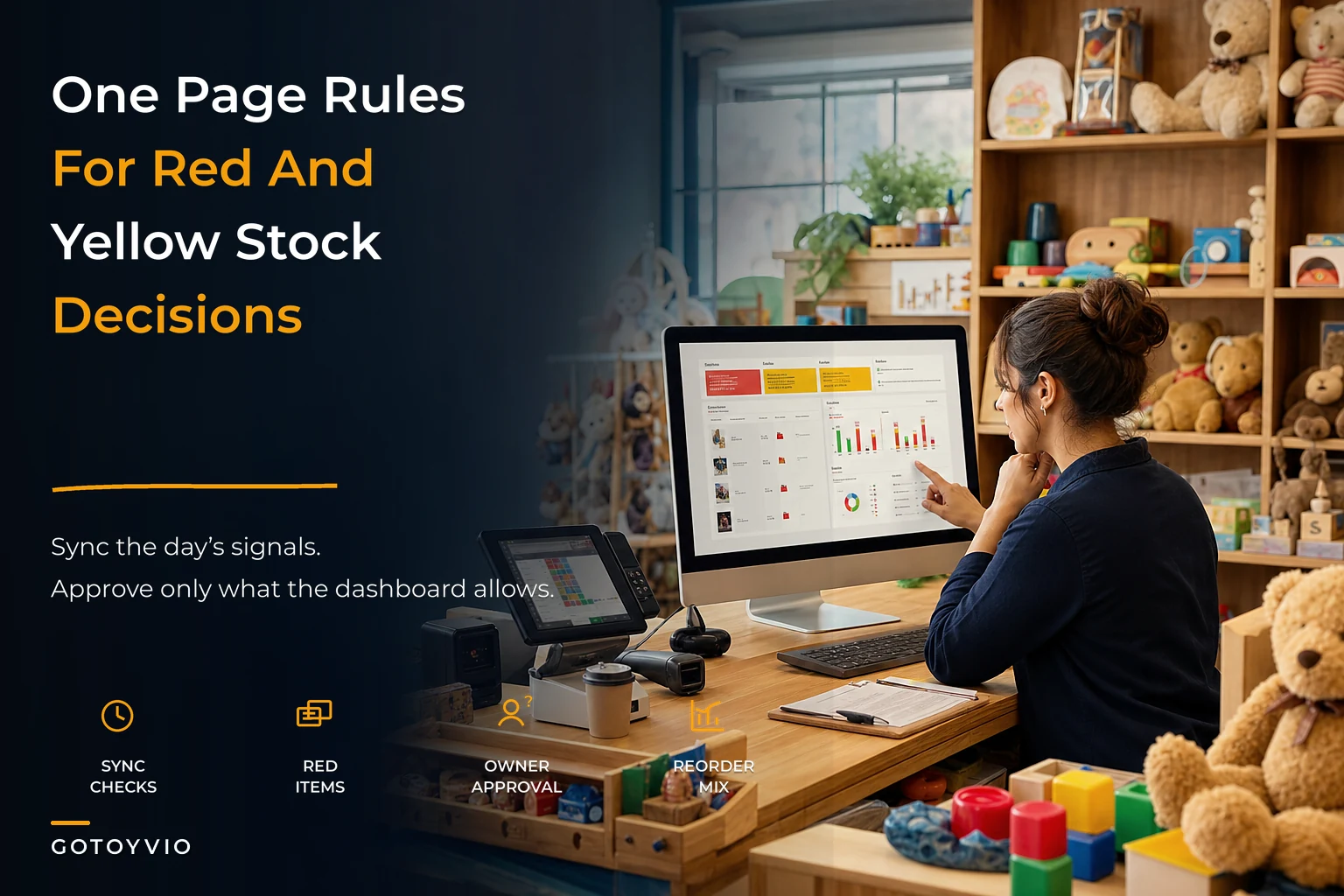
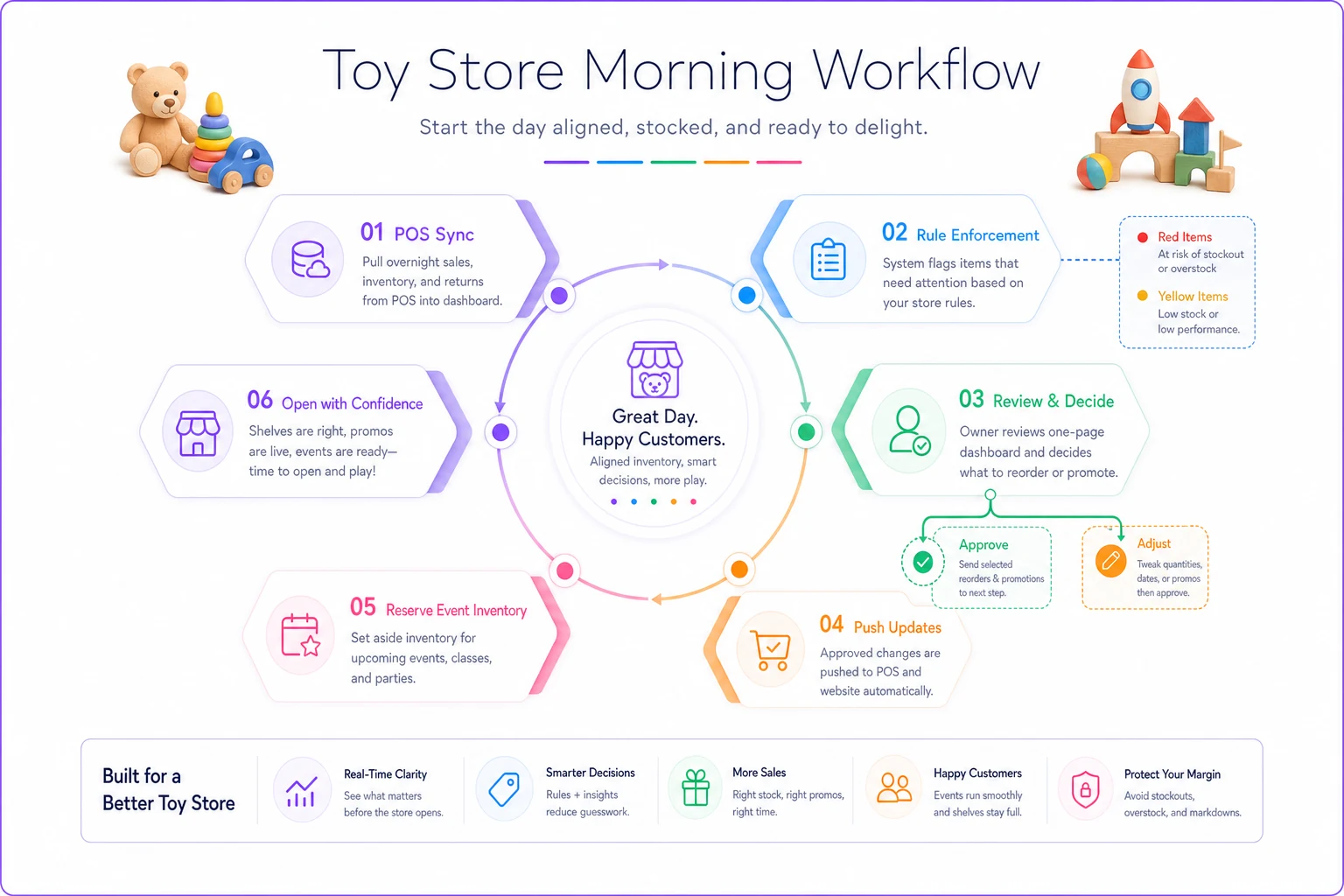
Real enforcement looks like this: your morning dashboard shows three items in red that need to be reordered today based on your pre-set rules. Not suggestions. Not "consider reordering." Actual violations of your governance rules that need immediate action. The same dashboard shows two items in yellow approaching reorder points for tomorrow. That's your entire reorder decision for the day, pulled from last night's POS sync and this morning's online orders.
The same principle applies to promotions. Instead of wondering what to put on sale, your governance rules automatically flag items that have been in inventory over 90 days with fewer than 2 units sold in the past 30 days. These aren't recommendations—they're rule violations that need addressing. Mark them down, bundle them, or return them to the vendor. The decision is yours, but the flag is automatic.
Building a one-page operational dashboard that actually works
Forget everything you've seen about "executive dashboards" and "business intelligence." For a single location with limited staff, your entire operational governance should fit on one screen that loads in seconds and tells you exactly what to do today.
-
Items below reorder point (red)
-
Items approaching reorder point within 2 days (yellow)
-
Promotions that need setup today
-
Events requiring inventory allocation
Here's a quick visual of that morning workflow.
The middle third shows performance against your rules:
-
Items violating age-of-inventory rules
-
Categories outside target margin ranges
-
Promotional performance against minimum ROI gates
-
Stock-to-sales ratios by category
The bottom third provides context for decisions:
-
This week's cash position vs. ordering needs
-
Upcoming known releases and their historical performance patterns
-
Active promotions and their pull-through rates
-
Event calendar with expected inventory needs
That's your entire governance system. One page. Every morning.
The magic is in how this connects to actual operations. When you mark an item for reorder, it doesn't just update a spreadsheet—it triggers your actual ordering workflow. When you approve a promotion, it pushes to your POS and website. When you allocate inventory for an event, it reserves those units across all channels.
Converting POS noise into clear daily decisions
Your POS throws off hundreds of data points daily. Sales by hour, tender types, employee performance, item-level transactions. For governance purposes, you need maybe a dozen of those transformed into decision triggers.
Focus on the five inputs below to convert POS noise into a single reorder trigger.
-
Current stock level vs. your minimum
-
Sales velocity over the past 14 days
-
Seasonal adjustment factor
-
Lead time from vendor
-
Current cash allocation for this category
Five inputs that create one output: reorder today, yes or no.
The transformation happens through decision rules, not reports. A report tells you "Minecraft Lego sets sold 8 units last week." A decision rule tells you "Reorder Minecraft Lego sets TODAY because current stock (3) minus expected sales before next delivery (5) equals stockout risk."
Promotional decisions work the same way. Instead of running margin reports, you set rules:
-
If item age > 90 days AND velocity < 0.5 units/week
Flag for markdown
-
If category margin < 40% for 2 consecutive weeks
Review pricing
-
If promotional item sells < 2 units in first 3 days
Increase discount or end promotion
These aren't suggestions—they're your operational governance. The dashboard enforces them.
Why age-based governance beats velocity-based rules
Most retail systems focus on velocity: what's selling fast, what's selling slow. Velocity lies in toy retail, though. That STEM kit might sell one unit every two weeks—terrible velocity—but at $89 and 55% margin, it's worth the shelf space. Meanwhile, those $6 fidget toys fly off the shelves but barely cover their handling costs.
Age-based governance flips this around. Instead of asking "how fast is it selling?" you ask "how long can I afford to hold it?" Set maximum age limits by category:
| Category | Maximum Age Rule |
|---|---|
| Trendy items (Pokemon, current movie tie-ins) | 60 days |
| Evergreen toys (Lego, Playmobil) | 120 days |
| Seasonal items | Must clear by season end minus 14 days |
| Collectibles | 90 days unless pre-sold |
When something violates its age limit, you have three choices: mark it down, bundle it, or return it. The system doesn't care which you choose—it just enforces that you choose.
This also prevents the classic toy store death spiral where old inventory accumulates because "it might sell during Christmas" while eating up cash that could buy fresh product. Your governance rules become protection against your own optimism.
The three-input promo decision framework
Promotional decisions in toy stores usually happen one of two ways: panic ("sales are slow, put something on sale") or calendar ("it's October, time for a Halloween promotion"). Neither works consistently.
Effective promotional governance uses three inputs:
-
Inventory age violations (what needs to move)
-
Cash flow gates (can we afford the margin hit)
-
Event calendar opportunities (what creates natural demand)
When all three align, you promote. When they don't, you don't.
Here's how this plays out on a Tuesday morning: your dashboard shows four items violating age rules. Your cash position is 15% above minimum—gate passed. This weekend has a community festival driving foot traffic. The system automatically suggests bundling those four aged items as a "Festival Special" at 20% off. You approve with one click, it pushes to all systems, done.
Compare that to the typical approach: realize sales were slow last week, walk the store looking for something to promote, create a promotion that might not even target the right inventory, manually update POS, forget to update the website, wonder why it didn't work.
Turning event planning into inventory allocation rules
Events—whether Pokemon prereleases, Lego building sessions, or holiday activities—create inventory allocation complexities most stores handle poorly. You need inventory for the event, but you're still selling regularly. Without clear governance, you either oversell and disappoint event attendees or overhold and miss regular sales.
The solution isn't complicated—it's about enforcement. When you schedule an event, your governance system immediately:
-
Reserves required inventory
-
Sets aside promotional items
-
Blocks those units from online sales
-
Creates reorder triggers if stock runs low
Two weeks before your Pokemon tournament, the system reserves 24 booster packs. Those packs disappear from available inventory across all channels. If regular sales bring total stock below the reserve plus your minimum, it triggers an immediate reorder flag. No spreadsheet checking. No manual counting.
Breaking the Tuesday morning report-reading ritual
Walk into most toy stores on Tuesday morning and you'll find the owner doing the same thing: printing reports, checking spreadsheets, comparing last week to last year, then making the same inventory decisions they would've made anyway. It looks productive, feels important, changes nothing.
Real governance means Tuesday morning looks different. You open one screen. Three items need reordering—you approve with current vendors or find alternates. Two items violate age rules—you mark down or bundle. This weekend's event needs 12 more items allocated—you approve or adjust. Total time: 15 minutes. Then you're on the floor talking to customers or working on actual growth.
The enforcement-first approach means decisions happen daily in small chunks rather than weekly in overwhelming sessions. Monday you handle reorders. Tuesday you review promotions. Wednesday you check event allocations. By Friday, when most stores are scrambling to figure out weekend inventory, you're already set.
Common governance gaps that create chaos
The gaps always show up in the same places. During busy seasons, the daily governance review gets skipped. "I'll catch up tomorrow" becomes "I'll do a big review Sunday" becomes discovering you're out of stock on bestsellers while sitting on $15k of dead inventory.
Another gap: exception handling. Your governance rules say reorder at 10 units minimum. But what about items with 90-day lead times? Seasonal items? High-theft categories? Without exception handling built into your governance, you're constantly overriding your own rules—which means they're not really rules at all.
The third gap is the worst: governance without delegated authority. Setting rules that require owner approval for every single decision turns your governance system into a bottleneck. If your assistant manager can't approve a reorder under $500, you haven't built a system—you've just added a step. Real governance means pushing decision authority down with clear parameters.
How AI-powered systems eliminate manual governance work
This is where operational software enhanced with AI automation genuinely changes things. Instead of you checking stock levels against reorder points, the system does it continuously. Instead of manually calculating promotional ROI, AI tracks actual performance against your targets. Instead of remembering to allocate event inventory, automated workflows handle it when events are created.
The AI doesn't make decisions for you—it enforces the governance rules you've already set. Think of it as an operations manager who never forgets, never gets tired, and checks every rule every day. You still decide what to order, what to promote, when to run events. But the system ensures those decisions happen when they need to, based on real data rather than delayed until something breaks.
It also learns patterns over time. It notices that Pokemon presales consistently require 20% more inventory than estimated. It identifies that markdowns below 30% don't actually move aged inventory in your market. It spots that reorder points need seasonal adjustment. Then it suggests governance rule updates based on actual performance, not industry averages.
The difference between this and just having better spreadsheets is that the system doesn't wait for you to check it. It surfaces the right decision at the right time, without you having to go looking.
Moving from reactive to predictive decisions
The biggest shift happens when you stop reacting to yesterday's problems and start preventing tomorrow's. Tuesday doesn't start with "what sold out yesterday?" but with "what will sell out by Thursday if I don't reorder today?"
This predictive approach means smaller, more frequent orders that preserve cash flow. Instead of panic-ordering 100 units because you ran out, you're ordering 25 units twice a week based on actual velocity. Cash isn't tied up in inventory. Your stockroom isn't overwhelmed. Your fulfillment chaos across channels disappears because inventory levels stay predictable.
The same applies to promotions. Instead of discovering dead inventory during annual counting, you're addressing aging items weekly. Small, targeted promotions that move specific inventory rather than store-wide sales that crater margins.
The compound effect of daily governance
When single-location retail reporting actually works, small daily decisions compound into real operational improvements. That daily 15-minute review prevents the Saturday crisis. Automatic reorder triggers prevent stockouts. Age-based promotion rules prevent year-end inventory writedowns.
One store went from spending around 8 hours weekly on "analysis" to 15 minutes daily on governance. Their stockout rate dropped from roughly 12% to under 3%. Dead inventory older than 120 days went from $22k to under $5k. Not through any brilliant strategy—just consistent enforcement of simple rules.
More importantly, the owner got her Saturdays back. Instead of being the only person who knew when to reorder, what to promote, and how to allocate inventory, the governance system made those decisions visible and executable by any trained employee. The store could actually operate without her present for a few days without things falling apart.
When enforcement-first governance doesn't work
This approach fails in specific situations, and it's worth being honest about that. If you're a startup toy store still figuring out your market, rigid governance rules will hurt more than help. You need flexibility to experiment, pivot, and learn what works. Governance comes after you know your operational patterns, not before.
It also struggles with highly curated selections where every item is unique. If you're selling vintage toys or one-of-a-kind collectibles, age-based rules and velocity triggers make less sense. You need judgment-based decisions, not rule-based enforcement.
Third failure point: markets with extreme seasonality. If 70% of your revenue comes in November-December, your governance rules need complete seasonal overhauls. The complexity might outweigh the benefits of automation for smaller operations.
Building your first one-page governance dashboard
Start small. Pick three decisions that eat the most time:
-
Daily reorder decisions
-
Weekly promotional selections
-
Event inventory allocation
Create simple rules for each:
-
Reorder when stock minus 7-day velocity equals less than minimum
-
Promote items older than category age limit
-
Reserve event inventory 14 days in advance
Build a simple view that shows violations of these rules. Don't worry about automation yet—just visibility. Even a basic spreadsheet that flags violations beats complex reports that don't drive decisions.
Once those three decisions become automatic, add the next layer:
-
Category margin monitoring
-
Seasonal inventory adjustments
The goal isn't perfection—it's moving from reactive to proactive, from complex to simple, from weekly scrambles to daily rhythms.
The endgame: operations that run without you
The ultimate goal of enforcement-first governance isn't efficiency—it's freedom. Freedom from being the single point of failure. Freedom from weekend inventory crises. Freedom to focus on growth instead of daily firefighting.
When governance rules are clear, documented, and enforced automatically, your store operates predictably. Employees know exactly what needs ordering. Promotional decisions follow clear triggers. Event inventory gets properly allocated. The business runs on systems, not heroics.
This isn't about replacing judgment with algorithms. It's about reserving your judgment for strategic decisions while systematic governance handles the operational ones. Should you carry this new toy line? That requires judgment. Should you reorder your current bestseller? That's just governance.
The toy stores that thrive over the next few years won't necessarily be the ones with the best products or the best locations. They'll be the ones making consistently good decisions daily rather than occasionally great decisions monthly. And that starts with a single page that tells you exactly what needs to happen today.
Ready to elevate your toy store operations?
Join 500+ toy retailers using GoToyvio to increase sales, reduce stockouts, and enhance customer loyalty.