
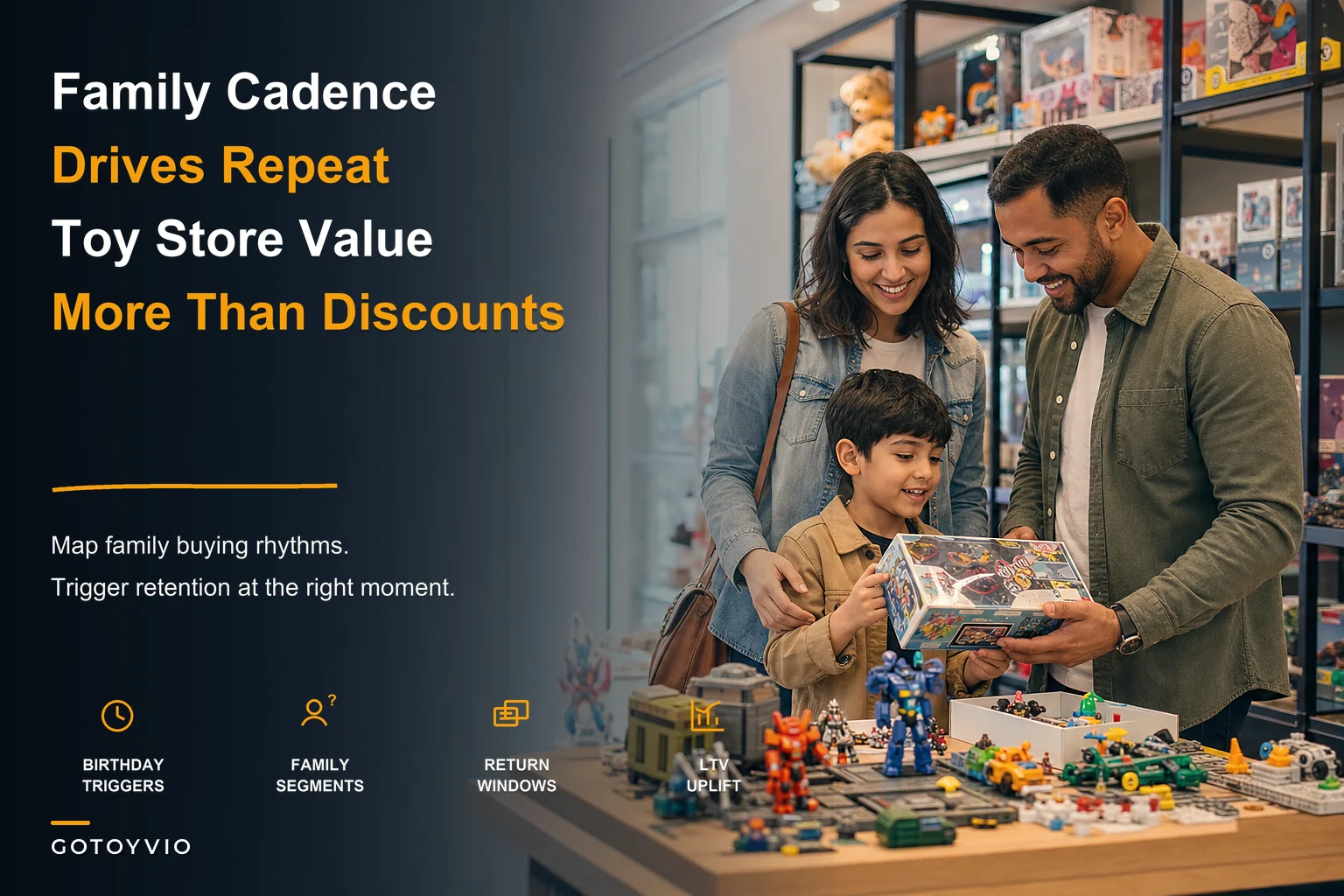

Walk into any successful toy store and watch the checkout line for twenty minutes. You'll notice something - certain customers come back like clockwork. Not the grandparents buying birthday gifts or the collectors hunting for rare items. It's the parents with kids aged 3-8 who show up every six to eight weeks, spending $40-80 each visit.
These families represent roughly 30% of most toy store customers but drive 65-70% of annual revenue. Yet most toy stores treat them exactly the same as someone buying a one-time birthday gift.
The math behind family purchasing patterns tells a different story. A typical "core family" customer visits 7-8 times per year, spending around $450 annually. Compare that to gift buyers who visit twice yearly at $60 per visit. One family customer equals nearly four gift buyers in annual value. But here's what really matters - families stay customers for 3-4 years on average versus 14 months for other segments.
That's a lifetime value difference of $1,600 versus $140.
Understanding your real customer segments (not what you think they are)
Most toy stores mentally categorize customers as "parents" and "everyone else." The actual purchasing patterns reveal five distinct segments with completely different behaviors.
Core families make up your bread and butter. Kids aged 3-8, usually 2+ children, living within 3 miles. They visit every 6-8 weeks for rewards, weekend activities, or just because the kids are bored. Average transaction: $45-65. They know your staff by name.
Event shoppers appear for birthdays and holidays. They spend more per visit ($80-120) but only show up 2-3 times yearly. They ask lots of questions, need gift wrapping, and often look stressed.
Collectors hunt specific items. Could be LEGO Architecture sets, vintage Star Wars, or limited edition dolls. Small group (maybe 5% of customers) but they'll drive 45 minutes for the right item and pay full retail without blinking.
Grandparents overlap with event shoppers but behave differently. They come in with a specific age range ("something for a 6-year-old boy") and a budget ("around $30-40"). They appreciate guidance and often buy additional small items.
Impulse browsers wander in because they're nearby. Maybe waiting for a restaurant table or killing time while their car gets serviced. Conversion rate under 20%, but when they buy, it's usually unplanned purchases around $25-35.
Each segment needs different retention strategies. Sending collector-focused emails about vintage finds to core families wastes everyone's time. Promoting family game nights to gift buyers who live 20 miles away? Pointless.
The purchase cadence patterns that actually predict lifetime value
Purchase timing reveals more about customer value than purchase amount. After analyzing transaction patterns across dozens of toy stores, clear rhythms emerge that most owners never notice.
Never run out of bestsellers again.
GoToyvio helps you monitor inventory and sales to keep your shelves stocked and customers happy.
- Real-time stock tracking
- Automated reorder alerts
- Sales and promotion analytics
No credit card required
Core families follow predictable cycles that repeat like seasonal clockwork:
-
January
Post-holiday lull, educational toys
-
February-March
Indoor activities, craft supplies
-
April-May
Outdoor toys, summer prep
-
June-August
Water toys, travel games
-
September
Back-to-school rewards
-
October
Halloween costumes, fall crafts
-
November-December
Holiday shopping
But within those seasonal patterns, individual family cadence varies based on number of children, ages of children, distance from store, school calendar, and weather patterns.
A family with two kids aged 5 and 7 living 1.5 miles away visits every 5-6 weeks from March through October, then monthly November through December. That's 11-12 visits annually. A family with one 9-year-old living 4 miles away? Maybe 4-5 visits yearly.
Families don't randomly decide to visit. Something triggers each trip - a school achievement, rainy Saturday, upcoming birthday party, or simple boredom. Understanding these triggers lets you influence timing.
Building automation sequences around family milestones
Instead of blasting monthly newsletters, you build trigger-based sequences around actual family events.
Start with school calendar automation. When report cards come out, send "celebration reward" emails to families with school-age kids. Time it 2-3 days after report card day. Subject line: "Report card treats - bring it in for 15% off." Conversion rate on these? Around 18-22% within a week.
Birthday sequences work even better. Capture birth months (not specific dates - less creepy) during checkout. Send birthday emails on the first of the month: "Tommy's birthday month! Here's what kids his age are loving." Include age-appropriate suggestions and a special birthday discount. Follow up mid-month if they haven't visited.
Seasonal triggers based on purchase history work because they follow natural toy progression patterns:
-
Bought a bike in April? Email about helmets and accessories in May
-
Purchased Halloween costume? Follow up about Thanksgiving crafts
-
Bought outdoor toys in spring? Suggest indoor alternatives in October
Weather-based triggers for local families deserve special attention. Set up simple alerts: when Saturday's forecast shows rain, Thursday's email suggests "rainy day survival kits" with board games, craft supplies, and indoor activities. Open rates hit 45% because you're solving an immediate problem.
The key is timing and relevance. A family that bought sidewalk chalk in March probably wants bubbles and water toys by May.
Here's a simple workflow for these trigger-based automations.
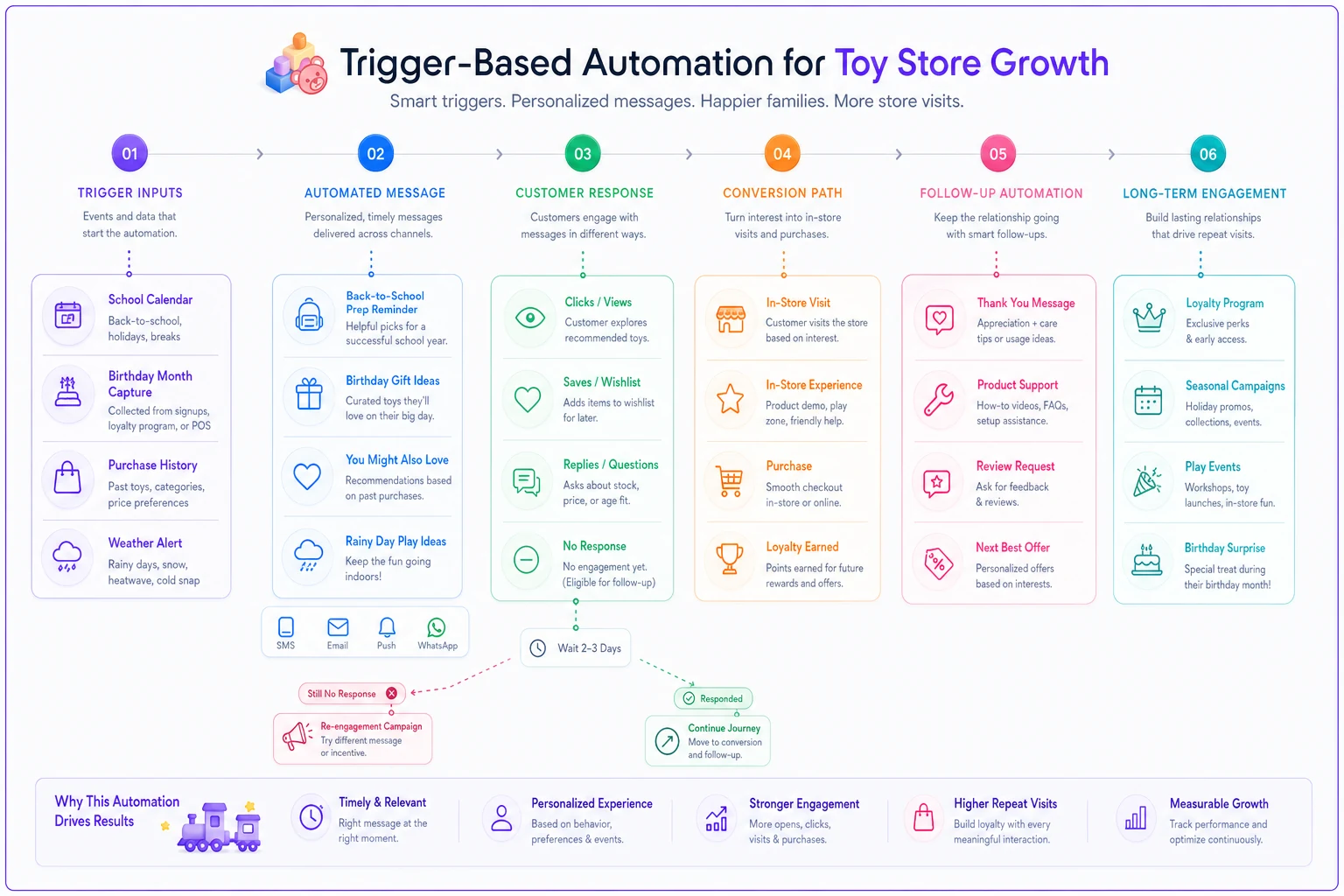
Keep the steps simple: detect trigger → send targeted message → prompt visit → follow up if no visit.
Creating "sticky" experiences that drive natural return visits
Retention isn't just about emails and discounts. Physical experience drives repeat visits more than any marketing sequence.
The "toy library" concept works brilliantly for family retention. Families pay $15 monthly to borrow one toy at a time, switching weekly. Sounds crazy? One store implemented this with just 40 toys in rotation. Result: members visit weekly (versus monthly) and spend an additional $30-40 per visit on items they keep. The membership pays for the toy inventory within three months.
Weekend demo stations create appointment shopping. Every Saturday 10am-noon, set up a different activity: LEGO building challenges, craft projects, board game trials. Families start planning around it. Cost: maybe $50 in supplies and 4 hours of staff time weekly. Return: 25-30 families showing up consistently, average purchase $35-45.
Birthday party packages seem obvious but execution matters. Basic party (10 kids, 90 minutes, party room) runs $150-200. But every party generates 3-4 new family customers from attendees. Track party kids and you'll see 60% become regular customers within six months.
The "trade-in" program targets the toy lifecycle problem. Families accumulate toys their kids outgrow. Offer store credit for gently used items (usually 20-30% of original value). Resell them at 50-60% of retail. Families clean out toy rooms, get credit for new purchases, and feel good about recycling. You make margin on both transactions.
Low-cost retention tactics that tiny teams can actually maintain
Forget complex CRM systems and marketing automation platforms that need constant attention. These simple tactics work with minimal time investment.
The birthday wall uses a physical board in-store where families add kids' birthdays. Each month, pull that month's names and call personally. "Hi Sarah, noticed Emma's birthday is coming up. We set aside that craft kit she loved last visit if you're interested." Phone calls beat emails by 300% for conversion.
First-name service means training staff to remember names. When the Williams family walks in: "Hey Jackson! The new dinosaur puzzles came in yesterday." This matters more than any discount program.
The Friday folder involves partnering with local elementary schools. Provide one-page activity sheets for Friday folders (the weekly papers kids bring home). Include a simple puzzle, coloring page, or game with subtle store branding. Cost: $100 monthly for printing. Result: consistent brand awareness with zero additional effort.
Micro-events that run themselves like "Tuesday Toddler Time" from 10-11am. Just put out some demo toys and play music. Moms show up, kids play, conversations happen, purchases follow. No formal programming needed.
Text message simplicity skips email entirely. Collect mobile numbers and send 2-3 texts monthly. "New LEGO sets arrived" or "Rainy weekend special - 20% off puzzles." Keep it under 50 characters. Response rates crush email by 4x.
Phone calls beat emails by 300% for conversion.
These tactics work because they match small-store reality. You're not managing complex campaigns or analyzing attribution models. You're building simple, repeatable touches that fit into normal operations.
The event playbook that turns one-time buyers into regulars
Events seem like tons of work for uncertain return. But the right events, executed simply, transform customer relationships.
Start with "adoption events" for new product lines. When you bring in a new brand or category, make it an event. Not a fancy launch party - a simple Saturday morning introduction. The brand rep does demos (they'll usually come for free), you provide coffee and donuts ($30), families try products. New product sales jump 40% in the first month, but more importantly, you capture contact info from interested families.
Holiday events beyond the obvious work better. Skip the crowded Christmas season. Focus on underserved holidays like Valentine's craft workshops (parents desperate for activities), Easter egg hunts in the parking lot (minimal setup, huge draw), back-to-school shopping parties (August, when parents are stressed), and Halloween costume swaps (families trade outgrown costumes).
Each event should have three clear goals:
-
Drive immediate sales
-
Capture new family information
-
Create a reason to return soon
The costume swap illustrates this perfectly. Families bring outgrown costumes, get credit toward new ones. You facilitate the swap, taking a 20% margin on trades. Families save money, clean out closets, and kids get "new" costumes. But most families also buy accessories, face paint, and treat bags. Event revenue: $800-1200. New family registrations: 15-20. Cost to run: two hours of staff time.
Measuring what matters (and ignoring what doesn't)
Typical retail metrics mislead toy stores. Average transaction value? Meaningless when comparing a grandmother's $120 Christmas purchase to a family's weekly $35 visit. Focus on metrics that reveal relationship health.
Visit frequency by segment tells the real story. Track how often each customer type returns. Core families should target 8+ visits annually. Event shoppers should hit 3+ visits. When frequency drops, investigate why. Did a competitor open nearby? Are you missing key products? Is customer service slipping?
Cohort lifetime value beats simple revenue tracking. Group customers by when they first visited, then track their value over time. January cohorts behave differently than August cohorts. Birthday party attendees outperform walk-ins by 250% in year-one value.
Reactivation rate measures your ability to win back lapsed customers. Someone hasn't visited in 90 days? They're at risk. At 180 days? Probably gone. Track what percentage you successfully bring back with targeted outreach.
Product attachment rate reveals merchandising effectiveness. When someone buys a bike, do they also buy a helmet? Board game buyers getting expansion packs? Low attachment means you're missing easy revenue.
Here's a simple tracking template that actually gets used:
| Metric | Target | Current | Action Needed |
|---|---|---|---|
| Core family visits/year | 8+ | 6.2 | Increase event frequency |
| Birthday capture rate | 70% | 45% | Train register staff |
| Reactivation success | 25% | 18% | Improve win-back offers |
| Party → customer conversion | 60% | 42% | Follow up with attendees |
| Weather event response | 20% | 14% | Test earlier send times |
Use these to flag problems quickly and assign simple actions. Avoid vanity metrics that don't point to operational fixes.
The family lifecycle timeline most stores never map
Families don't stay static. The couple buying baby toys becomes parents of toddlers, then school-age kids, then tweens who think toys are "for babies." Most stores miss these transitions completely.
The typical family journey unfolds predictably over 12+ years. Years 0-2 represent the discovery phase where first-time parents are learning what they need. Years 2-4 become exploration phase as families try different toy types and figure out preferences. Years 4-8 mark the peak phase with multiple kids and frequent visits. Years 8-12 show decline as kids age out and visits decrease. After year 12, families enter the gift phase, buying for others' kids.
Each phase needs different retention strategies. During exploration, families want guidance and variety. Peak phase families want convenience and rewards. Decline phase requires evolution - books, games, hobbies that appeal to older kids.
One store tracked 50 families over four years. Families with multiple children stayed active 18 months longer than single-child families. Families who attended events stayed 2x longer than non-attendees. Most interesting: families who used birthday registries had 70% higher lifetime values.
Registry families integrated the store into their social circles. Their friends became customers. Their kids' friends had parties there. The store became part of their community infrastructure, not just a retail location.
Building escalation paths that increase purchase frequency
Smart stores create reasons for increasing visit frequency over time. Think of it as gameplay mechanics applied to retail.
Start new families with a simple punch card. Not innovative, but it works. Buy 9 toys, get the 10th free. Average family completes it in 8-10 months. When they complete the first card, upgrade them to a "gold" card with better rewards. Suddenly they're investing in reaching the next level.
Create collector mechanics within mainstream products:
-
"Build Your Own City" with weekly building sets
-
"Reading Champions" with book series
-
"Craft Master" with monthly projects
Families commit to completing sets, driving predictable repeat visits.
The "toy savings account" sounds weird but drives incredible loyalty. Families deposit $20-40 monthly, earning 10% bonus credit. They're essentially pre-paying for toys while getting a discount. You get predictable cash flow and guaranteed future visits. One store has 30 families on this program, generating $800 monthly in advance revenue.
Subscription boxes for local delivery work if kept simple. Monthly themed boxes at $35-45. No customization, no complexity. "April Outdoor Fun Box" or "September Learning Box." Limit to 20-25 subscribers to keep it manageable. Families love the convenience, you love the recurring revenue.
When automation actually helps (and when it makes things worse)
Everyone talks about automation saving time. In reality, bad automation creates more work than manual processes. The key is automating only what genuinely repeats without variation.
Good automation candidates include birthday month emails, weather-triggered messages, school calendar reminders, reactivation sequences for customers who haven't visited in X days, and new product announcements to collectors.
Bad automation candidates include personalized recommendations (usually wrong), complex segmentation (too much maintenance), dynamic pricing (confuses customers), social media posting (looks robotic), and customer service responses (frustrates everyone).
The operational sweet spot: automate the triggers, personalize the execution. System alerts you that the Johnson family hasn't visited in 60 days. You make the phone call. Software tracks birthdays, you write the personal note. This hybrid approach maintains the personal touch that drives toy store loyalty while eliminating repetitive tracking tasks.
Think of automation as your memory system, not your replacement staff. It remembers dates, patterns, and triggers. You provide the human connection that converts those triggers into visits.
Converting seasonal shoppers into year-round families
Every December, your store fills with people you've never seen before. Most disappear until next December. But roughly 15-20% could become regular customers with the right approach.
The conversion window is narrow - 6 weeks after their holiday purchase. After that, they've forgotten you exist. The playbook starts with week 1 post-purchase: thank you text (not email) with assembly tips or play ideas for what they bought. No selling, just helpful content.
Week 3 brings a "how did it go?" message. Ask if the gift was a hit. If they respond, suggest complementary items. "Glad Emma loved the art set! The refill packs are 20% off this month if you need them."
Week 6 offers invitation to a January event. "Family Game Day - try before you buy" or "New Year Toy Swap." Something low-key that brings them back physically.
The critical factor: reference their specific purchase. Generic "thanks for shopping" messages get ignored. "Hope David is enjoying that LEGO Creator set" gets responses.
Track these seasonal converts separately. They behave differently than organic family customers - less frequent visits but higher average purchases. They're also more likely to become event shoppers than weekly visitors. That's fine. Three visits annually at $60 each beats one December purchase.
The ROI reality of retention versus acquisition
The numbers for a typical 3,000 square foot toy store doing $400k annually tell a clear story about where to invest your limited resources.
Acquisition costs vary wildly by channel:
| Channel | Cost per New Customer |
|---|---|
| Facebook ads | $25-40 |
| Google ads | $30-45 |
| Direct mail | $15-20 |
| Events | $8-12 |
| Referrals | $3-5 |
Retention costs stay consistently low:
| Tactic | Cost per Customer |
|---|---|
| Email sequences | $0.50 |
| Text campaigns | $0.25 |
| Birthday calls | $2.00 |
| Event invitations | $1.50 |
| Loyalty programs | $ |
Retention tactics consistently deliver lower costs and more predictable long-term value than most acquisition channels.
The numbers for a typical 3,000 square foot toy store doing $400k annually tell a clear story about where to invest your limited resources.
Ready to elevate your toy store operations?
Join 500+ toy retailers using GoToyvio to increase sales, reduce stockouts, and enhance customer loyalty.