


Most toy store assortment guides tell you to analyze turns, track sell-through rates, optimize your product mix. Those metrics matter. But what actually kills small toy stores is carrying 2,400 SKUs when your cash can only support 800 profitably.
This pattern destroys specialty toy retailers more often than people admit. They start with a focused selection, grow the assortment as sales pick up, then suddenly find themselves with $47,000 tied up in slow-moving inventory while unable to reorder their bestsellers. It compounds during peak season when you need maximum cash flexibility but have it locked in educational toys that haven't moved since March.
The framework here isn't theoretical. It comes from analyzing actual toy store operations where owners cut their working capital needs by 35–40% while maintaining or growing revenue. These stores learned to treat assortment decisions as cash allocation decisions first, merchandising decisions second.
Why traditional assortment planning breaks for small toy stores
Specialty toy stores face a genuinely weird inventory challenge. Unlike clothing retailers who can clearance last season's styles, or bookstores where backlist sells steadily, toy stores deal with products that have wildly different lifecycle patterns. A LEGO Architecture set might sell consistently for three years. A fidget toy trend dies in six weeks. Board games have predictable seasonal patterns. Collectibles follow completely different rules.
Standard retail wisdom says to maximize variety, offer something for everyone, cover all age ranges. This assumes unlimited cash and shelf space. For a single-location toy store doing $400k–$600k annually, following that advice means death by a thousand SKUs.
The cash reality is brutal when you map it out. Say you're carrying 2,000 SKUs with an average cost of $12. That's $24,000 just to maintain one unit of everything. Proper inventory depth means 3–4 units minimum for any consistency, pushing you toward $72,000–$96,000 in working capital. Add safety stock for your top 20% performers and you're looking at $110,000+ tied up in inventory.
Meanwhile, your actual cash generation might only support $65,000 in inventory investment profitably. The gap gets covered by credit, which eats into already thin margins through interest, or by chronic stockouts on bestsellers because cash is trapped in slow movers.
The portfolio approach: think like an investment manager, not a merchant
The mental shift that changes everything: your assortment is an investment portfolio. Each SKU is a cash allocation decision with an expected return timeline and a risk profile.
Never run out of bestsellers again.
GoToyvio helps you monitor inventory and sales to keep your shelves stocked and customers happy.
- Real-time stock tracking
- Automated reorder alerts
- Sales and promotion analytics
No credit card required
High-velocity evergreens are your bonds—steady, predictable returns. Classic Melissa & Doug wooden toys, standard LEGO City sets, Ravensburger puzzles. They won't make you rich but they generate consistent cash flow.
Seasonal items are your growth stocks. High return potential during specific windows, dead money outside those periods. Advent calendars, pool toys, holiday-themed items.
Trendy products are your speculative investments. Massive upside if you catch the wave early, total losses if you miss the timing. Remember Rainbow Loom? Fidget spinners? Certain anime-related collectibles and social media-driven toys are playing that role right now.
Exclusive or limited items are your alternative investments. Higher margins, controlled supply, but require more cash upfront and carry higher risk.
This framework forces real discipline. You wouldn't put 80% of an investment portfolio into speculative penny stocks. So why allocate 80% of your inventory budget to untested products?
SKU triage system: the three-bucket sort that actually works
Most toy stores have three types of inventory problems hiding in plain sight: zombies (haven't sold in 90+ days), vampires (sell occasionally but tie up disproportionate cash), and false heroes (seem successful but actually lose money when you factor in real costs).
The triage cuts through complexity with brutal simplicity. Every SKU goes into one of three buckets:
Protect and Grow (25–30% of SKUs) These items earn their shelf space and cash allocation. They turn at least 4x annually, maintain margins above 45%, and show consistent demand patterns. A typical store might have 200–300 SKUs here. They get prime shelf space, safety stock, and automatic reorder triggers.
Optimize and Monitor (40–45% of SKUs) The middle bucket holds decent performers that need attention. Maybe they turn 2–3x yearly, or margins are solid but velocity is slow, or they're seasonal items in off-season. These get reduced facings, tighter inventory controls, and monthly performance reviews.
Exit or Transform (25–30% of SKUs) Death row. If something lands here, you need an exit plan within 30 days. Clearance it, bundle it, or return it to vendor. No exceptions, no "but it might sell during Christmas" excuses.
A visual workflow helps make the triage repeatable and obvious to the team.
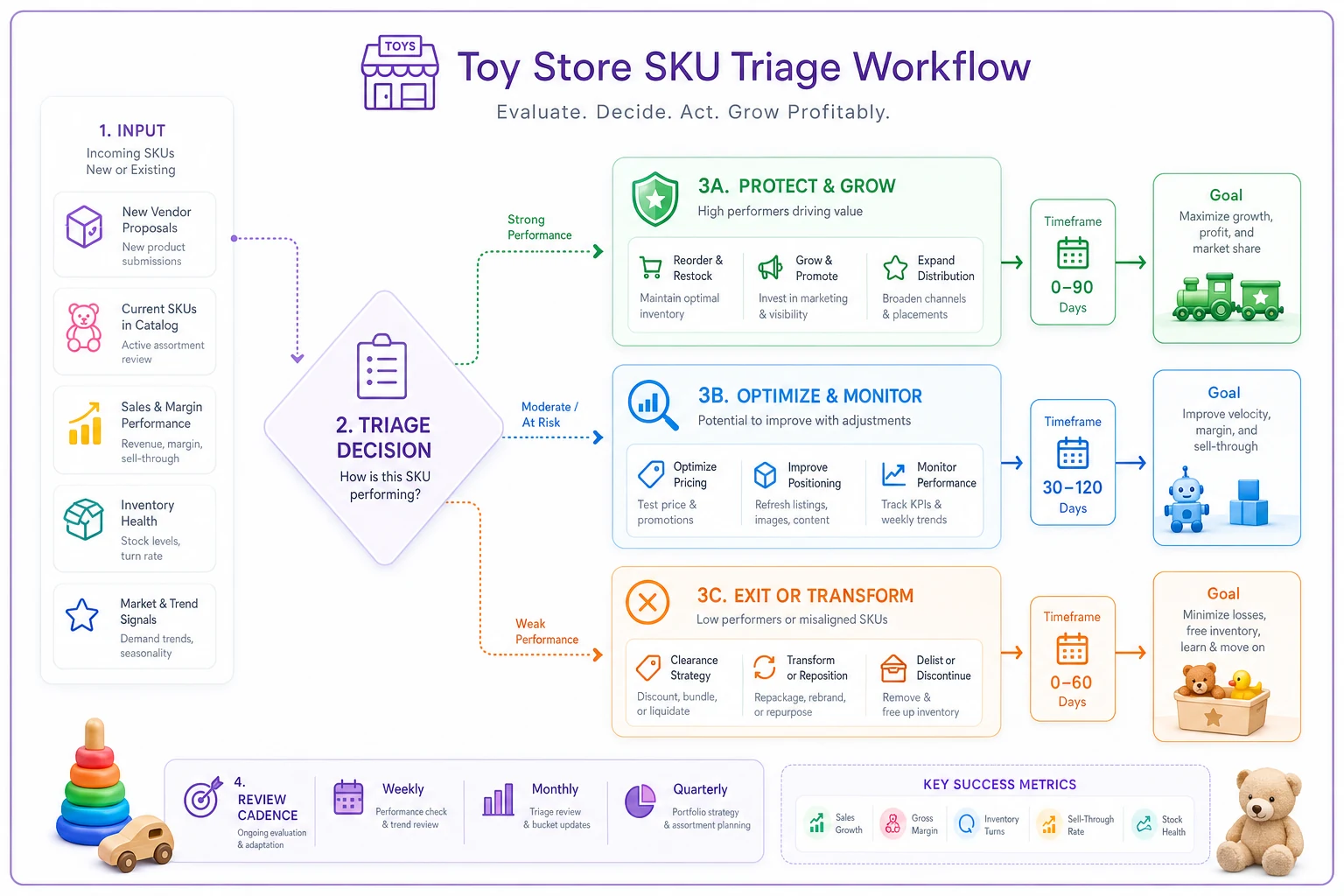
The brutal part is running this triage quarterly and actually following through. Most stores identify their dogs and keep them anyway, hoping things will turn around. They don't.
Lifecycle rules that prevent inventory cancer
Every product category follows predictable lifecycle patterns. Ignoring them is like ignoring symptoms—problems compound quietly until they're terminal.
Introduction Phase Rules New products get 45 days to prove themselves. Order minimum quantities (usually 3–6 units), track daily movement, and make your hold/fold decision at day 45. If it hasn't sold at least 2 units, it's out. No exceptions for "educational value" or "completes the collection."
Growth Phase Rules When something starts moving, resist the urge to over-order. Double your inventory, monitor for two weeks, then adjust. One of the most common mistakes is ordering 144 units of something that sold 12 units in two weeks, then watching 120 units die on the shelf.
Maturity Phase Rules Steady sellers need steady rules. Set par levels based on two-week sales velocity plus one week safety stock. When Brio train sets consistently sell 3 units weekly, your par is 9 units, reorder trigger at 6. Simple, repeatable, cash-efficient.
Set par levels based on two-week sales velocity plus one week safety stock.
Decline Phase Rules The moment velocity drops 40% from peak, start exit planning. Don't wait for death—anticipate it. Mark down 20%, monitor for two weeks. No movement? 40% off. Still dead? Bundle it or donate it. The cash recovery from aggressive markdowns beats the slow bleed of shelf warmers every time.
Seasonal capacity budgeting (not just Christmas planning)
Small toy stores often run seasonal planning backwards. They list everything they want to carry for the holidays, add up the cost, then scramble to find the cash. The right approach starts with cash capacity and works backward.
Your seasonal capacity formula:
-
Base inventory investment
$65,000
-
Seasonal multiplier capacity
1.8x
-
Maximum seasonal investment
$117,000
-
Incremental capacity
$52,000
That $52,000 is your seasonal war chest. Where most stores go wrong is blowing it all on Christmas inventory in October, leaving nothing for opportunistic buys or January recovery.
The allocation should follow this pattern:
-
September build
20% ($10,400)
-
October build
35% ($18,200)
-
November build
25% ($13,000)
-
December opportunistic
10% ($5,200)
-
January recovery
10% ($5,200)
Those December and January reserves are your competitive advantage. While other stores are maxed out, you have cash for distressed inventory buys, special deals, and quick pivots.
The framework extends beyond Christmas too. Summer toys need capacity allocation starting in March. Back-to-school items need space in July. Halloween costumes need budget in August. Map your entire year's capacity needs, then protect those allocations.
The one-page scorecard that replaces 47 reports
Complexity kills execution. Successful toy stores run their entire assortment strategy from a single-page scorecard updated weekly.
Top Section: Portfolio Health
-
Total SKU count vs. target
-
Cash invested vs. capacity
-
Average turn rate
-
Margin blend
Middle Section: Triage Status
-
Items in Protect bucket
count and % of sales
-
Items in Optimize bucket
count and improvement rate
-
Items in Exit bucket
count and clearance timeline
Bottom Section: Lifecycle Alerts
-
New items under review (with days remaining)
-
Growth items needing reorder
-
Declining items flagged for markdown
-
Dead items awaiting disposal
Right Sidebar: Cash Generation
-
Weekly cash from operations
-
Inventory investment change
-
Free cash flow
-
Days cash on hand
The whole thing fits on one page. Print it Monday morning, review it over coffee, make three decisions, move on. No analysis paralysis, no 47-tab spreadsheets, no monthly meetings that go nowhere.
Real-world example: how one store freed up $31,000 in dead cash
A specialty toy store in a college town was dealing with chronic cash crunches despite decent sales. They carried 2,200 SKUs in a 2,400 square foot space, turning inventory 2.3x annually. The owner felt like she was always behind on hot products while drowning in stuff that wouldn't move.
Triage revealed the real problem:
-
680 SKUs hadn't sold in 90+ days (31% of total)
-
Those zombies represented $31,000 in dead cash
-
Meanwhile, the top 50 SKUs were constantly stocked out
-
Customer complaints centered on availability, not selection
The fix wasn't complicated, just required discipline. First, aggressive clearance of the bottom 500 SKUs through bundles and markdowns—some went 60% off, which hurt, but necessary. That freed up $23,000 in cash within six weeks.
Then she set hard SKU limits: maximum 1,200 SKUs total, with 300 in Protect, 600 in Optimize, and 300 maximum in Exit at any time. This forced constant pruning.
Lifecycle rules prevented new accumulation. Every new product faced the 45-day trial. Growth items got controlled investment, not hopeful over-ordering. Declining items got marked down at the first sign of slowdown, not after six months of denial.
Results after four months:
| Metric | Before | After |
|---|---|---|
| SKU count | 2,200 | 1,180 |
| Inventory turns | 2.3x | 4.1x |
| Cash tied in inventory | $78,000 | $52,000 |
| Stockouts on top items | Frequent | Near zero |
| Sales | Baseline | +8% |
The freed cash went into deeper stock on proven sellers and promotional flexibility. She could buy opportunistically, run better events, and maintain the selection customers actually wanted.
Warning signs your assortment is eating your cash
These patterns indicate your toy store assortment strategy has gone sideways:
You're borrowing to buy seasonal inventory while last season's items sit in storage. Your lifecycle rules are broken or don't exist.
Your backroom is full but your sales floor has empty spots. Classic sign of portfolio imbalance—too much cash in slow movers, not enough in winners.
You know your top 10 sellers by heart but can't name what 500+ SKUs even are. If you can't remember it, customers aren't looking for it either.
Vendors are pushing payment terms because you're always late. When cash is trapped in inventory, vendor relationships suffer, terms worsen, and the cycle accelerates.
You're discounting products you received three months ago. Either your buying is broken or your lifecycle management doesn't exist.
When this framework doesn't work
This approach fails in specific situations worth naming.
If you're primarily a destination store for collectors or hobbyists, variety might matter more than efficiency. A store specializing in high-end European wooden toys needs broad selection despite slow turns.
During major expansion or remodel phases, normal rules don't apply. You might need to carry loss-leaders or invest in new categories for strategic reasons.
If you have external funding or deep pockets, you can afford more patience with inventory. But even then, why tie up cash unnecessarily?
Building your own framework (starting Monday)
Start with the triage. Print your inventory report, grab three highlighters, and mark every SKU: green for Protect, yellow for Optimize, red for Exit. Be honest. That educational toy you love but hasn't sold in four months? Red.
Next, set capacity limits. Use your actual available cash for inventory—not what you wish you had. That's your number. Work backwards from there.
Build your one-page scorecard. Don't overthink it. Basic metrics you can update weekly. Consistency matters more than sophistication.
Finally, roll out lifecycle rules gradually. Start with the 45-day new product rule, add others as you get comfortable. The framework should feel like guardrails, not handcuffs.
Where operational software accelerates this framework
The manual version of this framework works but requires constant vigilance. Every Monday you're calculating turns, checking aging, updating your scorecard. Doable, but draining over time.
AI-powered operational software changes that dynamic. Instead of manual SKU triage, the system continuously monitors performance and flags items automatically. Your lifecycle rules become automated triggers instead of manual reviews. The scorecard updates itself daily based on real-time data.
The bigger shift is integration. The software connects your inventory allocation rules to your assortment decisions. When you mark something for exit, buying patterns adjust automatically. When seasonal capacity planning kicks in, it ties directly into your seasonal inventory system.
The AI components help predict which new products will succeed based on historical patterns, flag items entering decline before it's obvious, and adjust capacity allocations when cash flow shifts. It's not about replacing judgment—it's about better information and automatic execution of rules you've already set.
For limited edition and collectible items, the system can track market signals and alert you to markdown timing that moves inventory without wrecking perceived value.
The portfolio mindset changes everything
Running a specialty toy store means making hundreds of inventory decisions every week. Without a framework, each one feels isolated and heavy. With a cash-aware portfolio approach, decisions become systematic.
You stop asking "Should I carry this?" and start asking "What does this generate on my cash?" You stop hoping slow sellers will eventually move and start enforcing lifecycle rules that prevent accumulation. You stop drowning in complexity and start managing from one page.
The stores that survive specialty retail aren't always the ones with the best products or locations. They're the ones that treat inventory as the investment it actually is—demanding returns, managing risk, protecting cash flow.
Your assortment should work as hard as you do, generating returns that justify every dollar tied up in it. That's what this framework delivers: not just better inventory management, but a business model that scales with your growth instead of consuming it.
Ready to elevate your toy store operations?
Join 500+ toy retailers using GoToyvio to increase sales, reduce stockouts, and enhance customer loyalty.