


Three months ago, a toy store owner in Portland watched their entire Funko Pop rare variant collection sit unsold for six weeks. They'd priced everything at standard retail markup—the same formula they used for board games and regular action figures. Then panic set in. They slashed prices 40% across the board to move inventory.
Within 48 hours, their regular collectors stopped buying completely. Not just the discounted items—everything collectible in the store. The owner called me confused. Sales had actually gotten worse after the discount. Their longtime customers were furious, claiming the store had "burned" them on previous purchases. New customers assumed all the collectibles were overpriced to begin with if they could drop prices that much.
The store's reputation for limited editions was basically shot.
This happens constantly with collectible toy pricing. Store owners treat limited editions like regular inventory—apply standard markups, panic when things don't move immediately, then destroy years of carefully built perceived value with one badly-timed sale. The damage spreads beyond the discounted items. Once collectors think you'll eventually mark everything down, they stop buying at release. They wait. Your cash flow dies while they wait.
Why standard retail pricing breaks with collectibles
Regular toy pricing follows a straightforward path. You buy at wholesale, mark up 50-100%, adjust for local competition, maybe run seasonal sales. It works because Lego sets and Barbie dolls are commodity products. Parents compare prices across stores. The cheapest usually wins.
Collectibles operate on different psychology entirely. A limited edition Transformers figure isn't competing with the one at Target. It's competing with secondary market value, scarcity perception, and the collector's fear of missing out. When you price it like a regular toy, you're signaling it's not actually limited or special.
Take Pokemon card releases. One store originally treated new set releases like any product launch—stock up, display prominently, standard markup. They'd get 50 boxes of a new set and price them at $110 each. After two weeks of slow sales, they'd discount to $95 to move inventory. Their competitor down the street would get 10 boxes, price them at $125, and sell out in three days. Same product, same market, but the competitor understood scarcity messaging.
Standard markup also misses category-specific collector behavior. Hot Wheels collectors will pay $8 for a Super Treasure Hunt that costs $1.29 at retail, but only if they believe it's genuinely rare. Marvel Legends collectors track which figures are short-packed and pay premiums specifically for those. Vintage Star Wars collectors literally check production dates and factory codes.
These aren't parents grabbing birthday gifts—they're investors who know more about your inventory's market value than you do.
The deposit system that changed everything for exclusive releases
About eight months ago, a store in Michigan completely restructured how they handled exclusive releases. Instead of buying 30 units of limited edition figures upfront and hoping they'd sell, they started taking $25 deposits three months before release. Full transparency—they'd only order what was pre-sold plus 20% extra for walk-ins.
Never run out of bestsellers again.
GoToyvio helps you monitor inventory and sales to keep your shelves stocked and customers happy.
- Real-time stock tracking
- Automated reorder alerts
- Sales and promotion analytics
No credit card required
The math was beautiful. Previously they'd tie up $4,500 in inventory that might sit for months. With deposits, they'd collect $750 upfront from 30 committed buyers, order 36 units total, and have only 6 units of real inventory risk. Their cash flow improved immediately.
The real magic was psychological. Collectors who put deposits down became invested in the purchase. The cancellation rate was under 5%, compared to the 30% who used to back out of verbal holds. The deposit created commitment.
Position deposits as "securing your allocation" and create a VIP deposit list to reward best customers.
They refined the system over time. High-demand items required 50% deposits. Regular exclusives needed $25 minimum. For items over $200, they offered payment plans—$50 down, then monthly payments until release. This opened up bigger purchases to collectors who couldn't drop $300 at once.
The messaging around deposits mattered too. They positioned it as "securing your allocation" rather than "pre-ordering." Collectors felt like insiders getting special access, not customers being asked to front money. They even created a VIP deposit list for their best customers who got first dibs on allocations.
Category-specific pricing frameworks that actually work
Different collectible categories need completely different pricing approaches. What works for vintage action figures fails miserably for trading cards.
Trading Cards (Pokemon, Magic, Yu-Gi-Oh)
Never price below MSRP on new releases, even if competitors do. Set purchase limits immediately—2 boxes per customer for standard sets, 1 for special editions. Price booster boxes at MSRP for the first two weeks, then adjust based on secondary market. Singles pricing should track TCGPlayer market price minus 10-15% to account for condition uncertainty. Create bundle deals for bulk buyers but never discount below 85% of total value.
Action Figures (Marvel Legends, Star Wars Black Series, WWE Elite)
Track which figures are short-packed in cases. Price regular figures at MSRP plus 20%. Short-packs at MSRP plus 40-60%. Never clearance exclusive figures—return them to distributor or hold for later demand. Build value by creating complete wave deals at 5% discount, but only if customers buy every figure. For vintage or older waves, price at 80% of eBay sold listings average.
Building Sets (Lego exclusives, Mega Construx limited editions)
These hold value differently. Price at MSRP until official retirement announcement, then immediately jump 25%. Never discount exclusive sets. For retired sets, track BrickLink price guide and price at 90% of six-month average. Opened but complete sets price at 70% of sealed value. Create relationships with adult collectors who'll pay premiums for mint boxes.
Designer Toys (Funko exclusive, Kidrobot, Mighty Jaxx)
Extremely perception-sensitive. Price convention exclusives at 2.5x retail minimum. Store exclusives at 1.5x. Chase variants never below 3x common version price. If an exclusive doesn't sell at premium pricing, hold it—never discount. The moment you discount one exclusive, collectors assume all your exclusives are overpriced.
Die-cast Vehicles (Hot Wheels Treasure Hunts, M2 Machines Chases)
Different rules entirely. Regular mainlines at standard markup. Supers/Treasure Hunts individual pricing based on current secondary market. Create mystery bundles for regular collectors—$25 for 30 random cars with guaranteed one premium. Never openly display Super Treasure Hunts—keep behind counter and offer to known collectors first.
| Category | Key rules |
|---|---|
| Trading Cards | Never price below MSRP on new releases; set purchase limits (2 boxes standard, 1 special); price booster boxes at MSRP for first two weeks; singles track TCGPlayer minus 10-15%; bundle deals but never below 85%. |
| Action Figures | Track short-packed figures; regular figures MSRP+20%; short-packs MSRP+40-60%; never clearance exclusives; complete wave deals at 5% if buying every figure; vintage at 80% of eBay sold average. |
| Building Sets | Price at MSRP until retirement, then jump 25%; never discount exclusives; retired sets at 90% of six-month BrickLink average; opened complete sets at 70% of sealed value. |
| Designer Toys | Convention exclusives 2.5x retail min; store exclusives 1.5x; chase variants 3x common; hold instead of discounting exclusives. |
| Die-cast Vehicles | Mainlines standard markup; supers/treasure hunts priced to secondary market; mystery bundles; keep premium items behind counter. |
Each category needs rules tuned to its collector behavior and secondary market signals.
Messaging that protects margins without killing demand
The way you talk about pricing matters as much as the actual numbers. Stores with identical prices see completely different results based purely on how they frame them.
Never say "our prices are firm." Say "we price based on current market value to ensure fairness for all collectors." The first sounds stubborn. The second sounds professional.
When collectors challenge your pricing, don't defend the markup. Explain the value. "This Transformers Masterpiece is $20 above MSRP because we're one of three stores in the state that got allocation, and we're guaranteeing mint packaging with our inspection process." You're not justifying a price—you're explaining scarcity and service.
Create price protection policies that build trust. One successful approach: if an item doesn't sell within 60 days, early buyers get store credit for the difference. This removes the fear of buying at release while protecting your initial margins. Most collectors never claim it, but knowing it exists makes them comfortable paying full price.
For high-value items over $150, always include something extra—a protective case, authentication card, or exclusive sticker. The add-on might cost you $3, but it justifies the premium pricing psychologically. Collectors can rationalize the purchase because they're getting "more" than just the item.
Build transparency into your pricing. Post your pricing policy publicly. Explain that limited editions follow different rules than regular stock. Be clear about what will never go on sale (exclusives, limited runs, first editions) versus what might see discounts (regular waves, common figures, overstocked items).
The 72-hour rule that saved margins
One store developed what they call the 72-hour rule, and it transformed their limited edition sales. Any new limited or exclusive item cannot be discounted for 72 hours after release, no matter what. No exceptions, no special deals, no bundle discounts.
This created urgency for serious collectors while protecting early buyer confidence. Collectors knew if they wanted something badly, they had to move fast. But they also knew the store wouldn't undercut them immediately.
After 72 hours, they reassess.
-
If 50% sold, hold pricing for another week.
-
If under 30% sold, create bundles but maintain individual pricing.
-
If over 70% sold, actually raise prices 10% on remaining stock.
-
Only if something completely fails to move after two weeks do they consider actual discounts, and even then, max 15% off.
The psychological impact was huge. Collectors started showing up for releases again instead of waiting for sales. The store's reputation shifted from "always having sales" to "fair but firm pricing." Revenue per collectible increased 34% year-over-year just from this one policy change.
They also implemented reverse discounting for certain categories. Hot items that sold out got waitlists at 10% above original price. When restocks arrived, waitlist customers gladly paid the premium for guaranteed allocation. This trained customers that waiting actually costs more, not less.
Stock caps and artificial scarcity (without being sleazy)
Creating scarcity messaging without lying requires careful balance. You want urgency without deception.
Always cap pre-orders at 80% of expected allocation. If you're getting 20 units, take deposits for 16 maximum. This ensures you have stock for launch day walk-ins while creating legitimate scarcity messaging—"pre-orders nearly sold out" is true at 16 units.
Display caps work too. Never put more than 3 of any limited item on the floor, regardless of back stock. When collectors see only 2 Marvel Legends on the peg, they assume that's all you have. The psychology drives immediate purchase decisions. Keep the rest in back and restock the peg once daily.
For online listings, show actual quantity only when under 5 units. Above that, just show "in stock" or "limited quantity available." Collectors who see "47 available" think they have time. Those who see "limited quantity" buy immediately.
Create purchase history requirements for ultra-limited items. "Must have purchased $200 in collectibles in past 6 months to access this allocation." This isn't arbitrary gatekeeping—it rewards actual collectors over flippers while creating exclusive access perception. Your regulars feel valued, and new customers have incentive to build purchase history.
Time-based releases add urgency without fake scarcity. "Available for pre-order for 48 hours only" or "Launch day pricing valid until Sunday" creates decision pressure. You're not lying about stock levels—you're creating legitimate deadline urgency.
When breaking the rules makes sense
Sometimes you need to break every rule above. The key is knowing when and why.
Liquidation scenarios demand different logic. If you're closing a location, sitting on $50,000 in collectible inventory, maintaining perceived value doesn't matter. Blow it out at 50% off and convert to cash. Your reputation at that location won't matter in two weeks anyway.
Category exits require aggressive pricing too. If you're dropping Funko entirely to focus on other lines, holding firm on pricing just extends the pain. Mark everything 30% off, message it as "making room for new collections," and move on. The customers who care will stock up, and you're not planning to serve that market anymore anyway.
Seasonal overlap creates pricing pressure you can't ignore. November Marvel Legends competing with Christmas shopping? You might need to discount to move inventory before bigger-ticket items dominate wallet share. But message it as "early holiday pricing" rather than clearance, and return to regular pricing in January.
Damaged packaging is where flexible pricing actually builds trust. That Transformer with the crushed corner? Price it at 60% for opener collectors. They get a deal, you move damaged goods, and mint collectors see you maintain standards. Everyone wins.
When distributors dump allocations last minute, you might need to break margin rules to avoid crushing cash flow. If you suddenly receive 100 units of something you ordered 10 of, eating the margin hit beats sitting on $10,000 in dead inventory for months.
Turning pricing discipline into operational automation
The stores succeeding with collectible toy pricing aren't just following rules—they're building systematic approaches that remove emotional decision-making from the process.
Smart stores track secondary market prices automatically, pulling eBay sold listings and TCGPlayer prices into spreadsheets weekly. They set algorithmic rules: if secondary market jumps 30%, increase price 20%. If it drops 40%, hold pricing but flag for review. The human makes strategic decisions, but day-to-day pricing follows predetermined logic.
Here's a simple workflow for automated pricing and notification handling.
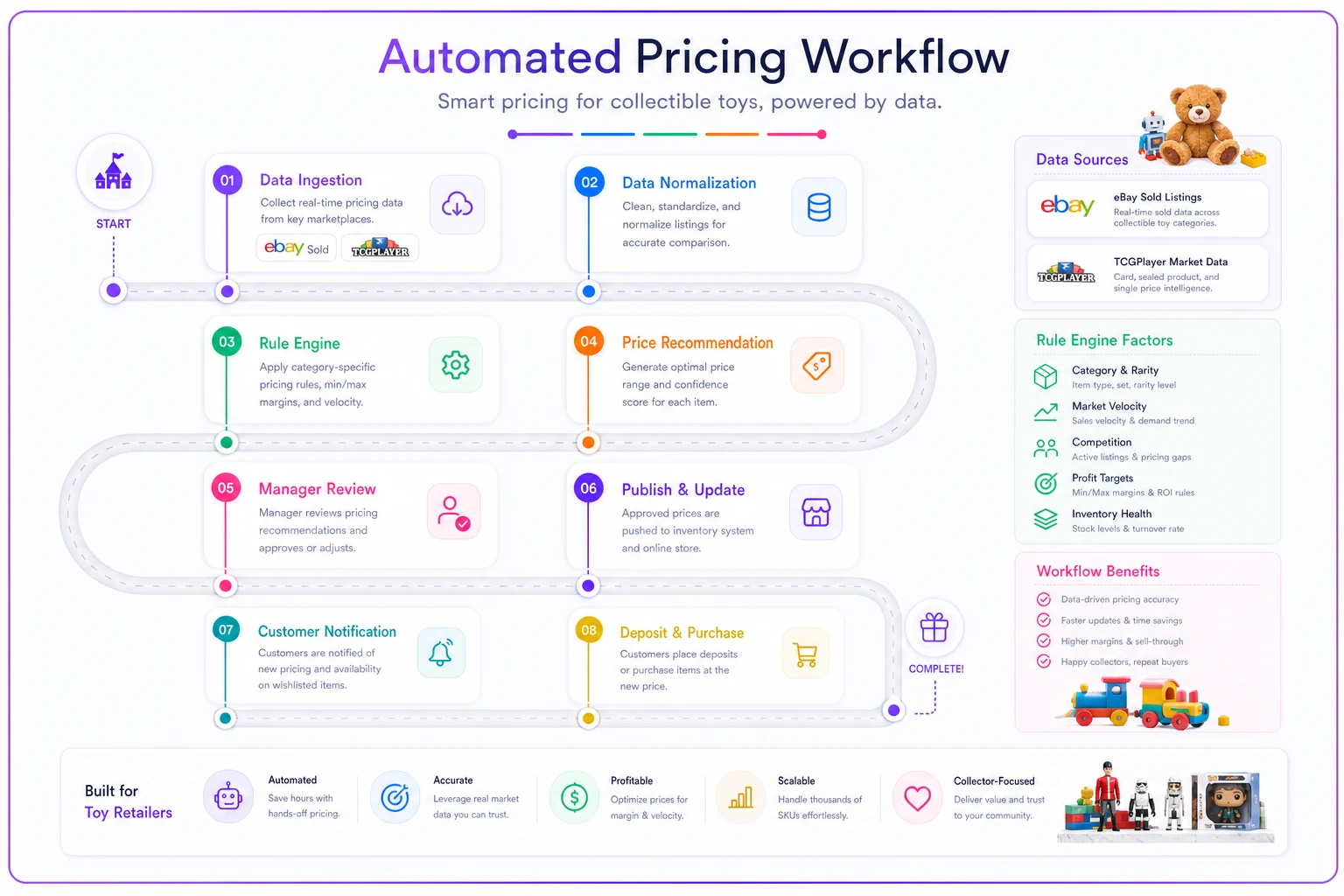
Inventory management becomes crucial. Stores using modern operational software can set different pricing rules for different categories automatically. Limited editions might require manager approval for any discount. Regular waves could allow 10% markdowns after 30 days automatically. The system enforces discipline when human psychology wants to panic-discount.
Good operators track customer lifetime value by category. That collector who buys every exclusive at full price? They're worth protecting with consistent pricing. The bargain hunter who only shows up for sales? They're not your core market anyway.
Software that segments customers helps you make better pricing decisions based on who you're actually serving. Communication automation helps too. Instead of manually messaging collectors about new releases, automated systems can notify deposit holders first, general collectors second, and casual customers third. This creates natural scarcity through staged communication without any deception. By the time casual buyers see the announcement, serious collectors have already claimed allocations.
The long game always beats the quick flip
After running numbers across dozens of toy stores, the pattern is clear. Stores that maintain pricing discipline on collectibles see 40-50% higher margins than those that discount aggressively. But more importantly, they build customer bases that actually appreciate over time.
The store that never discounts limited editions has collectors who drive two hours to shop there. The store that runs constant sales has bargain hunters who still price-check Amazon while standing at the register. One customer base generates sustainable profit. The other creates a race to the bottom.
The irony? Collectors will actually thank you for maintaining prices. They want their collections to hold value. When you discount that exclusive they bought last month, you're literally devaluing their investment. Hold the line on pricing, and you're protecting their purchases while building a reputation that attracts serious buyers.
The toy stores thriving in the collectible market aren't competing on price. They're competing on access, curation, and trust. Price accordingly, and the right customers will find you. Race to the bottom on pricing, and you'll arrive there alone.
Ready to elevate your toy store operations?
Join 500+ toy retailers using GoToyvio to increase sales, reduce stockouts, and enhance customer loyalty.