

Most independent toy stores grade their vendors on vibes. You "feel like" the LEGO-adjacent distributor ships slower than they used to. You "think" that one plush supplier has been shorting your orders. But when it comes time to renegotiate terms or cut a line, you've got nothing written down — just a gut feeling and a vague memory of the last time something went sideways.
That's the gap a vendor scorecard fills. Not a 40-column spreadsheet that takes an hour to update, but a single page you can actually use in a conversation. The problem is most scorecard templates online were built for companies with buyers and category managers. For a tiny team running a shop with two employees and a seasonal part-timer, that stuff falls apart within a month.
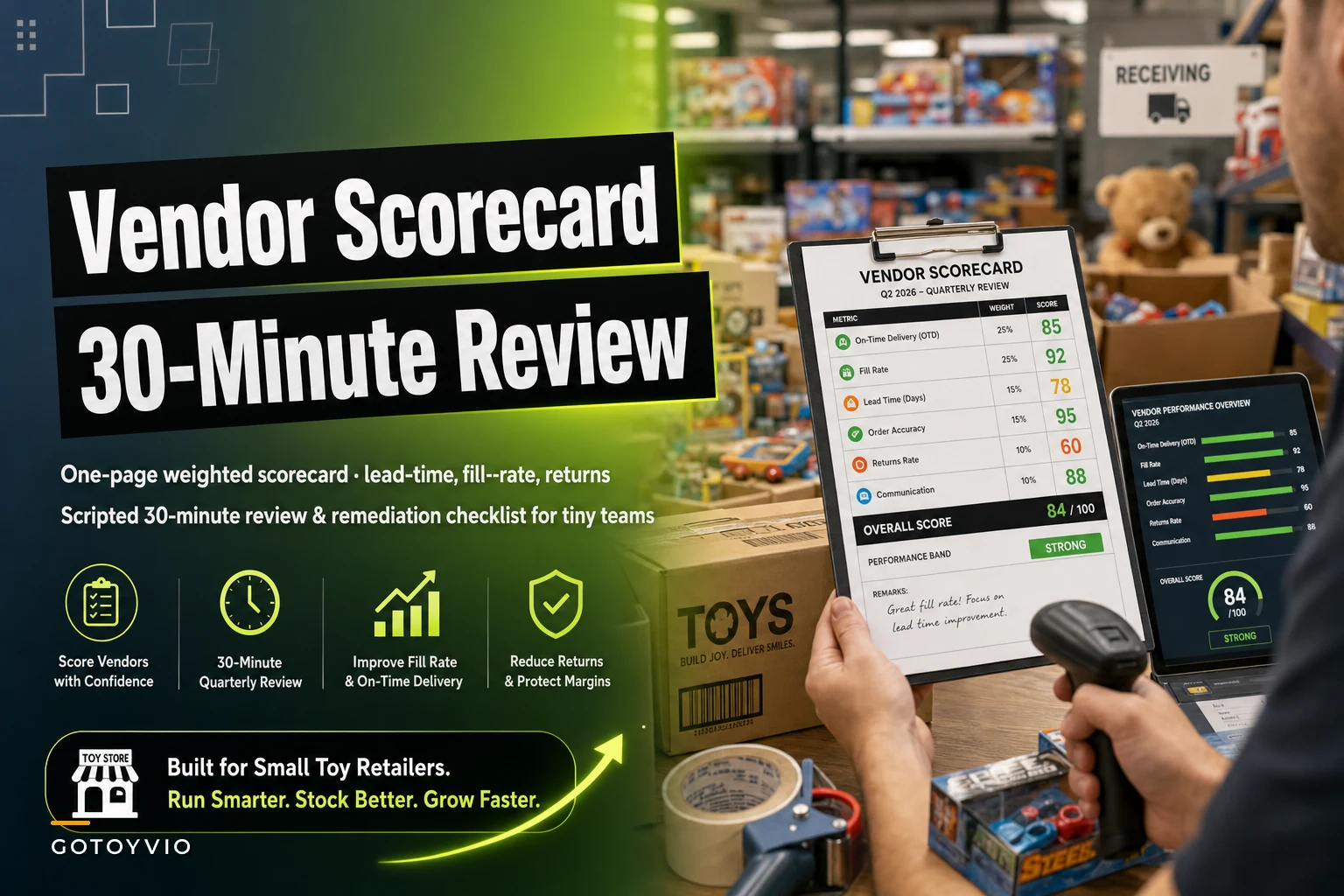
So this is a scorecard sized for reality: three metrics that actually predict whether a vendor is costing you money, weighted so the number means something, plus a 30-minute quarterly agenda you can run without prepping for a week.
Why three metrics, and why these three
The temptation is to measure everything. Price, packaging quality, invoice accuracy, communication responsiveness, minimum order flexibility, promotional support — the list goes on. Measure all of it and you'll measure none of it consistently.
For a toy store, three things actually hit your P&L in a way you can trace:
-
Lead-time reliability — did the order show up when they said it would?
-
Fill rate — did you get everything you ordered, or did they short you?
-
Return/defect rate — how much of what arrived was wrong, damaged, or had to go back?
Everything else is downstream of these. A vendor with great prices who ships late and short during Q4 is quietly more expensive than one who charges 4% more and never misses. The scorecard makes that invisible cost visible.
These three metrics also tend to fail at different times for different reasons. Lead-time blows up seasonally. Fill rate quietly degrades when a vendor takes on bigger accounts and you drop down their priority list. Returns spike when a supplier switches factories or cheapens materials. One number won't catch all three, which is exactly why you track them separately before rolling them up.
The scorecard: weighted bands on a single page
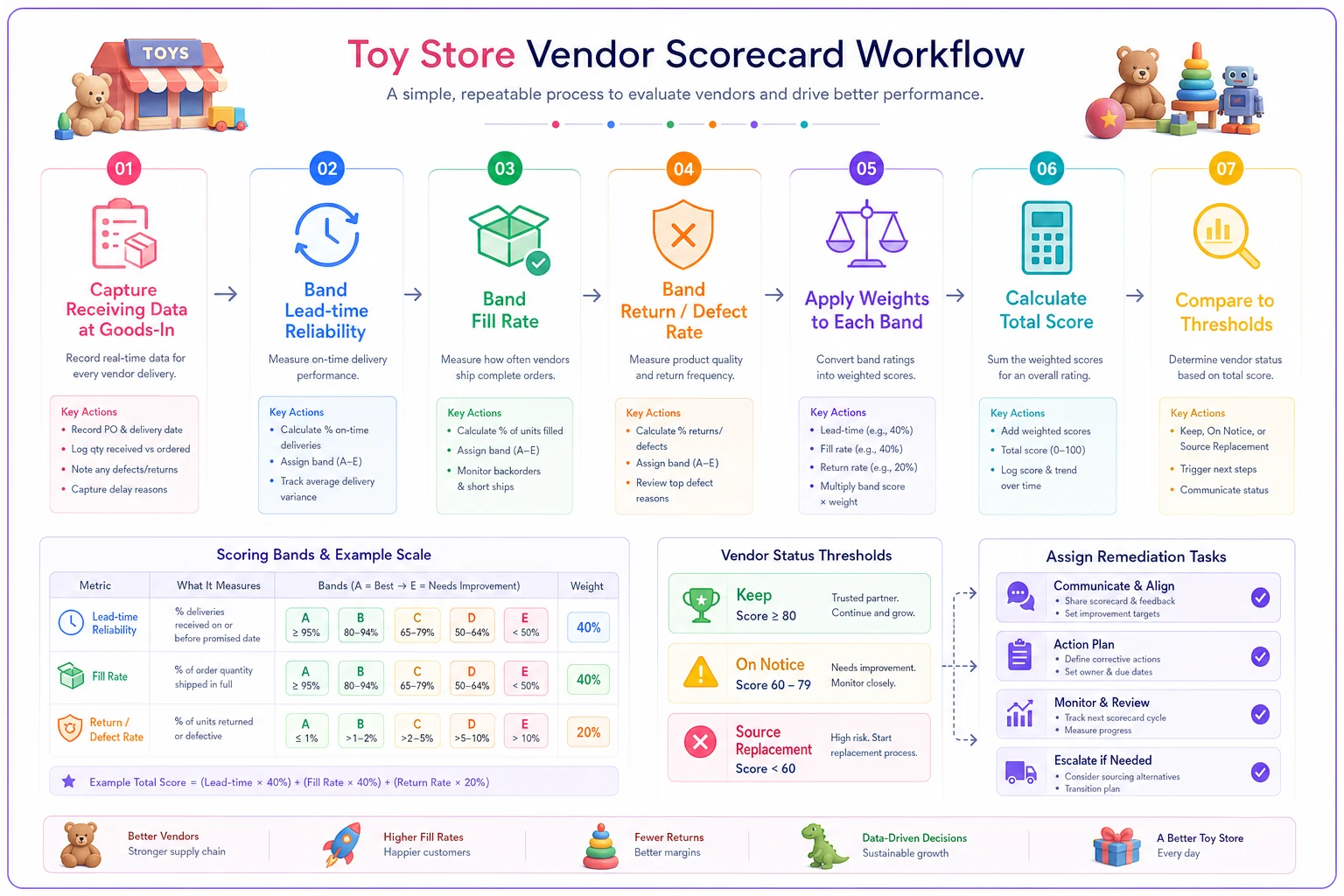
The core idea is a banded score. Instead of recording raw percentages you then have to interpret, each metric gets scored into a band — Green, Yellow, or Red — and each band carries points. Then you weight the three metrics based on what matters for your store.
Never run out of bestsellers again.
GoToyvio helps you monitor inventory and sales to keep your shelves stocked and customers happy.
- Real-time stock tracking
- Automated reorder alerts
- Sales and promotion analytics
No credit card required
Most toy stores should weight lead-time heaviest. Stockouts on a hot release cost you the sale and the customer, who just walks to Amazon. Fill rate sits second. Returns, while annoying, usually hurt least in raw dollars — though a chronic defect problem signals a vendor who's slipping across the board.
A weighting that works for a typical single-location shop:
| Metric | Weight | Green (full points) | Yellow (half) | Red (zero) |
|---|---|---|---|---|
| Lead-time reliability | 45% | 90%+ on-time | 75–89% | under 75% |
| Fill rate | 35% | 97%+ shipped complete | 90–96% | under 90% |
| Return/defect rate | 20% | under 2% | 2–5% | over 5% |
A vendor who's Green on lead-time (45), Yellow on fill rate (17.5), and Green on returns (20) lands at 82.5 out of 100.
A quick visual of the scoring workflow:
Then set two thresholds you decide in advance:
-
70 or above — keep, no action needed
-
50–69 — on notice, remediation conversation required
-
below 50 — actively source a replacement
The reason banding beats raw numbers: it forces a decision. A vendor sitting at "89% on-time" sounds fine until you realize that's one missed delivery away from Red during your busiest quarter. The band tells you where you actually stand.
Where the data comes from (and how to not make this a part-time job)
The whole thing falls apart if gathering the numbers takes longer than the review itself. Most of this data already lives in your receiving records — you just have to capture it at the moment goods come in instead of reconstructing it from memory three months later.
The lightweight version: every time you receive a PO, log four things in a running sheet or in your receiving flags —
-
Promised delivery date vs. actual arrival
-
Units ordered vs. units received
-
Anything damaged, defective, or wrong
-
One free-text note if something notable happened
If you already run a time-boxed receiving process with POS hold flags, you're most of the way there — the data from inspecting incoming shipments feeds straight into fill-rate and defect tracking. The scorecard is really just a quarterly roll-up of receiving data you should be capturing anyway.
One thing worth being deliberate about: capture the promised date at order time, not when the vendor emails you an updated estimate. Vendors who are slipping love to "revise" delivery windows a week out so they technically hit the new date. If you only record the revised date, your lead-time score flatters a vendor who's actually unreliable. Lock the original commitment.
Remediation steps tied to each failure
A score without a next step is just a complaint. The point of banding is that each Red or Yellow maps to a specific action, so the quarterly review produces decisions instead of grievances.
If lead-time is the problem:
-
Ask for the real reason — factory delay, freight, or deprioritization of your account
-
Move to phased ordering so you're not exposed to a single late shipment. Breaking large orders into staggered deliveries is a core tactic in lead-time hedging for collectibles and imports, and it directly protects you from a vendor who can't hold a date
-
Add a lead-time buffer to reorder points for anything from this vendor until the score recovers
If fill rate is the problem:
-
Identify whether the shorts cluster on specific SKUs (a supply issue) or spread across the order (a prioritization issue)
-
Request allocation commitments in writing for your top sellers before peak season
-
If shorting is chronic, build in a substitute-sourcing plan so a gap on one SKU doesn't become a hole on your shelf
If returns/defects are the problem:
-
Document with photos every time, and attach costs — your staff time, return shipping, lost sale
-
Push for a defect-rate credit or restocking arrangement in your terms. The contract language around returns and remedies is worth tightening up front; there's a breakdown of the clauses that matter in the supplier playbook for independent retailers
-
If a defect spike coincides with a vendor switching factories, treat it as a signal that quality control loosened, not a one-off
The mistake here is jumping straight to "fire the vendor." For a small store, replacing a supplier has real switching costs — relationship, terms, minimums, the time to vet a new source. Remediation first, replacement only when remediation fails, is almost always the cheaper path.
The 30-minute quarterly agenda
This is the part that makes it stick. A scorecard nobody reviews is just another abandoned spreadsheet. The agenda below is built to run in half an hour, four times a year, ideally with whoever handles ordering and receiving in the room.
Minutes 0–5: Update the numbers Pull the receiving data for the quarter and fill in each vendor's three bands. If you've been logging as you go, this is mostly just transcription.
Minutes 5–15: Read the rollups Go down the list. Anything 70+, skip entirely — say the name, confirm no action, move on. Spend time only on Yellows and Reds.
Minutes 15–25: Assign remediation For each flagged vendor, pick the specific remediation step and name who owns the conversation and by when. Write it down. "Talk to the plush supplier" is not an action. "Email plush supplier for written fill-rate commitment on top 10 SKUs by Friday" is.
Minutes 25–30: Flag replacements and close Anyone below 50 who's already been through a remediation cycle moves to the "source a replacement" list. Confirm the date of next quarter's review before anyone leaves the room.
That's it. The discipline is in protecting the 30 minutes and refusing to relitigate vendors who scored fine. Most of these meetings go off the rails because someone wants to vent about a supplier who's actually performing adequately.
A real scenario
A neighborhood toy store — two full-time staff plus seasonal help — ran about 14 active vendors. They'd never formally tracked supplier performance. Reorders went to whoever they'd always used.
The first quarterly scorecard surfaced two problems they'd been absorbing without noticing. One board-game distributor was sitting at a lead-time Red: roughly 70% of orders arrived on time, and almost all the misses landed in Q4 when it hurt most. A plush supplier was fine on timing but shorting somewhere between 8 and 11% of units on larger orders, quietly leaving gaps on the shelf during their highest-traffic weekends.
Neither got fired. The board-game distributor moved to phased ordering with a buffer baked into reorder points. The plush supplier got a written request for allocation on the store's top sellers before the holiday run. Over the next two quarters, the board-game vendor's on-time rate climbed back into Yellow, and the plush shorts dropped to around 3–4%.
The owner estimated the two fixes together saved a few thousand dollars across the season — mostly recovered holiday sales that would've otherwise been lost stockouts. The bigger shift was less dramatic: reorder conversations stopped running on memory and started running on a page everyone could see.
When this makes sense — and when it doesn't
This scorecard earns its keep when you're carrying enough vendors that you can't hold all their performance in your head, and when at least some of your inventory is time-sensitive — hot releases, seasonal, or imports with real lead-time exposure. If stockouts cost you customers, you want this.
When it's overkill: If you run five vendors and you'd notice a problem instantly, a formal scorecard is bureaucracy for its own sake. Keep a receiving log and trust your read.
Who should skip the heavy version: A brand-new shop still figuring out its assortment shouldn't be grading suppliers it's only placed two orders with. You need a few quarters of data before the bands mean anything — a single late shipment in a small sample reads as catastrophic when it might just be noise.
The honest failure mode isn't the scorecard being too simple. It's building something too elaborate, updating it twice, and quietly letting it die. Three metrics, banded, weighted, reviewed in 30 minutes a quarter. Keep it that small and you'll actually keep doing it — which is the only version that ever changes a vendor's behavior.
Ready to elevate your toy store operations?
Join 500+ toy retailers using GoToyvio to increase sales, reduce stockouts, and enhance customer loyalty.