



Most toy store owners assume vendor governance is a big-chain thing. It isn't. When you're running a shop with one or two people, your suppliers hold a lot more power over your cash and your calendar than most owners want to admit. A late reship, a surprise minimum order, a consignment deal that quietly colonizes your best shelf space for six months — those aren't paperwork problems. They're the difference between a solid Q4 and one where you're borrowing against next spring.
The problem is that every governance framework written for "real businesses" assumes you have a buyer, a legal reviewer, and a receiving crew. You have none of that. You have yourself, maybe a part-timer, and a phone full of vendor texts. So the practical question isn't "how do I build vendor governance" — it's "what's the smallest set of rules that actually protects me while letting me move fast?"
That's what a real supplier playbook for independent retailers looks like. Not a binder. A handful of clauses, one decision matrix, a payout rhythm, and a forecasting cadence you can run between customers.
Why vendor problems hit tiny teams harder
Nobody really tells small retailers this: the cost of a vendor mistake doesn't scale down with your size. A big-box store that gets stuck with 400 units of a dead SKU spreads that pain across dozens of locations. You eat all 400 in one 1,200-square-foot room.
In practice, this usually shows up three ways. Cash gets trapped in slow inventory because a vendor pushed a minimum you couldn't justify. Shelves get colonized by consignment product that "costs nothing" but sits on the exact endcap that should be moving your highest-margin items. And you lose hours every week chasing reships, credits, and "did that PO actually go through" questions because nothing is written down in a way you can point to later.
What tends to happen with small shops is that the owner knows a vendor is a problem well before they act on it. They keep reordering out of habit and relationship guilt. Governance isn't about being cold to your reps — it's about giving yourself permission and evidence to make the call when you need to.
The contract clauses that actually matter at your size
You don't need a 12-page supplier agreement. Big contracts are built to survive litigation. Yours needs to survive a busy Saturday. The goal is a short set of clauses you can drop into a purchase order, an email confirmation, or a one-page terms sheet that a rep will actually sign.
Never run out of bestsellers again.
GoToyvio helps you monitor inventory and sales to keep your shelves stocked and customers happy.
- Real-time stock tracking
- Automated reorder alerts
- Sales and promotion analytics
No credit card required
Focus on the three things you can't afford to lose: cash, shelf space, and time.
Defect and short-ship remedy. Specify that damaged or short shipments get a replacement or credit within a defined window — say, 15 days of your notice — and that you can withhold payment on the disputed portion. Without this, you end up paying full invoices and "trying to work it out later," which almost never resolves in your favor.
Return/markdown allowance on new lines. For any new brand or unproven SKU, negotiate a small return or markdown allowance on the first order — even 10–15%. This is the single most useful clause for a small shop because it caps your downside on the exact bets that scare you.
Price and MOQ lock. Lock the unit price and minimum order quantity for the season. Reps adjust terms mid-year more often than you'd think, and a quiet MOQ bump from 6 to 12 units per SKU can double your cash exposure on a slow line.
Delivery window with a teeth clause. A ship date means nothing without a consequence. Add: if product arrives after your stated cutoff — critical for holiday and event stock — you may cancel or return at their cost. This clause has saved plenty of stores from paying full price for Christmas product that landed December 28th.
Exclusivity or territory note, if relevant. If a vendor promised you're the only shop in your area carrying a line, get it in writing with a radius. Verbal exclusivity evaporates the moment a bigger account calls.
One thing worth saying: reps sign these more often than owners expect. You're not asking for anything unreasonable — you're asking for the terms any competent buyer would request. The ones who refuse everything are telling you something useful about how the relationship will actually go.
A consignment decision matrix you can run in your head
Consignment gets pitched as free inventory. It isn't. You're trading your scarcest resource — prime shelf and floor space — for product you don't own and can't fully control. Sometimes that's the right call. Often it's a slow drain.
The mistake tiny shops make is treating consignment as a yes/no relationship rather than a per-line decision. A local maker's handcrafted line might be a great consignment fit. A national brand offloading overstock "on consignment" is usually just shifting their problem onto your floor.
Run every consignment offer through this matrix before you say yes:
| Factor | Good consignment fit | Bad consignment fit |
|---|---|---|
| Margin split | You keep 60%+ | You keep under 50% |
| Space demand | Fits existing shelf gaps | Needs prime endcap/window |
| Sell-through history | Proven local demand | Unproven or vendor's dead stock |
| Restock control | You decide reorders | Vendor auto-refills |
| Payout timing | You pay after sale | Vendor wants fast settlement |
| Exit terms | Easy return of unsold | You're stuck holding it |
| Admin load | Simple monthly count | Complex per-unit tracking |
If an offer lands mostly in the left column, consignment can genuinely expand your assortment without risking cash. If it drifts right — especially on space demand and margin split — you're better off passing or buying a small quantity outright so you at least control the merchandising.
One pattern worth naming: consignment lines tend to accumulate. Each one looks harmless at signing, but six consignment vendors later, a third of your floor is product you don't own, can't discount, and can't fully control. Cap the total. A useful rule for a small shop is that consignment never exceeds around 15–20% of your floor space, no matter how reasonable each individual pitch sounds. The same discipline applies to your paid assortment — the cash-aware assortment framework covers that side of the equation and the same thinking carries over to space you're giving away for free.
POS tagging and payout cadence: the part everyone skips
This is where most consignment and small-vendor relationships fall apart operationally. The deal is fine. The tracking is a disaster. You think you sold 14 units of a maker's line last month, they think it was 9, and now you're both rebuilding the count from memory on the fifteenth.
The fix is boring and it works: tag everything at the point of sale and settle on a fixed rhythm.
Tag at intake, not at sale. Every consignment or special-terms item gets a POS tag or SKU prefix the moment it enters the store — something like CON- for consignment or a short vendor code. If you wait until checkout to remember "oh, that's Sarah's line," you'll miss it half the time and your numbers will drift.
Pick one payout cadence and never negotiate it per-vendor. Monthly is right for most small shops. Same day every month — say the first Tuesday. When each vendor runs on a different settlement schedule, you spend your life reconciling instead of selling.
Here's the workflow that keeps it clean:
-
Item arrives → tagged with vendor code and consignment flag at intake.
-
Item sells → POS automatically attributes the sale to that vendor code.
-
End of month → pull a sales-by-vendor-code report (a two-minute export, not a manual count).
-
Generate a simple settlement statement
units sold, gross, your cut, their payout.
-
Pay on the fixed date, attach the statement, done.
Here's a quick visual of the same flow to keep it obvious during onboarding and vendor calls.
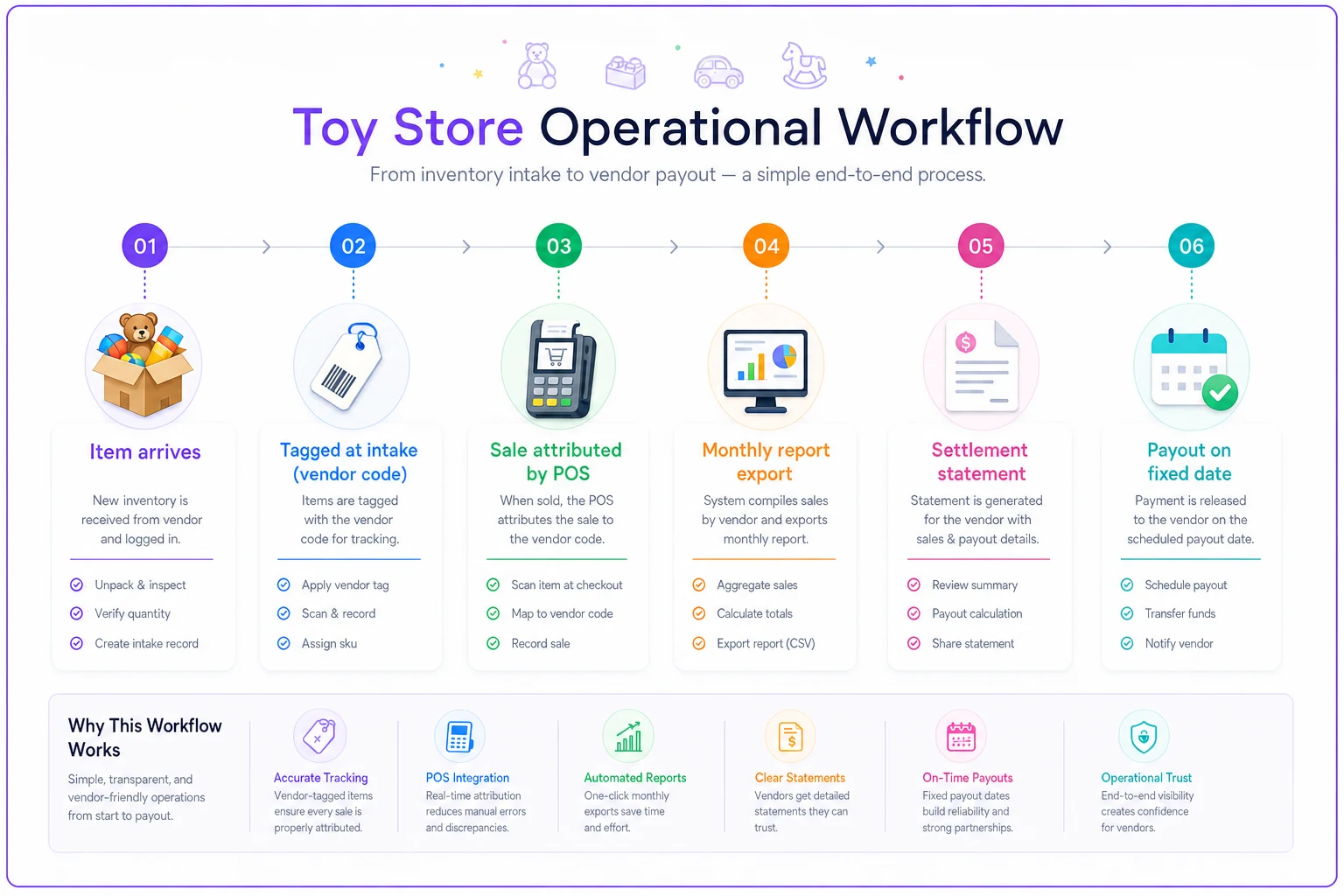
The whole point is that steps 3 and 4 shouldn't involve counting shelves. If your point-of-sale can't spit out sales by vendor tag, that's the gap to close. This is exactly the kind of thing an AI-assisted operational platform handles in the background — attributing each sale, flagging any consignment line that hasn't moved in 60 days, and drafting the payout statement so you're reviewing numbers instead of assembling them. The decision stays yours; the assembly work disappears.
Use a short, consistent vendor code (e.g., three letters) to keep tags uniform and reconciliation trivial.
Getting payout timing right also protects your cash rhythm more broadly. Consignment payouts are just another outflow that needs to land on a predictable date — the profit-first cashflow playbook covers how to structure all of that.
A lightweight collaborative-forecasting cadence
Forecasting sounds like something that requires software you don't have and data you've never properly collected. For a tiny shop, it's actually a short, recurring conversation with your handful of core vendors — the ones supplying the products that drive most of your revenue.
The insight most owners miss: your best vendors want your demand signal. A rep who knows you'll likely reorder 40 units of a hot line in October can hold stock for you. A rep who hears from you only when you're already out of something can't help. Sharing a rough forecast isn't giving away leverage — it's buying priority.
-
Monthly (15 minutes, solo) Update your top-20 SKU sell-through and flag anything trending up or dying. This is your internal read.
-
Quarterly (one call or email per core vendor) Share a rough forward view — "expecting to reorder these lines, roughly these quantities, around these dates." Ask what they're seeing move across other accounts.
-
Pre-season (once, before Q4 and before spring) Lock tentative quantities and delivery windows with your top three or four vendors. This is where your delivery-window clause earns its keep.
You don't need a spreadsheet with formulas. A running note with SKU, last 90 days sold, and "likely next order" is enough. The value is in the rhythm, not the sophistication. Shops that do even a rough quarterly check-in with core vendors tend to see fewer stockouts on proven winners, because the vendor is planning around them instead of reacting to them.
When this makes sense — and when it doesn't
Collaborative forecasting is worth it with vendors supplying your reliable, repeat-selling lines. It's a waste of time with one-off novelty vendors or anything you're still testing. Don't forecast product you don't trust yet — cap your first order with a return allowance and let sell-through tell you what you need to know.
Who should NOT overbuild this
If you're doing under a few hundred thousand in revenue with a stable handful of vendors, don't build a governance apparatus. Three or four contract clauses, the consignment matrix, tagged POS, and a quarterly check-in is the whole system. Adding more structure than that just creates admin you'll abandon come December.
The retailers who should tighten this up are the ones feeling any of these: consignment creeping past a fifth of the floor, recurring reship disputes with no paper trail, cash stuck in vendor minimums that can't be justified, or Q4 stockouts on proven bestsellers. Those are governance failures wearing an inventory costume.
A real scenario
A two-person toy shop — owner plus one part-timer, roughly $310k in annual revenue — had drifted into eight consignment relationships over two years. Each felt harmless at signing. Together they occupied close to a third of the floor, including the front window, and monthly settlement was a recurring nightmare of manual counts and vendor disputes. Payouts sometimes took the better part of a week to reconcile.
They did three things. Ran every consignment line through the matrix and cut from eight vendors to four, freeing the window and two endcaps for owned, higher-margin product. Tagged all remaining consignment at intake with vendor codes. Moved every consignment vendor to a single monthly payout date with an auto-generated statement.
Over the next two quarters, the reclaimed prime space lifted owned-product sales on those fixtures, month-end reconciliation dropped from most of an afternoon to about twenty minutes, and the vendor disputes they'd been having quarterly stopped entirely because the numbers were no longer up for debate. Nothing dramatic — no revenue explosion — just a shop that stopped leaking time and floor space to relationships it had never properly governed.
The takeaway
Vendor governance for a tiny retailer isn't a legal project or a systems overhaul. It's a handful of clauses that cap your downside, a matrix that keeps consignment from quietly taking over your floor, a tagging and payout rhythm that ends the reconciliation guesswork, and a forecasting cadence short enough to actually run. Build those four things at a scale that fits two people, and your suppliers start working around your plans instead of you scrambling around theirs — which, at your size, is exactly the leverage you need.
Ready to elevate your toy store operations?
Join 500+ toy retailers using GoToyvio to increase sales, reduce stockouts, and enhance customer loyalty.