


The problem with long-lead collectibles isn't the wait. It's that the wait forces you to make big commitments with almost no information, and then live with those commitments for months while your cash sits inside a shipping container somewhere off the coast of California.
A limited-run resin figure from an overseas manufacturer might have a 20-week lead time. You place the order in February. It lands in July. By then the hype cycle you were betting on has either exploded — and you underordered — or quietly died, and you're stuck with 48 units at $34 landed cost. Either way, you guessed wrong months ago and there was nothing you could do about it in between.
Lead-time hedging for small retailers is really about refusing that all-or-nothing bet. Instead of one large order locked in early, you build a structure where you commit in stages, keep fallback options ready, and communicate honestly with customers so a delay doesn't cost you the sale.
This post walks through phased ordering, minimum viable allocations, substitute sourcing, and the exact customer messages that keep deposits from turning into refunds — broken out by lead-time tier so you can actually apply it.
First, sort your inventory by lead-time tier (not by category)
Most toy stores organize buying by vendor or product line. For hedging purposes, that's the wrong lens. What determines your risk is how long the money is tied up before you can react — so sort by lead-time tier instead.
Here's a workable breakdown:
| Tier | Lead time | Typical examples | Main risk | Hedging priority |
|---|---|---|---|---|
| Short | 1–3 weeks | Domestic distributor restocks, evergreen plush | Minor timing slips | Low — reorder normally |
| Medium | 4–8 weeks | Domestic exclusives, licensed board games | Missing a demand spike | Moderate — small buffer |
| Long | 9–16 weeks | Imported collectibles, kit models, Japanese figures | Cash locked + demand shift | High — phase orders |
| Very long | 17+ weeks | Made-to-order resin, small-batch imports, crowdfunded lines | Total guess, no recovery window | Critical — deposits + substitutes |
The insight most owners miss: the danger isn't the long lead time by itself — it's the combination of long lead time and high per-unit cost. A $6 sticker sheet with a 14-week lead time is annoying but cheap to be wrong about. A $40 landed collectible with the same lead time can eat your open-to-buy for the whole quarter if it sits.
So before anything else, take your top 30 SKUs by dollar commitment and tag each with a tier. You'll usually find that a handful of very-long-lead items represent a disproportionate share of your locked cash. Those are the ones worth the extra work below.
Phased orders: stop betting the whole quantity up front
A phased order splits one large commitment into scheduled tranches so you're never fully exposed to a guess.
Never run out of bestsellers again.
GoToyvio helps you monitor inventory and sales to keep your shelves stocked and customers happy.
- Real-time stock tracking
- Automated reorder alerts
- Sales and promotion analytics
No credit card required
The common version looks like this: instead of ordering 60 units at once, you commit to 24 now, with pre-negotiated options to pull an additional 18 at week 6 and another 18 at week 10 — each triggered by real signals like preorders, waitlist size, or early sell-through on a related SKU.
-
Old way
order 50 units. Total commit ~$1,400. If half sit, you've got $700 frozen for months and a markdown looming.
-
Phased way
firm order 20 units ($560). Negotiate two follow-on options of 15 each at weeks 5 and 9. You trigger tranche two only if preorders plus waitlist hit 12. You trigger tranche three only if tranche-one sell-through hits 60% before it even lands.
Why this works: the first tranche covers your floor demand — the quantity you're confident you'll move no matter what. The later tranches let you buy into confirmed demand instead of predicted demand. You're trading a little unit-cost efficiency for a meaningful reduction in dead stock risk.
A worked example, long-lead tier:
-
Old way
order 50 units. Total commit ~$1,400. If half sit, you've got $700 frozen for months and a markdown looming.
-
Phased way
firm order 20 units ($560). Negotiate two follow-on options of 15 each at weeks 5 and 9. You trigger tranche two only if preorders plus waitlist hit 12. You trigger tranche three only if tranche-one sell-through hits 60% before it even lands.
You might pay $29.50 instead of $28 on the smaller batches. That extra $1.50 a unit is cheap insurance against sitting on $700 of frozen stock. The vendors worth keeping are the ones who'll structure this with you — which ties directly into how you write your ordering terms in the first place.
When phasing actually makes sense
-
The item is high per-unit cost and long lead
-
The vendor has some production flexibility mid-run
-
Demand is genuinely uncertain (new IP, unproven artist, first import from a maker)
When phasing is a bad idea
-
Truly one-shot production runs where later tranches simply don't exist — here you either commit or pass
-
Very short lead items where you can just reorder normally
-
Items where the smaller-batch price penalty is steep enough to wipe out your margin
Don't force phasing onto a strictly limited run. If the maker produces 300 units globally and then never again, phasing is a fantasy. That's a straight yes/no allocation decision, and it belongs in the minimum viable allocation logic below.
Minimum viable allocations: the smallest bet that keeps you in the game
For very-long-lead or one-shot items where you can't phase, the question isn't "how many do I want" — it's "what's the smallest quantity that keeps this worth doing at all."
A minimum viable allocation (MVA) is the floor order that:
-
Covers your known committed demand (confirmed preorders plus reservations)
-
Leaves a thin cushion for walk-in interest
-
Doesn't push a single SKU past your per-item cash cap
The mistake that shows up constantly: owners order to fill the shelf rather than to cover demand. A display looks sad with 4 units, so they order 20 to make it look abundant. Four months later, 14 are still there. The shelf-aesthetic instinct is real, but on long-lead collectibles it's expensive vanity.
A simple way to set the floor:
-
Count confirmed demand — preorders, deposits, waitlist entries that have actually converted before.
-
Add a walk-in cushion, usually 20–40% of confirmed demand for a hyped item, less for a niche one.
-
Check the total dollar commitment against your per-SKU cap. Many small stores use something like "no single long-lead SKU exceeds 8–10% of open-to-buy."
-
If confirmed demand alone blows past your cap, that's a signal to raise deposits, not to eat the risk yourself.
That last point matters. If demand is so strong it exceeds what you can safely finance, the answer is to shift more of the commitment onto customers through deposits and reservations rather than absorbing all the exposure. A solid preorder and reservation SOP is what makes MVA math trustworthy — because your "confirmed demand" number is only as good as your preorder discipline.
Substitute sourcing: your fallback before you need it
Substitute sourcing means lining up alternate ways to fill demand before the primary order is late or shorted. Most stores only start hunting for substitutes after the delay email arrives — which is exactly when everyone else in your niche is doing the same thing and stock is gone.
Three practical substitute types worth mapping in advance:
-
Direct equivalent — a comparable item from a different maker or a domestic distributor who stocks something close. Higher cost, faster availability.
-
Adjacent satisfaction — not the same product, but scratches the same itch. If the imported mecha kit is stuck, a domestically-stocked kit at a similar price and difficulty level can hold the customer.
-
Upgrade/downgrade path — a pricier deluxe version or a cheaper standard version of roughly the same thing, useful when you can offer the customer a real choice instead of a refund.
Map one direct equivalent and one adjacent option on the SKU record so you can offer substitutes immediately when a delay hits.
Substitutes aren't about matching the product exactly. They're about protecting the sale and the relationship. A customer who came in for a specific figure and left with a happy alternative is a far better outcome than a refund and a "we'll email you when it's back."
Build a substitute map for your top long-lead SKUs — one line each: primary item, best direct equivalent, adjacent option, and which domestic distributor could get it fast. You don't need a system for this; a note on the SKU record is enough. The point is to have decided before the pressure hits.
Customer-communication templates by lead-time tier
This is where most of the actual sales protection happens. Delays don't kill deposits — silence kills deposits. The customer who hears nothing for six weeks starts assuming the worst and asks for their money back. The customer who gets a short, honest update stays put.
Set expectations correctly at the point of sale, tiered by lead time.
Medium tier (4–8 weeks) — at checkout: > "Quick heads up — this one ships to us in about 4–8 weeks. We'll text you the moment it lands and hold it for you for 5 days. No payment needed until it's in."
Long tier (9–16 weeks) — at deposit: > "This is an imported item with roughly a 3–4 month lead time. We'll take a [amount] deposit to reserve your unit and send you an update at the halfway point and again when it clears customs. If the timeline slips, you'll hear from us — we won't leave you guessing."
Very-long tier (17+ weeks) — at deposit: > "Just so expectations are clear: this is a small-batch item and realistically 4–6 months out. We'll check in monthly even if there's no news, so you always know where things stand. If it gets delayed beyond [date], you can keep the reservation, switch to [substitute], or get a full refund — your call."
Notice the very-long template names the substitute and the refund option up front. Offering the exit early, counterintuitively, reduces refunds — because the customer feels in control rather than trapped.
Then the update cadence. The rule that keeps deposits alive:
-
Halfway update short, even if there's nothing new. "Still on track, on the water now."
-
Customs/arrival update "Cleared customs, expect it on our shelf in about 10 days."
-
Delay update (only when real) what happened, the new estimate, and the three options — wait, substitute, or refund.
A delay message that offers no options reads as bad news. The same delay message with a substitute and a refund choice reads as service. Same facts, completely different customer reaction.
A real scenario: the resin figure that almost ate a quarter
A single-location collectible-and-toy shop committed to an imported resin figure line — 40 units, $38 landed, $79 retail, quoted at 12 weeks. The 12 weeks became 22. Somewhere in the delay, a second maker released a similar figure that soaked up a chunk of local demand.
Before they changed their approach, that would have played out as: 40 units landing into softened demand, a wave of refund requests from customers who'd waited half a year with near-zero communication, and a slow markdown crawl to clear the shelf. Roughly $1,500 in frozen cash for most of the quarter.
What they did instead: they'd only firmed 18 units up front — an MVA covering 11 confirmed preorders plus a cushion — held two follow-on tranches they never triggered once the delay news broke, and had a domestic adjacent figure already mapped as a substitute. When the 10-week slip hit, they sent the delay template with three options. About a third of deposit holders took the substitute, most of the rest waited, and only a couple refunded. The 18 units cleared without a markdown, and the cash exposure never went past roughly $680.
Nothing about that outcome was luck. The delay was the same either way. The difference was that the commitment was smaller, the fallback existed, and the customers were spoken to like adults.
Keeping the whole thing organized without drowning in spreadsheets
The mechanics above aren't hard individually. The hard part is remembering to send the halfway update on a 16-week order placed in a busy month, knowing which SKUs still have untriggered tranches, and tracking which deposit holders were offered a substitute. That's where things quietly fall apart in a small store — not in the strategy, in the follow-through.
This is one area where operational software earns its keep: tagging SKUs by lead-time tier, flagging when a tranche decision date arrives, and triggering halfway and arrival messages automatically instead of relying on someone to remember.
A simple workflow to automate tranche triggers and customer updates:
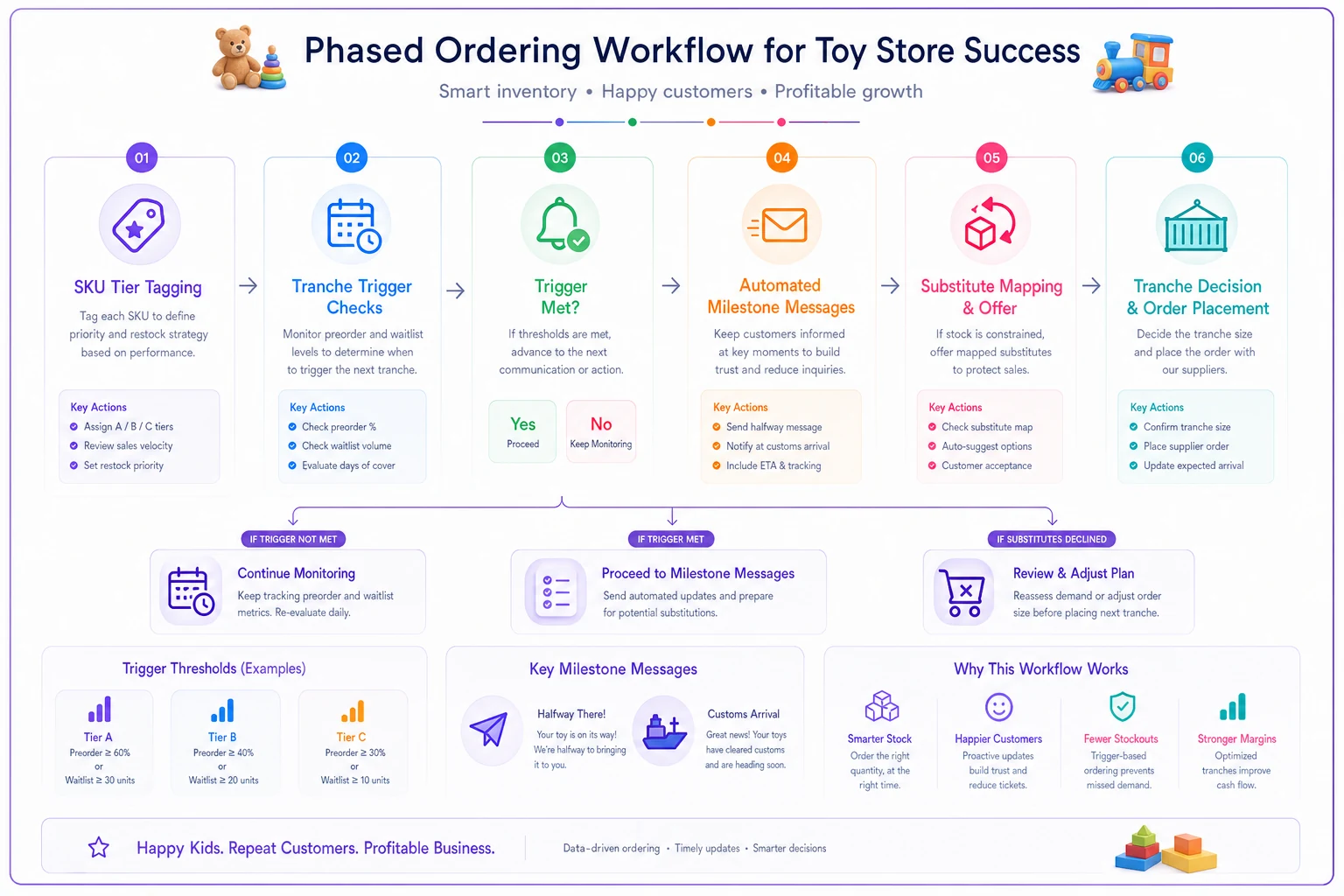
Platforms with AI-assisted scheduling can watch preorder counts against your tranche triggers and nudge you when it's decision time, so the phased-order logic actually runs on schedule rather than living in your head. But the framework matters far more than the tool — you can run all of this on a shared sheet and a calendar if you're disciplined about it.
For the seasonal side of this — timing your long-lead commitments against your peak windows so the money isn't locked up at the worst possible moment — it's worth pairing this approach with a proper seasonal inventory system. Lead-time hedging and seasonal planning are two halves of the same cash-protection problem.
The one thing to change first
If you take nothing else from this: stop placing your long-lead collectible orders as single all-in commitments. Split the top few by tier, set a minimum viable allocation for the one-shot items, map one substitute each, and write your deposit language so a delay comes with options instead of an apology.
The wait isn't going away. Import timelines will keep slipping, hype cycles will keep moving faster than shipping does, and you'll keep having to commit cash months before you know if the bet pays off. Hedging doesn't remove that uncertainty — it just makes sure that when you're wrong, you're wrong on 18 units instead of 40, and your customers stay with you either way.
If you take nothing else from this: stop placing your long-lead collectible orders as single all-in commitments. Split the top few by tier, set a minimum viable allocation for the one-shot items, map one substitute each, and write your deposit language so a delay comes with options instead of an apology.
The wait isn't going away. Import timelines will keep slipping, hype cycles will keep moving faster than shipping does, and you'll keep having to commit cash months before you know if the bet pays off. Hedging doesn't remove that uncertainty — it just makes sure that when you're wrong, you're wrong on 18 units instead of 40, and your customers stay with you either way.
Ready to elevate your toy store operations?
Join 500+ toy retailers using GoToyvio to increase sales, reduce stockouts, and enhance customer loyalty.