

Most small toy stores don't have a data problem. They have a disagreement problem. Your POS says you have 4 of a plush dragon in stock. Your Shopify store says 7. The spreadsheet you use for reorders says 2, because you last updated it three weeks ago after a slow Tuesday. Nobody is lying. Every system is just telling a slightly different version of the truth, and the gap between those versions is where oversells, dead stock, and pricing mistakes quietly live.
That's the whole reason to build a single source of truth (SSOT). When people hear "small retailer tech stack POS SSOT," they picture some enterprise integration nightmare. It's not. For a two-person shop, an SSOT is really just one decision: which system is allowed to be right, and then a set of habits that keep everything else obeying it.
This post is about how that system holds together — and where it breaks — for stores run by one or two people who don't have time to babysit software.
Why the POS should win (almost every time)
There's a running argument in small retail about whether your inventory truth should live in the POS, the ecommerce platform, or a separate inventory app. For a physical-first toy store, the POS wins, and it's not close.
The POS is where the most high-frequency, high-consequence events happen. Every sale, return, and exchange flows through it in real time, in person, with cash or card attached. That volume and immediacy make it the natural authority. Your online store updates in bursts and often lags. A spreadsheet updates whenever a human remembers.
Here's the pattern that trips people up: they let the newest or shiniest system become the default truth. A store gets excited about a slick ecommerce platform, starts treating it as master, then wonders why their in-store counts feel haunted. In practice, the system with the highest transaction frequency should almost always be the master — it's the one that drifts fastest when it's not in charge.
So the first rule is simple and a little boring: the POS holds the true quantity, the true cost, and the canonical SKU. Everything else is a copy.
The exceptions are narrow. If you do serious volume online — more than half your units ship rather than sell over the counter — you might flip the logic. But for the typical independent toy shop, POS-first is the default that causes the fewest headaches.
The real enemy: SKU drift
Picking a master system is the easy part. The thing that actually destroys SSOT projects is messy SKUs.
Never run out of bestsellers again.
GoToyvio helps you monitor inventory and sales to keep your shelves stocked and customers happy.
- Real-time stock tracking
- Automated reorder alerts
- Sales and promotion analytics
No credit card required
Toy inventory is unusually cruel here. You've got the same character across a dozen formats (plush, figure, playset, keychain), the same item under different distributor codes, licensed products where the license matters more than the manufacturer, and age-gated items where a 3+ vs 8+ label changes how you merchandise and who you can sell it to. When your SKUs don't encode any of that, your data can't answer basic questions like "how are our 8+ building sets doing" without a manual dig.
A typical example: a store enters the same LEGO-style set twice — once from the vendor invoice as "Bldg Set Space 1040pc" and once by hand at the register as "Space Blocks Big." Now two SKUs split the sales history of one product. Reorder logic sees two slow movers instead of one solid one. That single split, repeated across a season, is enough to make your entire velocity report untrustworthy.
A SKU-mapping template that actually holds up
You don't need a fancy taxonomy. You need a consistent one. Here's a lightweight structure that works for most toy shops:
| Segment | Purpose | Example values |
|---|---|---|
| Category | Broad shelf grouping | PLU (plush), BLD (building), GME (games), ART (arts/crafts) |
| Age tag | Merchandising + compliance | 0-2, 3-5, 6-8, 8P (8 plus), 12P |
| License | Licensed vs generic | POKE, DISN, MARV, GEN (generic) |
| Vendor short | Reorder + sourcing | melis (Melissa), ravn (Ravensburger) |
| Sequence | Uniqueness | 001, 002, 003 |
A finished SKU might read BLD-8P-GEN-lego-014. Ugly? A little. But now you can filter your whole catalog by age band or license in seconds, and you'll never accidentally create a duplicate because the naming rules force a decision before the item exists.
The age and license tags do double duty. They power merchandising decisions and quietly support compliance work — knowing exactly which SKUs fall under which age range matters when you're dealing with recalls or import documentation, and it's a lot easier when that data is baked into the SKU instead of buried in a note field.
One rule that saves more grief than any other: only one person creates new SKUs. In a two-person shop, one owner "owns" the SKU rules. The other requests new items rather than inventing them. It sounds rigid, but split SKU authority is the single most reliable way to reproduce the drift you're trying to kill.
How the pieces connect (the workflow, not the software)
Once the POS is master and your SKUs are clean, the SSOT is really just a flow of information outward. Picture it as a hub and spokes.
The POS sits in the center holding truth. From there, quantity and price push out to your online store, your printed shelf labels, and your reporting. Nothing pushes back into the POS except two things: physical events (sales, receiving, counts) and deliberate corrections during reconciliation. That's it.
The failure mode is when spokes start editing themselves independently. Someone changes a price directly in Shopify for a weekend sale, forgets to change it back, and now the online price and the register price disagree. A customer notices. That tiny inconsistency erodes trust faster than a stockout does, because it looks like you either don't know your own prices or you're playing games.
This is also where your fulfillment coordination lives or dies. If you sell across online, in-store, and pickup, every channel has to read from the same quantity or you'll oversell. We've written before about how small toy stores can stop fulfillment chaos across online, in-store and pickup — and honestly, most of that chaos traces straight back to a missing SSOT. When channels share one source of truth, "do we actually have this" stops being a question you answer by walking to the shelf.
Here's a visual of the workflow.
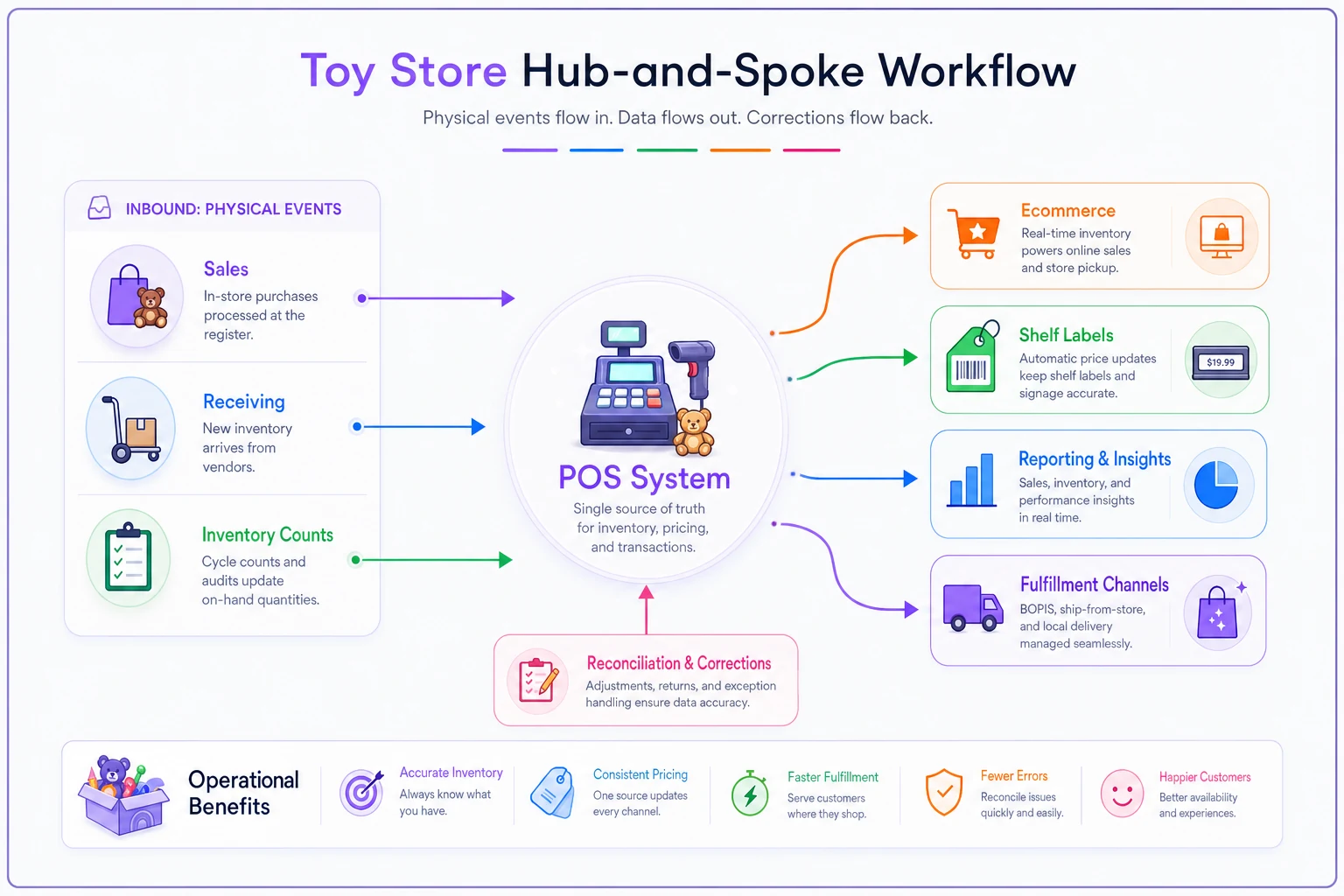
The diagram emphasizes that edits should originate in the POS and that other systems are read-only copies.
Sync cadence: how often is often enough?
New store owners assume real-time sync is the goal. Sometimes it is. Often it's overkill that introduces its own problems — real-time sync also means real-time error propagation, where one bad count instantly infects every channel.
-
Real-time online stock decrements on sale (this one's worth automating so you don't oversell hot items)
-
Hourly online quantities re-pull from POS to catch in-store sales
-
Daily price and new-SKU sync, run before opening
-
Weekly a light reconciliation pass (more on this below)
-
Seasonal full catalog audit before your two big rushes — back-to-school and holiday
The insight most people miss: cadence should match how fast each data type changes and how much damage being wrong causes. Quantity on a hot preorder item changes fast and hurts a lot when wrong, so it earns real-time treatment. A category tag basically never changes, so syncing it hourly is wasted effort. Tier your sync by consequence, not by what the software technically allows.
The lightweight reconciliation loop
Reconciliation is where SSOT stops being theory. For a tiny team, the trap is treating it like a giant annual inventory event that everyone dreads and therefore delays. Small, frequent checks beat big, rare ones every time.
-
Pull the top-20 movers from the week's sales. These are your highest-risk SKUs for drift because they turn fastest.
-
Physically count just those 20. Not the whole store — just the fast movers.
-
Compare to POS on-hand. Flag any SKU where the count differs by more than a unit or two.
-
Investigate flags, don't just fix them. A discrepancy on the same SKU three weeks running usually means a process problem — shrink, a receiving error, or two SKUs quietly splitting one product.
-
Correct in the POS only, then let the sync push the fix outward.
-
Log what you found in one line. Over a season, that log tells you exactly which parts of your operation leak.
That last step is what turns reconciliation from janitorial work into intelligence. The point isn't just to fix the number — it's to find why it was wrong so it stops happening.
For deciding what to watch and act on beyond counts, it helps to pair this with a tight reporting rhythm. The approach in our post on one-page reporting and governance for single-location toy stores fits neatly on top of a clean SSOT — clean data makes a one-page report actually trustworthy instead of a nice-looking guess.
A real scenario
A two-person shop doing roughly $30k–$38k a month, split about 70/30 between in-store and online, kept hitting the same wall: they'd oversell a popular collectible online because the site quantity lagged behind register sales. A few times a month a customer paid for something already gone, which meant an awkward refund email and a lost sale they couldn't recover during a hot release.
They didn't buy anything new. They made three changes. First, they declared the POS master and stopped editing quantities anywhere else. Second, they cleaned up their SKUs with an age and license tagging scheme, merging around 40 duplicate items that had been splitting sales history. Third, they set the online store to re-pull quantities hourly and decrement in real time on sale.
Within about two months the oversell emails basically stopped — down to maybe one edge case a month instead of a handful a week. The quieter win was reordering. With merged SKUs, their fast movers finally showed their real velocity, and a couple of items they'd assumed were "meh" turned out to be steady sellers they'd been under-ordering the whole time. No dramatic revenue explosion — just a shop that stopped fighting its own data.
When this is worth it — and when it isn't
When POS-first SSOT clearly makes sense:
-
You sell across more than one channel (even just in-store plus a website)
-
You've had oversells, pricing mismatches, or reorder mistakes you can't fully explain
-
Your catalog has grown past the point where you know every SKU by memory
When it's a bad idea to over-engineer it:
-
You're single-channel, in-store only, with a small catalog you can eyeball. A tidy SKU scheme still helps, but real-time sync is solving a problem you don't have.
-
You're mid-season during your busiest weeks. Don't rebuild your SKU taxonomy in December. Do the cleanup in your slow months.
Who should not chase full real-time everything: shops still doing counts on paper with no reliable POS. Fix the foundation first — you can't sync outward from a source you can't trust.
The part nobody tells you
An SSOT isn't a one-time setup. It's a small discipline you renew every week. The stores that keep it alive treat it like brushing teeth — quick, boring, non-negotiable. The stores that let it slide always start with good intentions and a beautiful spreadsheet, then drift back into three-versions-of-the-truth by the next holiday season.
The good news is that the discipline is genuinely small once the structure is right. One person owns SKUs. The POS holds truth. Sync flows outward on a schedule matched to consequence. A 20-minute weekly count catches drift before it compounds. That's the entire system, and for a one- or two-person shop, it's more than enough to make your data something you actually trust when it's time to reorder, price, or promise a customer that yes, the thing they want is really on the shelf.
Ready to elevate your toy store operations?
Join 500+ toy retailers using GoToyvio to increase sales, reduce stockouts, and enhance customer loyalty.