

Rentals look great on a spreadsheet. Buy a $180 wooden marble run, rent it out at $22 a week, and after nine or ten turns you've covered the cost — everything after is margin. The problem is that spreadsheet doesn't account for the mom who returns it missing three marbles, the toddler who chewed a corner off, or the parent calling two weeks later swearing your ride-on car gave their kid a rash.
That's the real reason most independent toy stores never try rentals. Not the money. The mess. So this is a practical toy rental pilot SOP built specifically for a small shop running a tight team — not a warehouse-scale rental company with a legal department. The goal is a 60-to-90-day test with maybe 15–25 items, enough to learn whether the demand and margins are real, without exposing yourself to problems you can't afford.
Start with item selection, because the wrong items kill the pilot before it starts
Most people who try rentals grab whatever's expensive or slow-moving, assuming that's the smart play. It's usually the opposite. Expensive items carry more replacement risk, and slow-movers are slow for a reason.
For a pilot, you want items that are:
-
Big enough that families won't just buy them — play kitchens, indoor climbers, ride-ons, large building sets, sensory tables
-
Durable with few loose parts, or parts that are countable in under 30 seconds
-
Easy to wipe down or wash — hard plastic and coated wood beat fabric and foam every time
-
Seasonal or milestone-based, so families have a natural reason to rent rather than buy (a Halloween costume trunk, a party bounce set, a walker for the 9–12 month stage)
The items that rent best tend to be the ones parents feel a bit guilty buying because the kid will outgrow them in four months. That guilt is your entire business case. Nobody rents a $12 toy. They rent the $140 thing they already know is temporary.
A simple scoring approach: rate each candidate 1–5 on four factors and only pilot items scoring 14 or higher.
| Factor | 1 (bad rental) | 5 (great rental) |
|---|---|---|
| Replacement cost | Under $30, just sell it | $100+, families won't buy |
| Part complexity | 40 tiny pieces | 1–3 large pieces |
| Cleanability | Fabric, foam, plush | Hard plastic, sealed wood |
| Outgrow speed | Kid uses for years | Outgrown in 3–6 months |
Skip anything plush or fabric-heavy for the first pilot. You can't reliably sanitize a stuffed animal between renters, and explaining that to a nervous parent is a conversation nobody wins.
Deposits and wear-fees: build them so you never chase money
The financial protection for a rental pilot lives almost entirely in the deposit structure. Get this right and a lost marble becomes a $4 line item instead of a counter argument.
Never run out of bestsellers again.
GoToyvio helps you monitor inventory and sales to keep your shelves stocked and customers happy.
- Real-time stock tracking
- Automated reorder alerts
- Sales and promotion analytics
No credit card required
A typical setup for a mid-priced item (say, $120 replacement value):
-
Rental fee $18–$24 per week
-
Refundable deposit $40–$60, held on the card, not charged
-
Missing small part $3–$6 each, capped
-
Missing major component deducted from deposit at listed value
-
Late return one extra rental period auto-charged after a 2-day grace
What most shops miss: put the wear-fee numbers on paper at checkout, printed on the rental agreement the customer signs. When the fee is pre-agreed and visible, you almost never get pushback. When you invent the number after the item comes back damaged, you get a fight — and probably a bad review.
Print the wear-fee numbers on the rental agreement at checkout so customers agree upfront.
Authorize the deposit as a hold rather than a charge whenever your payment processor allows it. A hold that quietly drops off in 7–10 days feels very different to a customer than a $50 charge they have to wait to get refunded. That difference alone reduces friction complaints noticeably.
The check-in / check-out process is where you actually prevent disputes
Nearly every rental disagreement traces back to nobody documenting the item's condition at handoff. The parent says the wheel was already cracked. You say it wasn't. Neither of you has proof, so you eat it.
A two-photo rule and a piece-count card fixes this. Takes about 90 seconds and ends roughly 90% of arguments.
Check-out workflow:
-
Pull the item's laminated piece-count card — a simple card listing every countable part.
-
Count parts together with the customer, out loud. Both of you confirm.
-
Take two quick photos on the store phone — one wide shot, one of any existing wear.
-
Attach photos to the rental record and note the piece count.
-
Customer signs the rental agreement and waiver at the counter.
-
Set the return date in the system.
Check-in is the same in reverse: recount against the card, compare to the check-out photos, then release the deposit hold. If a part is missing, you point at the card they already agreed to, apply the published fee, and move on. No debate, because they signed the count.
The recount step is the one people skip when the shop gets busy. Don't. An item that returns "complete" but is actually missing a piece — discovered three renters later — becomes impossible to assign to anyone. Count every single time.
Cleaning between renters: keep it visible and boring
Cleaning is a liability point and a marketing point. Parents care about this more than most shop owners expect, so don't hide it — make it a small, visible part of the process.
A tiered cleaning protocol works well for a pilot:
-
Hard surfaces (plastic, coated wood) wipe with a food-safe sanitizing solution, air dry, then a second wipe. Most items done in under five minutes.
-
Items with fabric or straps machine wash removable parts on a hot cycle. If it can't be washed, it probably shouldn't be in the pilot.
-
Battery and electronic components surface-wipe only, never submerge, and check batteries while you're at it.
Log the cleaning. A simple "cleaned by / date" sticker on the piece-count card does two things: it proves the item was sanitized if anyone ever asks, and it signals to the next family that you take it seriously. Some shops tag the item "sanitized — ready to rent," which turns a chore into a trust signal at the counter.
Keep the same operational discipline you'd apply to running weekend demos — the rigor from a solid weekend event operations checklist translates almost directly to rental turnaround: assigned owner, checklist, no step skipped when it's busy.
Liability waivers built for an independent, not a law firm
You need a waiver, but you don't need six pages of legalese that scares parents at the register. For a small pilot, a one-page rental agreement that doubles as the waiver covers the essentials. Have a local attorney review your final version — worth an hour of their time — but the structure you're aiming for includes:
-
Assumption of risk language
the customer agrees the item is used under their supervision and they're responsible for age-appropriate use.
-
Condition acknowledgment they confirm the item was received in good working condition (this is why the check-out photos matter).
-
Responsibility for loss and damage tied directly to your published deposit and wear-fee schedule.
-
Return terms and late fees.
-
Age and safety note customer confirms the item suits their child's age and they've reviewed any recall or safety information.
Keep the signed agreement attached to the digital rental record, not in a paper drawer — you want to find it in ten seconds when someone disputes a charge. And don't rent anything with an open safety recall; check that quickly before adding each item to the pilot. A recalled rental item is the one liability a waiver won't fully protect you from.
POS flows: the part that quietly breaks everything
This is where most rental pilots fall apart operationally. Standard retail POS software assumes an item sells once and leaves. A rental item leaves, comes back, gets cleaned, and goes out again — and your inventory count has to reflect all of that without polluting your regular sales reporting.
If you dump rental items into your normal inventory, two bad things happen. Your on-hand counts go wrong (the system thinks you have three marble runs when two are out on loan), and your sales reports get cluttered with deposit holds that look like revenue but aren't.
-
Available — on shelf, cleaned, ready
-
Out — with a customer, return date attached
-
Returned — needs cleaning — back but not yet sanitized
-
Available again once cleaned and logged
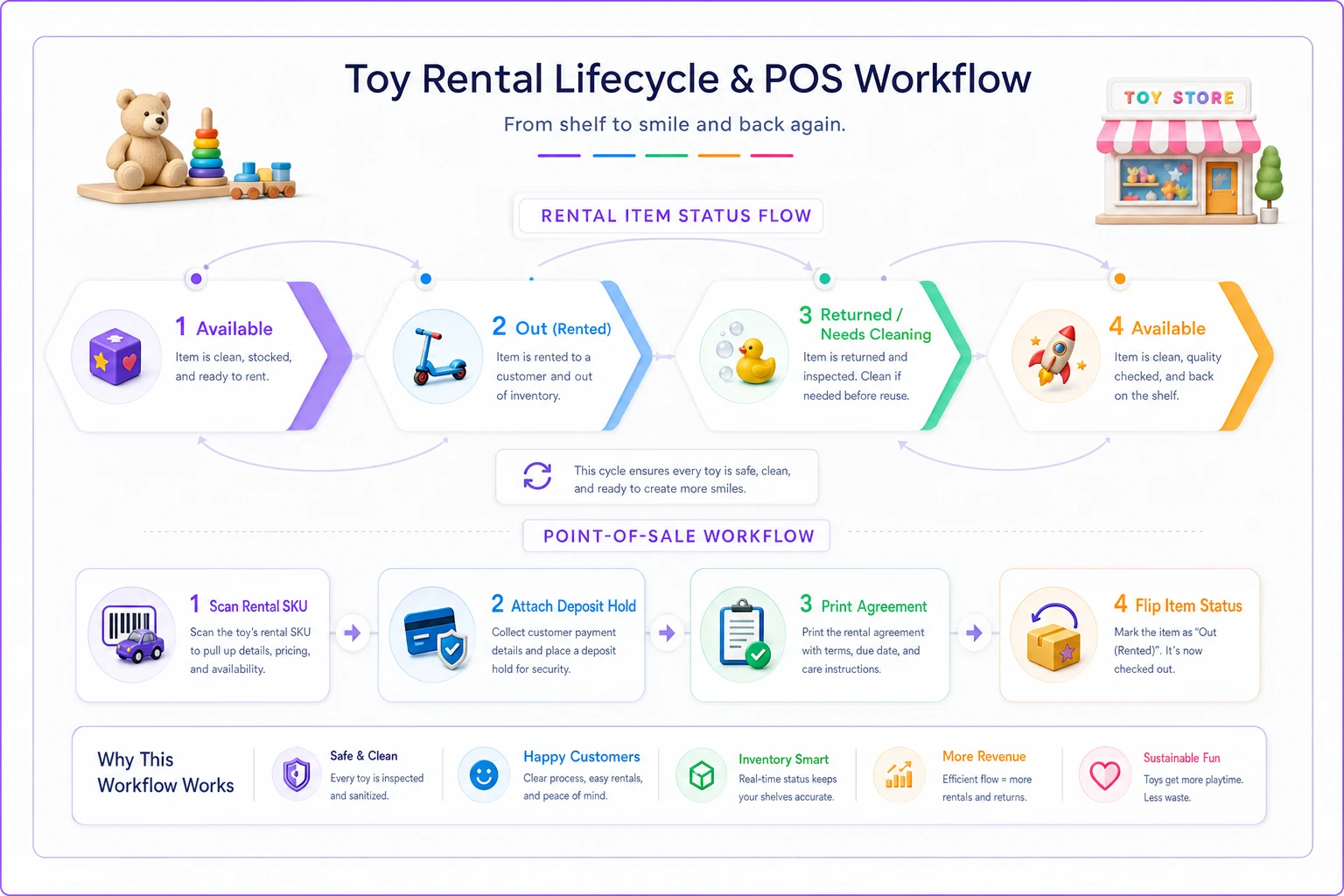
At the register: staff scans the rental SKU, the system flips it to "Out," attaches the deposit hold and return date, prints the agreement, and logs the piece count. On return, staff scans it back in, status flips to "Returned — needs cleaning," and the deposit hold releases only after the recount clears. That single status field stops you from accidentally renting out an item that's sitting dirty in the back or still with another family.
This is also where operational software with AI-assisted status tracking earns its keep — automatically flipping item states, firing a return reminder text two days before the due date, and flagging anything that's been stuck in "needs cleaning" too long so nothing quietly disappears from your rentable pool. You can honestly run a 20-item pilot on a spreadsheet and a shared calendar, but past 30–40 items the manual tracking becomes the actual bottleneck. Automating the reminders and status flips is what keeps a one- or two-person team from drowning in it.
Return handling: the small decisions that protect margin
Returns are where the money leaks. Three situations come up constantly — decide your policy before you open the pilot, not in the moment.
Late returns. Auto-charge the next rental period after a short grace window. A rigid same-day late fee generates resentment, while a 48-hour grace followed by an automatic charge tends to feel fair and still protects your inventory availability.
Partial damage. Apply the published wear-fee. This is only painless if you did the piece count and photos at check-out. Without those, you're guessing — and guessing usually means eating the cost.
"It was already like that." Your check-out photos settle it. If you didn't take them, assume you'll lose the argument and refund. This is the single strongest reason to never skip the two-photo step.
Track rental losses as a real line item throughout the pilot — missing parts, damage write-offs, items retired early all count. If your loss rate on a category runs consistently over roughly 8–10% of rental revenue, that category probably shouldn't graduate past the pilot.
A real scenario: what a small pilot actually looks like
A neighborhood toy store — one owner, two part-timers — piloted rentals with 18 items: play kitchens, a couple of indoor climbers, ride-ons, and two large building sets.
Replacement value across the set was roughly $2,400.
Over about ten weeks they logged somewhere in the range of 60–70 rental transactions. Average rental sat around $20 for a one-to-two week period. Two items came back with missing parts (handled cleanly by the published wear-fee because the piece counts had been done), and one ride-on needed a wheel replacement that came out of a deposit. Total losses landed under $90 for the whole pilot.
The revenue wasn't life-changing — a few hundred dollars a month — but that wasn't really the point. The pilot proved two things: families would rent milestone items, and the check-out/check-in discipline held up under a busy Saturday. The owner expanded to around 35 items after, and the numbers only worked because the loss rate stayed low. Sloppy check-ins would have flipped the whole thing negative.
When a rental pilot makes sense — and when it doesn't
It makes sense when you have foot traffic that skews toward parents of babies and toddlers, some storage space for cleaning and staging, and staff disciplined enough to run the check-out steps every single time. It also makes sense if you're trying to build repeat visits — rentals pull the same families back in on a schedule, and that repeat cadence is one of the strongest levers a small shop has.
It's a bad idea when you're already stretched thin at the counter and can't add the 90-second check-out ritual, or when storage is too tight to stage cleaning properly. It's also a poor fit if your assortment skews toward small, low-cost items — there's no rental case for a $15 toy.
Who should probably not do this yet: shops still fighting basic inventory accuracy or cashflow problems. Rentals add operational complexity, and if your core numbers aren't clean, this will just add noise. Get the fundamentals stable first — the discipline in a profit-first cashflow playbook matters more than a rental experiment when cash is tight.
Running the pilot without the headache
The reason rentals scare independent owners isn't the concept — it's the fear of disputes, missing parts, and liability they can't absorb. Every one of those fears is a process gap, not an inevitability. Countable piece cards, two check-out photos, a published wear-fee schedule the customer signs, a real deposit hold, and clear item status states in your POS handle nearly all of it.
Keep the first pilot small, boring, and disciplined. Pick 15–25 durable milestone items, run it for a couple of months, track your loss rate honestly, and let the numbers tell you whether to expand. The shops that succeed with rentals aren't the ones with the fanciest system — they're the ones that count the pieces every single time.
The reason rentals scare independent owners isn't the concept — it's the fear of disputes, missing parts, and liability they can't absorb. Every one of those fears is a process gap, not an inevitability. Countable piece cards, two check-out photos, a published wear-fee schedule the customer signs, a real deposit hold, and clear item status states in your POS handle nearly all of it.
Keep the first pilot small, boring, and disciplined. Pick 15–25 durable milestone items, run it for a couple of months, track your loss rate honestly, and let the numbers tell you whether to expand. The shops that succeed with rentals aren't the ones with the fanciest system — they're the ones that count the pieces every single time.
Ready to elevate your toy store operations?
Join 500+ toy retailers using GoToyvio to increase sales, reduce stockouts, and enhance customer loyalty.