



Most independent toy stores don't have a cash problem. They have a timing problem. The money is coming — it's just arriving three weeks after the invoice is due. You sold through the LEGO sets, the wooden train stuff moved well, the restock already cleared, and somehow you're still staring at a $14k supplier payment due Friday with $9k in the account.
That gap is where supplier payment optimization in retail actually lives. Not in squeezing another two points off cost, but in controlling when money leaves your account relative to when it comes in. Done right, you can fund an entire Q4 inventory build without a line of credit. Done wrong, you're paying 2/10 net 30 discounts you can't afford to skip while simultaneously running out of cash to pay rent.
This post is narrow on purpose. It's about payment timing, the scripts to negotiate it, and the worked math to decide whether a discount or a delay is the right call for your store.
Why timing beats price for most independents
Bigger retailers figured this out a long time ago — your supplier's biggest fear isn't giving you a discount. It's not getting paid at all, or getting paid so late they have to chase you.
When you ask for net 60 instead of net 30, you're not asking for a favor. You're offering predictability — a firm commitment on a date — in exchange for more time. Reps can work with that. What they can't work with is a store that pays whenever cash shows up and goes quiet when it doesn't.
The stores that get the best terms aren't always the biggest accounts. They're the ones who've never missed a committed date. That reliability is real leverage, and most owners underestimate it. A supplier who trusts your payment will extend terms a flakier — but larger — buyer never gets.
So before any of the math below matters, understand what you're actually trading: certainty for time. If you can't be certain, don't ask for the time — you'll burn the relationship.
The core trade-off: discount vs. runway
Every payment decision comes down to one question. Is the early-payment discount worth more than the cash you free up by paying later?
Never run out of bestsellers again.
GoToyvio helps you monitor inventory and sales to keep your shelves stocked and customers happy.
- Real-time stock tracking
- Automated reorder alerts
- Sales and promotion analytics
No credit card required
Most owners answer this emotionally. "A discount is free money, always take it." That's wrong often enough to cost real cash. Run it properly instead.
Say a supplier offers 2/10 net 30 — 2% off if you pay within 10 days, otherwise full price at 30 days. On a $12,000 invoice, the discount saves you $240.
But to grab that $240, you're paying 20 days early. You're giving up 20 days of using $11,760. The annualized cost of skipping that discount works out to roughly 37% — which sounds insane, and is exactly why the "always take the 2/10" advice exists.
What that advice ignores: it only holds if you have the $11,760 sitting idle. If taking the discount means you can't restock a fast-moving SKU, or you dip into your rent buffer, the real cost isn't 37% — it's the margin you lose on inventory you couldn't buy, plus the stress of running thin.
| Scenario | Take 2/10 discount | Pay full at net 30 |
|---|---|---|
| Cash on hand | Comfortable | Tight |
| $240 savings | Captured | Lost |
| 20 days of cash use | Gone | Retained |
| Restock ability | Reduced | Preserved |
| Right call when… | You have slack | You're funding growth |
The table isn't telling you to skip discounts. It's saying the discount is only "free money" when the cash would otherwise sit still. For a store building toward Q4, that cash almost never sits still.
Staged payments: the 30/60/90 structure
For larger orders — your big holiday buy, a new brand launch, a bulk collectible drop — staging payments across milestones is where you win real breathing room. Instead of one lump due on net 30, you split it.
A typical 30/60/90 structure on a $30,000 order looks like this:
-
30% ($9,000) due on invoice or ship date
-
40% ($12,000) due 60 days out
-
30% ($9,000) due 90 days out
Why this works for a toy store specifically: your big orders land in September and October, but the cash to pay for them doesn't fully materialize until the November–December sell-through. Staging payments lets the merchandise start paying for itself before the final installment hits.
The deposit — that first 30% — matters more than most owners realize. Offering a real deposit upfront is often what unlocks the back-loaded terms. The supplier gets skin in the game immediately, their risk drops, and they're comfortable waiting on the rest.
Offering a real deposit upfront is often what unlocks the back-loaded terms.
When 30/60/90 actually makes sense
-
Order size is large relative to your monthly cash flow (roughly 1.5x a normal month or more)
-
The inventory sells through within the payment window, not after it
-
You have a reliable sell-through history for the category
-
The supplier is established enough to carry the terms without getting nervous
When it's a bad idea
-
The product is slow-moving or unproven — you don't want staged payments on dead stock
-
You're using staging to avoid admitting you can't actually afford the order
-
The supplier is tiny and depends on fast payment to operate (you'll damage them and the relationship)
If you're ordering collectibles or imports where lead times are long and unpredictable, staged payments pair naturally with the phased-order approach covered in lead-time hedging for collectibles and imports. Same core idea — split your commitment so a single miss doesn't blow up your cash position.
Negotiation scripts that actually work
Most owners don't get better terms because they never ask, or they ask apologetically. Reps hear confident term requests regularly. Yours shouldn't sound like a plea.
Opening the conversation (new terms on an existing account):
> "We've been ordering consistently and I've never missed a payment. For the holiday build I'm planning a larger order than usual. Before I commit, I want to talk terms — I'm looking at net 60 on this one, and I can commit to firm dates. What can you do?"
Notice what that does. It leads with your track record, frames the bigger order as the reason, and offers firmness in return. You're giving them a reason to say yes.
Asking for staged payments on a big order:
> "This is a $28k order, which is a lot for us to carry on net 30. I'd like to structure it 30/60/90 — I'll put 30% down on ship, then two more payments. That gets you a deposit now and locks in the full order. Does that work on your end?"
Pushing back on a discount you can't afford to take:
> "The 2% early-pay is generous, but honestly the net 30 window works better for our cash cycle right now. I'd rather pay on time at full terms than rush it. Can we leave the standard terms in place?"
That last one matters. You don't have to take a discount just because it's offered. Declining it gracefully keeps your cash and signals you're thinking like an operator, not scrambling.
When you're going to be a few days late (do this before the due date):
> "Heads up — our December payment is going to land about five days late because of the holiday banking schedule. It'll be in your account by the [date]. Wanted you to know ahead of time rather than have it surprise you."
A proactive heads-up turns a missed date into a managed one. That's the difference between protecting your terms and losing them.
The real scenario: a two-location toy shop
A small toy retailer running two locations was placing a combined fall order of roughly $34k across three main suppliers. Historically they paid everything net 30, which meant a brutal stretch in early November — invoices due before the holiday rush had fully kicked in. Most years they covered it with a short draw on their line of credit, eating the interest and the mental overhead of cutting it close.
Before the next season, they did two things. First, they renegotiated their largest supplier (about $19k of the order) from net 30 to a 30/60/90 structure with 30% down. Second, they stopped auto-taking a 2/10 discount from a secondary vendor — grabbing it was forcing them to pay nearly three weeks early on cash they needed for the floor.
The result wasn't dramatic on paper. They gave up maybe $300–$400 in discounts over the season. But they skipped the line-of-credit draw entirely, avoided the interest, and never dipped below their cash floor. The owner said it was the first holiday in years they weren't checking the bank balance every morning. Roughly $300 in "lost" discounts bought a calmer quarter and no borrowing cost. That trade is worth making.
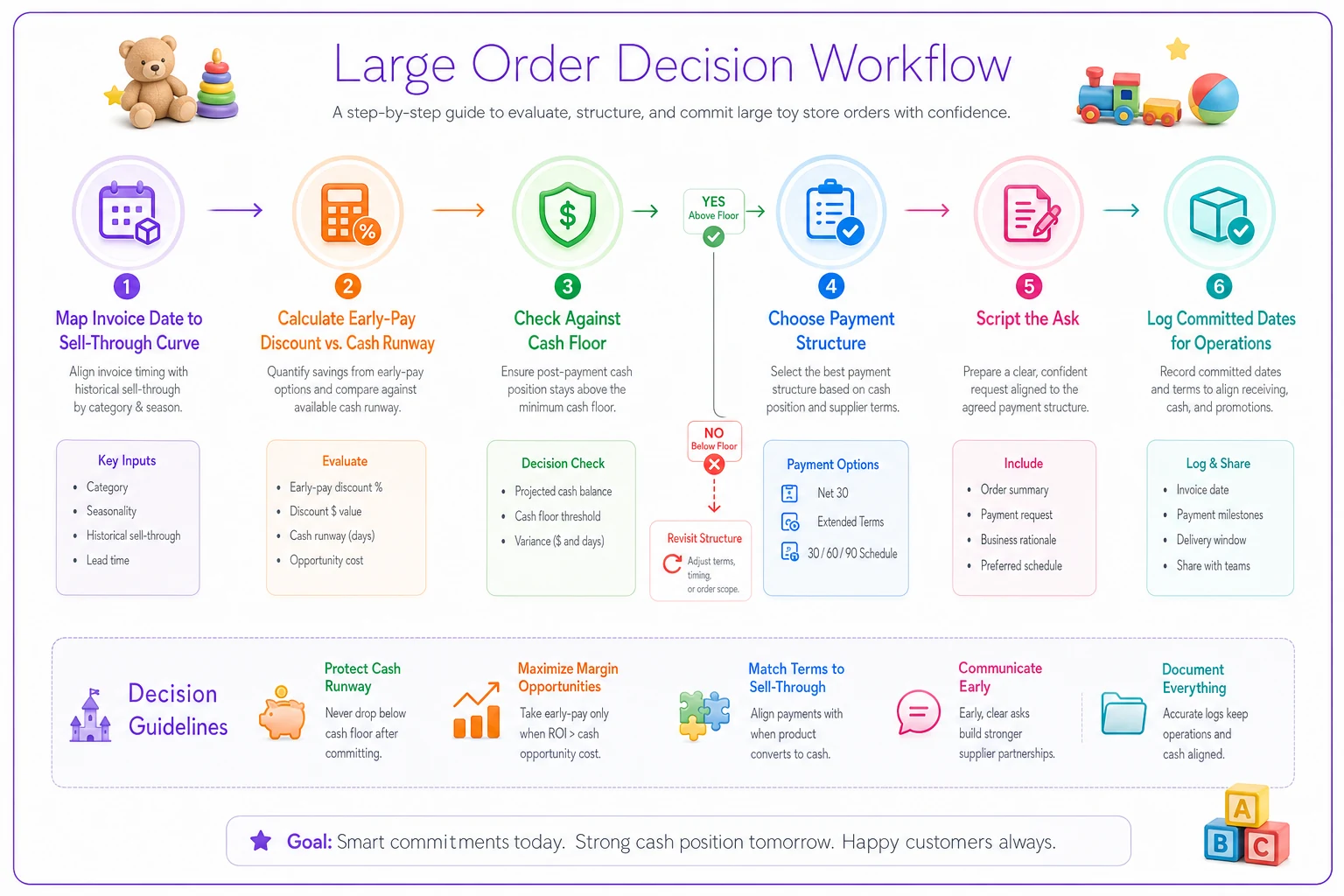
A simple process for deciding on every large order
Before you commit to any order big enough to stress your cash, run it through this:
-
Map the cash-out date against your sell-through curve. When does the invoice hit, and when does this inventory actually turn into cash? If the gap is more than a couple weeks, you need staged or extended terms.
-
Calculate the discount's real cost in context. Is the early-pay discount worth more than keeping the cash? Only "yes" if the cash would otherwise sit idle.
-
Check it against your cash floor. Decide your minimum account balance ahead of time. Any payment plan that pushes you below it is off the table, discount or not.
-
Decide the structure — straight net terms, extended terms, or 30/60/90 — based on order size relative to monthly cash flow.
-
Script the ask and commit to firm dates. Whatever you request, attach it to specific dates you will not miss.
-
Log the committed dates somewhere you'll actually see them. This is where most plans fall apart.
That last step is the quiet killer. Owners negotiate great terms, then lose track of which payment is due when across four suppliers and two payment structures. Staging payments means more dates to track, not fewer — and a missed staged payment undoes all the trust you built negotiating it.
A quick visual of the decision workflow:
Keeping your supplier terms, due dates, and commitments in one operational view rather than scattered across emails and invoice PDFs stops being optional pretty fast. When your system surfaces an upcoming staged payment a week out and ties it back to the specific order, you pay on the committed date without scrambling. The negotiation only pays off if you execute every date cleanly, and that's an operations problem more than a finance one.
Who should not restructure supplier payments
A few honest cautions, because this isn't right for everyone:
-
If your margins are already thin and your sell-through is unreliable, extended terms just delay a cash problem you haven't fixed. Fix the assortment first.
-
If you can't track payment dates reliably, don't add staged payments to the mix. You'll miss one and torch your credibility.
-
If a supplier is clearly small and payment-sensitive, squeezing them on terms can backfire. Sometimes paying fast and being their favorite account is worth more than the float.
For the broader framework on contract clauses, consignment, and how payment terms fit into your overall supplier relationships, the supplier playbook for independent retailers covers the structural side that sits around all of this.
Where this leaves you
Supplier payment optimization in retail isn't about being clever or aggressive. It's about matching when cash leaves your account to when it comes in, backing up every request with a track record, and never missing a date you committed to.
Run the discount math against your actual cash position, not the textbook version. Use 30/60/90 structures on orders that would otherwise strand your cash. Ask for terms confidently, offer firmness in return, and give suppliers a heads-up well before anything goes sideways. Do those things consistently and you'll fund a season that used to require borrowing — with a bank balance you're not checking every morning.
Supplier payment optimization in retail isn't about being clever or aggressive. It's about matching when cash leaves your account to when it comes in, backing up every request with a track record, and never missing a date you committed to.
Run the discount math against your actual cash position, not the textbook version. Use 30/60/90 structures on orders that would otherwise strand your cash. Ask for terms confidently, offer firmness in return, and give suppliers a heads-up well before anything goes sideways. Do those things consistently and you'll fund a season that used to require borrowing — with a bank balance you're not checking every morning.
Ready to elevate your toy store operations?
Join 500+ toy retailers using GoToyvio to increase sales, reduce stockouts, and enhance customer loyalty.