

Most independent toy stores don't have a marketing problem. They have a timing problem.
Walk into any small toy shop in October and the owner is scrambling to "do something for the holidays." By then it's late. The window for building an email list, capturing birthday data, and warming up local partnerships closed months ago. So the store defaults to what everyone else does — a discount, a boosted Facebook post, maybe a sandwich board out front — and hopes foot traffic shows up.
The result is a year of reactive, scattered effort. A little Instagram here. A random in-store event there. A flyer at the coffee shop nobody remembers making. None of it connects, so none of it compounds. And when the owner looks back at the year, they genuinely can't tell you which of those things brought in paying customers.
That's the real issue with local customer acquisition for toy stores: it's not that any single tactic is wrong, it's that they're run at the wrong time, in isolation, with no way to tell what worked. This post lays out a calendar-driven system so a solo marketer can run the right play in the right month, plug in a repeatable funnel, and cut anything that doesn't clear a simple ROI bar.
Why local toy-store marketing breaks (and it's usually not the ads)
The pattern is almost always the same. The owner is operationally maxed out — buying inventory, managing staff, handling returns — so marketing becomes the thing that gets done when there's time. Which means it gets done in bursts, tied to whatever's stressing them out that week.
A slow Tuesday triggers a panic promotion. A competitor's grand opening triggers a defensive coupon. A holiday triggers a frantic content sprint. Each action makes sense in the moment. Stacked over twelve months, they're noise.
The deeper structural problem: toy retail is violently seasonal, but the marketing that drives Q4 revenue has to happen in Q1, Q2, and Q3. The customers who spend $400 in December are the ones whose kid's birthday you captured in April, who came to your summer building-block class, who got your back-to-school email in August. If you only start marketing in November, you're fishing in a pond you never stocked.
What breaks at scale is worse. A store doing $300k does fine on charm and word of mouth. Push toward $700k or a second location and "the owner does marketing when she can" stops working entirely. There's no memory of what ran last year, no way to hand it to a part-timer, and no baseline to judge whether the money's doing anything. The whole thing lives in one person's head, which means it doesn't survive a busy week — let alone growth.
The core idea: a seasonal calendar drives the channel, not the other way around
Instead of asking "what should I post this week," you flip it. You decide, once, what each month is for. Then the channel and tactic fall out of that decision automatically.
Never run out of bestsellers again.
GoToyvio helps you monitor inventory and sales to keep your shelves stocked and customers happy.
- Real-time stock tracking
- Automated reorder alerts
- Sales and promotion analytics
No credit card required
-
January–February Recovery and list-building. Everyone's broke and toy'd-out from the holidays. Terrible for selling, great for capturing data and running low-cost engagement.
-
March–May Birthday season ramp and community roots. Spring birthdays, gift needs, and the best window to build local partnerships before summer.
-
June–August Foot traffic and experience. Kids are home, parents want things to do. Classes, demos, and in-store experiences carry this stretch.
-
September–October Warm-up and preorder capture. Back-to-school, then the quiet build toward Q4. This is where you seed the holiday list and lock in preorders.
-
November–December Harvest. You're not building anything new here. You're converting everything you spent nine months collecting.
Once the month has a job, the tactic is obvious. You don't run a birthday-club campaign in December — you run it in April so those families come back for December. You don't launch a partnership push in Q4 when everyone's slammed — you do it in spring when the local library actually returns your call.
The mistake most owners make is treating every month as a chance to sell. In reality, maybe five months of the year are genuinely built for conversion. The other seven are for loading the funnel so those five pay off.
The calendar → channel → tactic map
Here's the compressed version. Each row is a season, the job it's doing, the channels that fit, and the one funnel you actually run.
| Season | The month's job | Primary channels | The play you run |
|---|---|---|---|
| Jan–Feb | Rebuild the list, low-cost engagement | Email, in-store signage, Google Business posts | "Gift card leftover + January play" email; capture new opt-ins with a small in-store draw |
| Mar–May | Birthday capture + local partnerships | In-store checkout capture, local orgs, email | Birthday club funnel + one new community partner per month |
| Jun–Aug | Foot traffic via experiences | Events, Instagram/local groups, referrals | Class/demo funnel → post-event opt-in → referral ask |
| Sep–Oct | Warm-up + preorder | Email, SMS opt-in, Google Business | Preorder/reservation funnel + "holiday early access" list build |
| Nov–Dec | Convert everything collected | Email + SMS to existing list, in-store | Segmented gift-guide sends; loyalty + last-chance sequences |
Notice what's not here: no single month asks you to be great at six channels at once. Each season picks two or three and ignores the rest. A solo marketer can run one channel well. They cannot run seven poorly and expect results.
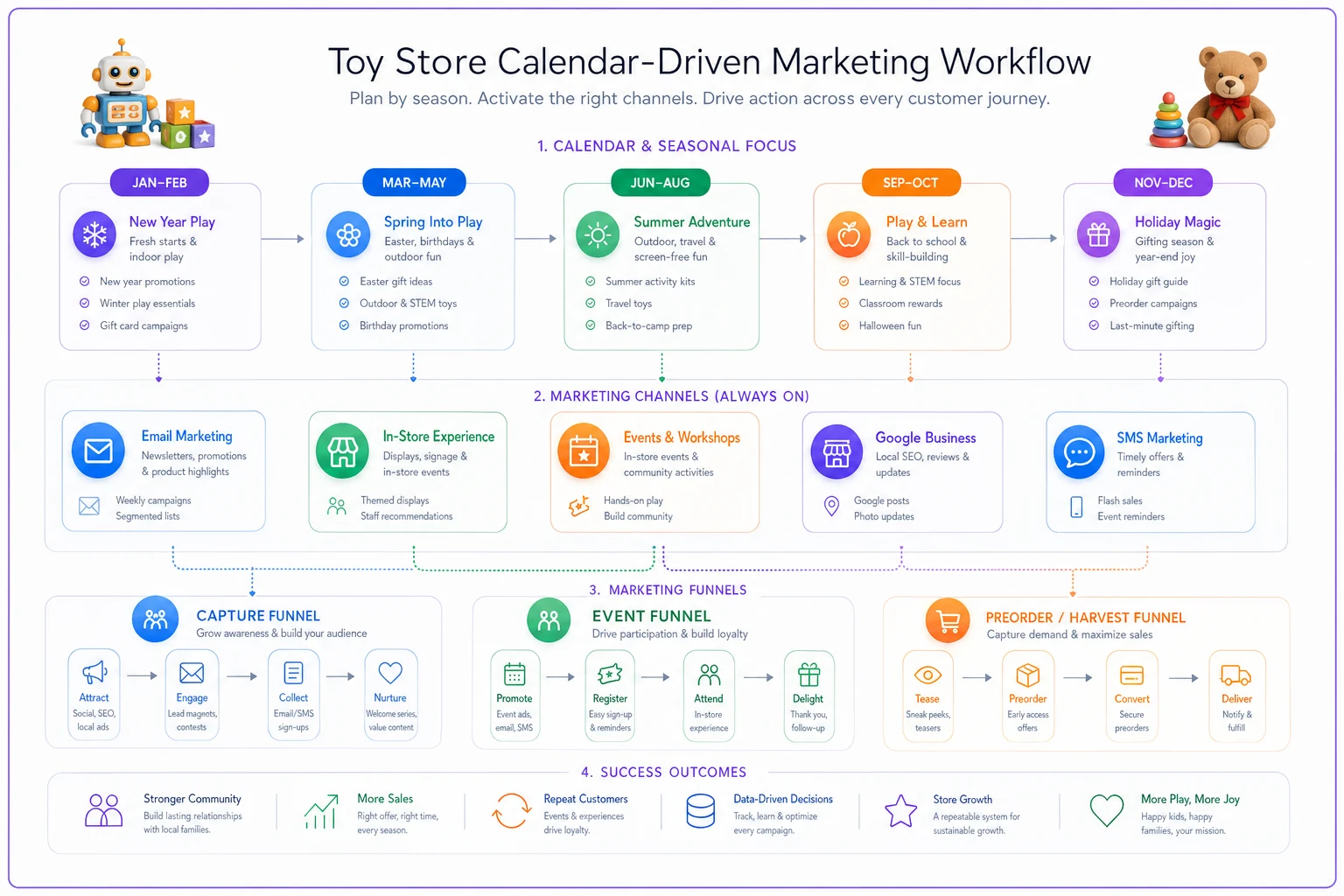
A simple visual shows how the calendar feeds each funnel.
Plug-and-play funnels: three templates that cover the whole year
You don't need twelve funnels. You need three, reused across seasons with the offer swapped. Each one is deliberately simple enough to run alone.
Funnel 1 — The Capture Funnel (used year-round, heaviest in spring)
-
Offer a low-friction reason to share info at checkout (small discount on next visit, entry into a monthly toy giveaway).
-
Capture name, email or phone, and each child's birth month — with clear consent.
-
Auto-tag by child age so you can segment later.
-
Send a single welcome message with one useful thing (a play-idea guide, not a coupon).
-
Two weeks before a captured birthday month, send a gift reminder.
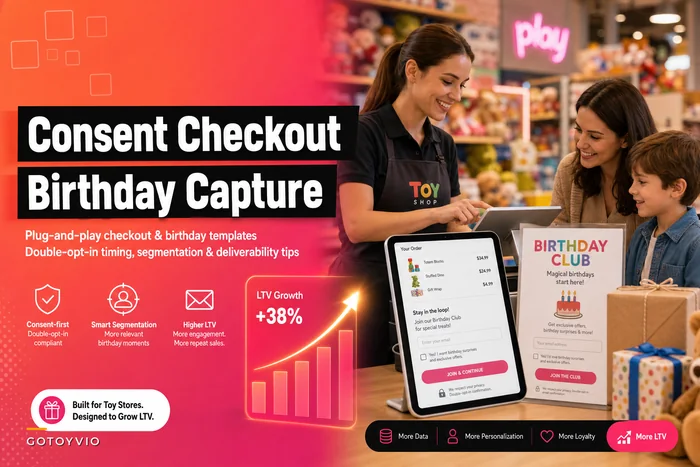
The consent piece is where stores quietly get themselves in trouble, and it's worth getting right from day one — the mechanics of doing it cleanly at the register are covered in the consent-first checkout and birthday-capture templates so you're building a list you can actually use, not one that creates legal headaches.
Funnel 2 — The Event Funnel (June–August, and one-offs in December)
-
Promote the class/demo through local groups and email two weeks out.
-
Require a free "reservation" — this captures contact info before they arrive.
-
Run the event, then make one opt-in ask on-site (photo, list signup).
-
Send a follow-up within 48 hours with a related product and a soft referral ask.
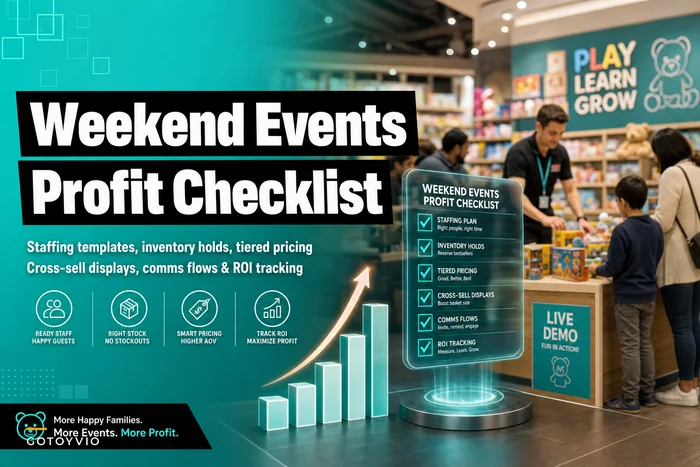
Events only pay when they're operationally tight — capacity, staffing, and the follow-up all have to land. If you're building this out, the weekend event operations checklist walks through keeping demos profitable instead of draining, which is the difference between an event that builds your list and one that just costs you a Saturday.
Funnel 3 — The Preorder/Harvest Funnel (Sept–Dec)
-
In September, invite your list to an "early access / preorder" for hot holiday items.
-
Segment the send by child age so the recommendations are relevant.
-
Take deposits on reservations to lock demand and smooth your cash.
-
In November–December, send a short gift-guide series to the same list, segmented.
-
Close with a last-chance / in-store-pickup deadline message.
This is your money funnel, and it only works because the other two loaded it. You're now selling to people who already know you.
ROI gates: the part everyone skips
Every play gets a simple gate before you run it again next year. If it doesn't clear, it's cut — no sentiment.
-
Cost to run (ad spend + rough hours × your value of an hour + any product given away)
-
New contacts captured (with consent)
-
Attributable revenue within 60 days (use a simple code or "how'd you hear about us")
-
Rule a list-building play should cost you under a few dollars per usable contact. A conversion play should return at least 3–4x its cost within 60 days, or it's on probation.
A realistic example: a summer building class costs about $180 to run (materials, a couple of staff hours, some snacks). It brings in 22 families, 18 of whom opt in. Four buy something that day for roughly $260 total. On day-one numbers, that looks like a loss. But those 18 contacts are now in the birthday and holiday funnels. If even a third of them spend during Q4, the class quietly becomes one of your highest-ROI plays of the year — which you'd never know without tracking contacts as an output, not just same-day sales.
That's the insight most owners miss: for loading-months, contacts captured is the ROI metric. Judging a July event on July revenue guarantees you kill the exact activities that fund December.
Tracking a solo marketer can actually keep up with
The failure mode here is over-engineering. People try to build a marketing dashboard, get overwhelmed, and go back to guessing. A single spreadsheet with one row per play beats an abandoned analytics setup every time.
-
Play name + month run
-
Channel
-
Cost (money + rough hours)
-
Contacts captured
-
Attributable revenue (60-day)
-
Keep / cut / adjust
Fill it in once a month. That's the whole system. After a full year, you have something no charm-based store has: a written record of what actually worked, ready to hand to a part-timer or repeat with confidence. Most of the tags and consent flags feeding this can ride along in your POS if your customer data is clean — which is a much bigger if than most owners assume, and worth auditing before you lean on it.
When this system makes sense — and when it doesn't
It makes sense when: you're doing enough volume that word of mouth alone has plateaued, you have some form of email or POS customer capture, and you're tired of not knowing what's working. Stores in the roughly $250k–$800k range benefit most — big enough that scattered effort costs real money, small enough that one person still runs marketing.
It's a bad idea when: your operational basics are broken. If you're regularly out of stock on your best sellers, or your customer data is a mess of duplicate and unconsented entries, marketing just pours people into a leaky store. Fix the leak first. Driving traffic to inconsistent inventory burns the goodwill you're trying to build.
Who should not bother yet: a brand-new store with no customer base and no data. Spend your first six months on the Capture Funnel and nothing else. You can't harvest a list you haven't planted.
A real scenario: the store that stopped guessing
A single-location shop doing somewhere around $420k a year ran the classic scattershot approach — boosted posts whenever it felt slow, a big discount blitz every December that trained customers to wait for it.
They switched to the calendar system. Nothing exotic: a spring birthday-club push, two summer classes, a September preorder invite to the list they'd finally started building, and segmented holiday sends instead of one blanket discount.
The first year wasn't a fireworks show. Q4 revenue came in noticeably stronger — call it a mid-teens percentage lift — but the bigger change was structural. They'd captured a few hundred birthday-tagged families, could point to exactly which plays drove sales, and cut a chronic Facebook spend that had never once produced traceable revenue. The December discount blitz shrank into a targeted last-chance send to people who already intended to buy, which quietly protected margin.
The owner's actual takeaway wasn't "marketing works." It was that she finally had a repeatable year — something she could run again without reinventing it, and eventually hand off.
The point
Local marketing for toy stores fails not because owners pick bad tactics, but because they run good tactics at the wrong time, disconnected from each other, with no memory of what happened. A seasonal calendar fixes the timing. Three reusable funnels fix the disconnection. A one-row-per-play spreadsheet and honest ROI gates fix the memory.
Do that, and the seven months you spend loading the funnel finally pay for the five months you spend harvesting it — which is how a store stops sprinting every November and starts running something it can actually grow on.
Ready to elevate your toy store operations?
Join 500+ toy retailers using GoToyvio to increase sales, reduce stockouts, and enhance customer loyalty.