
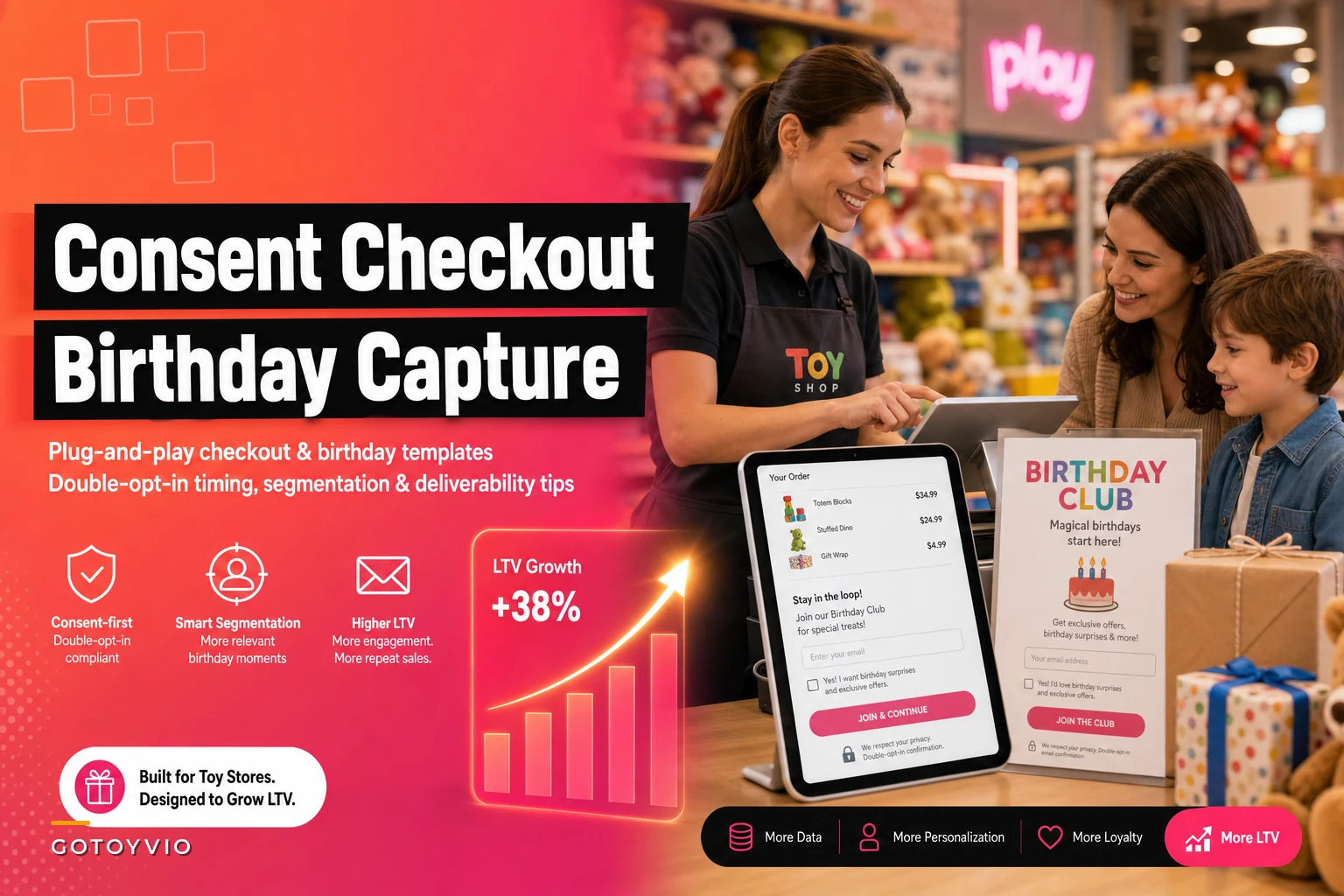

Your checkout flow is where email capture either works or completely falls apart. Most toy stores mess this up—they ask for too much upfront and kill conversions, or they grab emails without proper consent and wreck their deliverability later.
The real challenge isn't just getting the email. It's capturing the right information at the right moment without making people feel like they're being squeezed. A parent buying LEGOs for their 7-year-old has completely different needs than a collector hunting for exclusive Funko Pops. Most toy stores treat them exactly the same at checkout anyway.
The checkout flow that captures without creeping people out
Standard checkout forms are conversion killers. You've probably seen the pattern: email field, newsletter checkbox buried at the bottom, some vague language about "special offers." Nobody fills those out.
What works better is splitting consent into two distinct moments. First, you capture transactional permission during checkout with a clear value prop. Then you upgrade to marketing consent post-purchase when trust is already there.
Here's the copy pattern that consistently pulls 60–70% opt-in rates:
During payment: "Email receipt and order updates to:" [Email field] ☐ Text me when my order ships (optional)
Post-purchase screen: "Perfect! Your order #4827 is confirmed. Since you grabbed [specific product], you might want our insider alerts: ☐ Early access when new [brand] items arrive ☐ Birthday month surprise for [child's name if captured] ☐ Collector pricing on limited releases [Yes, keep me updated] [Just my receipt, thanks]"
Notice what's missing? Generic "newsletter" language. Everything ties to their specific purchase context.
Visual workflow of the split consent flow.
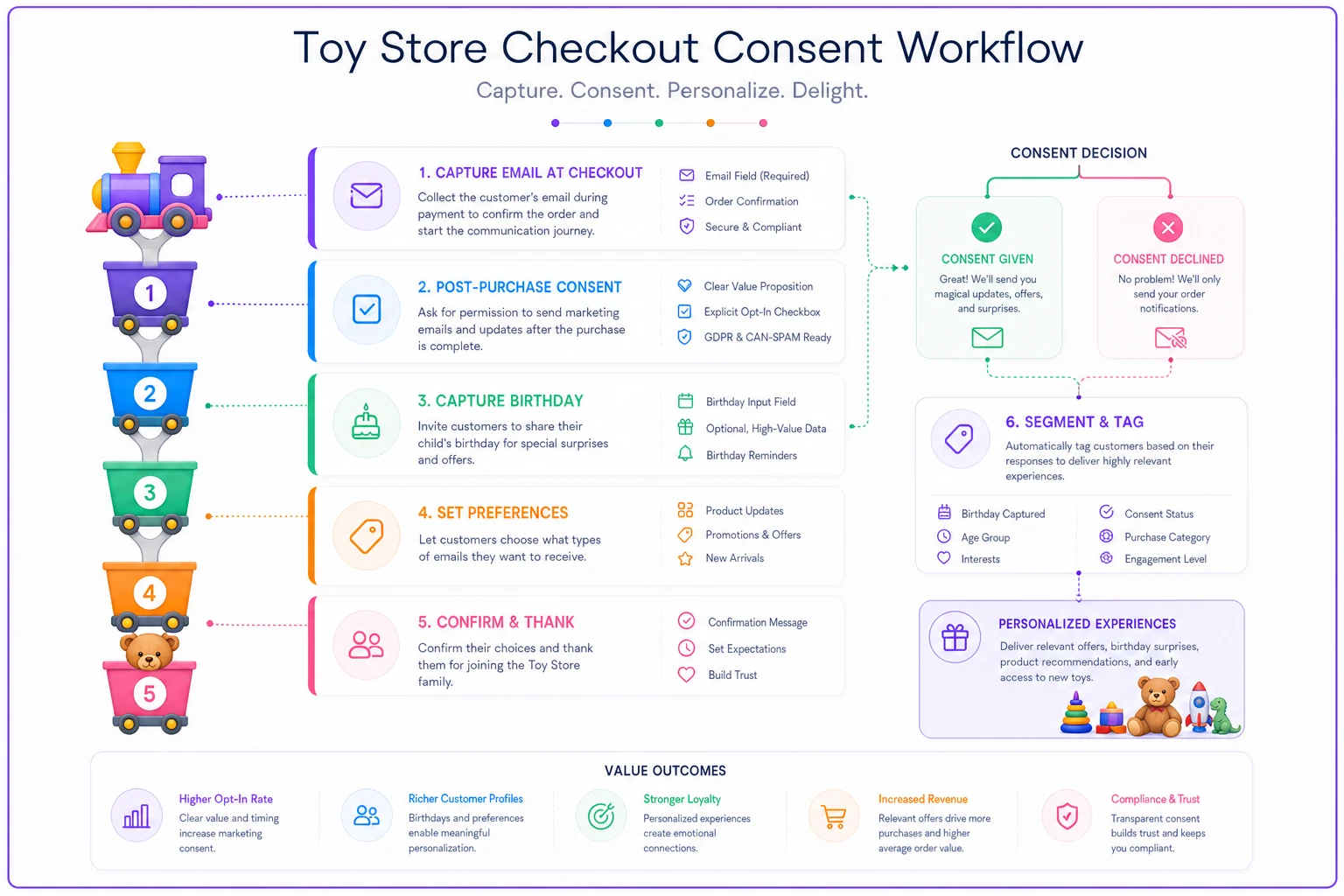
This workflow maps the two consent moments and the main follow-ups tied to the purchase context.
Birthday capture that parents actually complete
Birthday fields in checkout forms get skipped constantly. Parents buying toys online are usually rushing—kid's party is tomorrow, Amazon didn't deliver, full panic mode. Asking for birthday info mid-checkout is friction at the worst possible moment.
Never run out of bestsellers again.
GoToyvio helps you monitor inventory and sales to keep your shelves stocked and customers happy.
- Real-time stock tracking
- Automated reorder alerts
- Sales and promotion analytics
No credit card required
Move birthday capture to the thank-you page with incentive stacking:
Thank you page birthday module: "Make birthdays easier next year: Add [child's name]'s birthday: [Month dropdown] [Day] You'll get:"
-
Birthday month 20% off code (sent 2 weeks before)
-
Age-perfect gift guide based on their interests
-
Party supply checklist for their age group
[Save birthday] [Skip]
Then reinforce this in the order confirmation email for anyone who skipped it.
A toy store in Portland went from capturing birthdays on 8% of transactions to 42% within three months just by pulling birthday capture out of checkout entirely and making it optional post-purchase. Small change, surprisingly big difference.
Segmentation tags that separate families from collectors
Your operational software should automatically tag customers based on purchase patterns—not self-reported preferences. Asking "Are you a collector?" in checkout is useless. Everyone thinks they're a collector.
Let purchase behavior drive segmentation instead.
Auto-tag as "Collector" when:
-
Buys the same product line 3+ times
-
Purchase includes items over $75
-
Uses keywords like "NIB," "mint," or "unopened" in order notes
-
Ships to the same billing address repeatedly
-
Purchases during pre-order windows
Auto-tag as "Family" when:
-
Buys across 3+ age categories
-
Includes party supplies or gift wrap
-
Different shipping addresses across orders
-
Purchases educational toys or books
-
Orders during typical gift-giving months (May for graduation, December holidays)
These tags then trigger completely different email flows. Collectors get condition details, restock alerts, and exclusive access messaging. Families get age-appropriate recommendations, party planning content, and gift guides.
Double opt-in timing that doesn't tank your list
Double opt-in is legally required in some regions and strongly recommended everywhere else for deliverability. But timing matters more than most people realize.
Send the confirmation email within 60 seconds of signup. Subject line structure:
Subject: "Confirm your spot for [specific benefit mentioned]" NOT: "Please confirm your subscription"
Keep the email body ultra-minimal:
"Quick! Confirm your email to lock in: ✓ The birthday discount for [month captured] ✓ Early access to [brand they just bought] ✓ Your collector pricing status [Big button: Yes, confirm my perks] This expires in 48 hours."
The 48-hour expiration creates urgency without cutting off people who only check email once a day. And the subject line framing matters—"confirm your subscription" sounds like admin work, "confirm your spot" sounds like something worth doing.
Deliverability tactics for resource-strapped teams
Small toy stores typically run on Gmail or basic email platforms, not enterprise systems with dedicated IPs. That creates real deliverability challenges when you're trying to build a consent-based list.
Your sender reputation lives or dies on three things you can actually control.
List hygiene on autopilot:
-
Bounces after 2 attempts
-
Unopens after 90 days (promotional emails only)
-
Anyone who hasn't engaged in 6 months
This feels aggressive but it keeps your sender score healthy. A smaller engaged list consistently outperforms a large dead one.
Warming sequences for new domains:
-
Week 1–2
Send only to your most engaged 10%
-
Week 3–4
Expand to your top 25% most engaged
-
Week 5–6
Include 50% of the list
-
Week 7+
Full list deployment
During warming, only send your best content. No pure promotional emails.
Re-engagement campaigns before holidays:
"Run these in October before holiday email volume spikes: "Hey [name], still interested in toy updates? You haven't opened our emails in a while. Want to stay on the list for:"
-
Black Friday early access
-
Last-minute gift guides
-
Collector drops
[Keep me on] [Unsubscribe me]
Anyone who doesn't respond gets suppressed until January. It protects your deliverability during the most critical selling window of the year.
Copy templates by customer segment
For collector segment confirmation emails:
"Your exclusive access is confirmed You're in for:"
-
48-hour early access to limited drops
-
Condition notes before items go live
-
Collector-only pricing on select items
First perk: 15% off storage and display cases with code PRESERVE15
For family segment confirmation emails:
"Welcome to easier gift-giving! You're all set for:"
-
Age-perfect recommendations
-
Birthday month surprises
-
Stress-free party planning guides
Start here: Our foolproof [age] gift guide based on your recent purchase
For unknown/mixed segment:
"Thanks for joining our toy community! Quick question to personalize your experience: [Button: I'm shopping for kids] [Button: I'm a collector] Either way, here's 10% off your next order: WELCOME10"
These work because they acknowledge the customer's actual context instead of defaulting to generic welcome messaging.
The birthday email sequence that drives repeat purchases
Birthday emails generate roughly 5x the transaction rate of regular promotional emails—if you time them right. The standard "Happy Birthday! Here's 10% off" email leaves a lot of revenue on the table.
Email 1 (14 days before): Subject: "[Child's name]'s birthday is coming up!" "Their birthday is in 2 weeks. Here's your birthday month code: BDAY20 Valid all month on everything, including new arrivals. Based on [previous purchase], they might love: [3 specific age-appropriate recommendations]"
Email 2 (7 days before): Subject: "Party supply reminder for [child's name]" "One week until the big day! Don't forget: ☐ Party favors (we have grab bags ready) ☐ Gift bags and tissue ☐ Backup gifts for unexpected guests Your BDAY20 code works on all of these too."
Email 3 (On birthday): Subject: "Happy Birthday to [child's name]! 🎉" "Hope [child's name] has an amazing day! Your birthday code BDAY20 is still valid for 2 weeks if you need any last-minute items or want to grab something with birthday money."
The three-email structure works because toy purchases around birthdays happen in waves—advance planning, last-minute panic, and post-birthday spending. Most stores only hit one of those three moments.
Consent management without the legal nightmares
GDPR, CCPA, COPPA—the regulatory alphabet keeps growing. Small toy stores can't afford compliance teams, but violations are expensive in ways that go beyond fines. These checkpoints should be baked into your standard operational flow.
At checkout:
| Consent type | Requirement |
|---|---|
| Transactional emails (receipts, shipping) | Automatic — no opt-in needed |
| Marketing emails | Explicit opt-in required |
| SMS | Separate explicit opt-in |
| Child data | Never collect without parental consent |
In customer accounts:
"Email me about:"
-
New arrivals in [categories they've bought]
-
Sales and promotions
-
Event invitations
-
Birthday reminders I've saved
"Text me about:"
-
Order updates only
-
Flash sales (max 2 per month)
-
Event reminders
For data requests: Keep a simple spreadsheet tracking: date of request, type (deletion, access, correction), response date, and action taken. Most small retailers get fewer than five data requests per year. Consistent process matters more than fancy software at this scale.
Testing framework for tiny teams
You don't need complex A/B testing software. Track these three metrics weekly:
-
Consent rate at checkout (should be 50%+)
-
Confirmation rate on double opt-in (should be 70%+)
-
30-day engagement rate (opens or clicks within 30 days of joining)
If any metric drops below threshold, test one element at a time—subject lines (benefit-focused vs. urgency), button text (action vs. value), or timing (immediate vs. delayed sends).
Run each test for at least 500 contacts before making changes. Small samples produce false positives more often than most people realize.
When automation actually helps (and when it hurts)
The patterns above all share a common breakdown point: manual tracking. Birthday timing, segment tagging, re-engagement windows. These are exactly the spots where AI-powered operational software makes a real difference without overcomplicating things.
Instead of manually digging through purchase history to separate collectors from families, a decent operational platform can analyze buying behavior and apply the right tags automatically. Instead of someone remembering to schedule birthday emails two weeks out, the system handles it based on the data already captured at checkout.
Where automation hurts is the initial capture phase. If your confirmation messages feel too mechanical, opt-in rates drop. The early touchpoints need to feel human and carefully written. Use automation for the ongoing management and timing—not the first impression.
Implementing proper family purchase tracking also gets a lot easier when your consent capture is clean from the start. And if you're running weekend events, those sign-ups become another consent touchpoint—often converting better than checkout because the context is lower pressure.
Making this work in your actual store
Don't try to implement everything at once. Fix your checkout consent language first—that alone usually doubles opt-in rates within a month. Then add birthday capture on the thank-you page. Only after those two are working should you start building out segmentation and automation.
Most toy stores that do this properly see email revenue increase somewhere in the 30–40% range within six months. Not from sending more emails, but from sending the right ones to people who actually want them.
Behind every email address is either a parent trying to make their kid happy or a collector protecting their investment. Respect that in every touchpoint, and they'll actually want to hear from you.
Ready to elevate your toy store operations?
Join 500+ toy retailers using GoToyvio to increase sales, reduce stockouts, and enhance customer loyalty.