

The moment a toy store owner decides to "just try a few listings on Amazon," a specific problem starts ticking in the background. It usually doesn't blow up right away. Then one Saturday the store is out of a hot LEGO set that a regular family drove twenty minutes for, because the last four units shipped to an online buyer in another state at a price that barely cleared shipping.
That's the core tension. Marketplaces move volume, but they quietly pull inventory, margin, and attention away from the customers who actually keep an independent store alive. And the marketplace rules for independent retailers that matter most aren't the platform's terms of service — they're the internal rules you set for which products go online, how much stock you fence off, and when you're allowed to reprice.
Most owners never write those rules down. They wing it, and the store slowly bleeds in ways that don't show up cleanly on any single report.
Here's a decision framework that keeps the online channel additive instead of destructive.
Not every SKU belongs online — and picking wrong is the expensive part
The first mistake is treating the marketplace as a place to dump your whole catalog. It's not a distribution expansion. It's a filter. Some products should go online. Most shouldn't.
The products that sell well in-store because of relationship, timing, or scarcity are usually the worst candidates for a marketplace. A limited-run collectible that your regulars line up for has more value staying scarce locally. The second you list it on eBay at a competitive price, you've told your best customers there's no reason to rush in.
Meanwhile, the SKUs that actually make sense online are the boring, deep-stock, nationally-available items where you're competing on availability, not relationship.
A rough way to sort candidates:
| SKU characteristic | List online? | Reasoning |
|---|---|---|
| Deep stock, replenishable, non-exclusive | Yes | Low risk to local scarcity; easy to buffer |
| Manufacturer-restricted / MAP-enforced brand | Careful | Pricing gates and reseller rules apply; check agreement |
| Limited edition / allocation items | No | Scarcity is your local advantage — don't burn it |
| Seasonal peak items (Q4 hot toys) | Conditional | Only with strict buffers; these are your walk-in magnets |
| Slow movers / aging inventory | Yes | Marketplace as clearance channel is legitimate |
| Fragile / oversized / high return-rate | Rarely | Shipping and returns eat the margin fast |
That last category matters more than people expect. A large playset with a 12% return rate and $22 in shipping each way isn't a product — it's a liability with a barcode. Independents list these because they "have them anyway," then wonder why online is unprofitable.
Stores that do well online usually list fewer than 15% of their catalog. The ones that struggle list nearly everything and manage none of it.
Protective inventory buffers: the wall between online and your shelf
This is where most of the real damage happens, and it's entirely preventable.
Never run out of bestsellers again.
GoToyvio helps you monitor inventory and sales to keep your shelves stocked and customers happy.
- Real-time stock tracking
- Automated reorder alerts
- Sales and promotion analytics
No credit card required
If your online listings pull from the same available quantity as your point-of-sale, you will eventually sell something online that a customer is holding at the register. Or worse — you'll ship out the last units of a Saturday-morning hero product to a stranger.
A protective buffer is a reserved quantity that the marketplace cannot touch. You decide how many units are fenced off for the store, and the online channel only ever sees what's above that line.
In practice it looks like this:
-
On-hand
20 units
-
In-store buffer
12 units (reserved, invisible to marketplace)
-
Available to list online
8 units
When the store sells down to the buffer, the online listing drops to zero automatically. Your regulars are protected. You never oversell across channels.
The mistake that keeps showing up is buffers set as a flat number across every product. Buffers should scale with local velocity:
-
High walk-in velocity items — buffer heavy (60–80% of on-hand). These are the products people physically come in for.
-
Medium velocity — buffer moderate (30–50%).
-
Low walk-in / deep national stock — buffer light (10–20%). Let the marketplace move these.
-
Clearance / aging — buffer at zero. You want these gone through any channel.
Getting the buffer math wrong in either direction hurts. Too tight and you oversell locally. Too loose and you're carrying stock you could've turned online. This is the same underlying discipline covered in simple inventory-allocation rules for small toy stores — the marketplace is just one more channel competing for the same finite shelf.
When buffers actually matter most
During Q4, buffers stop being optional. A store with one location and a moderate online presence went into a holiday season with no buffers on their top ten sellers. By early December they'd shipped out roughly a third of their hot-toy stock to online buyers at thin margins, then had to disappoint in-store families who'd been told to "come by this weekend." The lost walk-in trips weren't just a single sale each — several of those families were the kind who spend $200–$300 across a season.
The fix cost nothing but a config change the following year. Buffers on the top sellers, set to protect roughly two weeks of local demand. Online still moved units — just not the ones the store floor needed.
Buffers are ultimately a forcing function for inventory discipline you probably should've had anyway. The online channel just makes ignoring that discipline more expensive.
Repricing gates: don't let automation undercut your own store
Automated repricers are seductive. They chase the buy box, drop your price a few cents below competitors, and feel like free optimization. For an independent, they're a trap if left ungoverned.
The failure mode: your repricer drops an item to $18.40 online to win a marketplace race. That same item sits on your shelf at $24.99. A price-checking customer standing in your aisle pulls up the listing on their phone and now feels lied to. You've trained your own foot traffic to distrust your in-store pricing.
Repricing gates are hard floors and rules that the automation is never allowed to cross:
-
Absolute floor price — never reprice below (cost + fulfillment + minimum margin). No exceptions, no buy-box chasing past it.
-
In-store parity gate — for any SKU also sold on the floor, the online price cannot drop more than a set percentage below the shelf price. Some stores keep online at or slightly above shelf price on purpose.
-
MAP compliance gate — for brands with minimum advertised pricing, the floor is the MAP, full stop. Violating this is how independents get their reseller accounts cut, and losing a key supplier over a repricing algorithm is a genuinely bad way to lose a business.
-
Velocity gate — don't reprice down on items that are already selling fine. If it's moving at your current price, leave it.
The parity gate is the one most owners skip and most regret. Protecting the perception that your store is fairly priced is worth more than a handful of extra online sales at rock-bottom margin.
Set your parity gate before enabling any repricer — it's the easiest way to avoid public pricing mismatches.
Protecting the perception that your store is fairly priced is worth more than a handful of extra online sales at rock-bottom margin.
Fulfillment choices that protect local relationships
How you fulfill online orders quietly shapes whether the online channel helps or competes with your store.
There are three realistic paths for an independent:
Ship from store. You pick, pack, and ship marketplace orders out of your existing inventory. Cheapest to start, but it directly competes with your shelf for stock and your staff's time. Only workable with strong buffers in place.
Third-party fulfillment (FBA-style). You send inventory to the marketplace's warehouse. It moves faster and off your plate, but that inventory is now gone from your store entirely — you can't sell it to a walk-in. Fine for deep-stock, low-local-relevance SKUs and terrible for anything your regulars might want.
Local pickup / hybrid. Some marketplaces and your own site support local pickup. This is the sleeper option because it converts an online browser into a foot-traffic visit — someone comes to collect their order and often buys something else while they're there.
| Fulfillment method | Competes with shelf? | Speed | Best for |
|---|---|---|---|
| Ship from store | Yes (needs buffers) | Moderate | Mixed catalog, low online volume |
| 3P warehouse | Committed away | Fast | Deep-stock national items only |
| Local pickup | No — drives traffic | Immediate | Anything a local customer might grab |
The coordination problem across all these channels is real, and it's where a lot of small teams lose hours every week. If you're already juggling online, in-store, and pickup, the operational discipline in how small toy stores stop fulfillment chaos across online, in-store and pickup applies directly here — marketplaces just add another lane to keep straight.
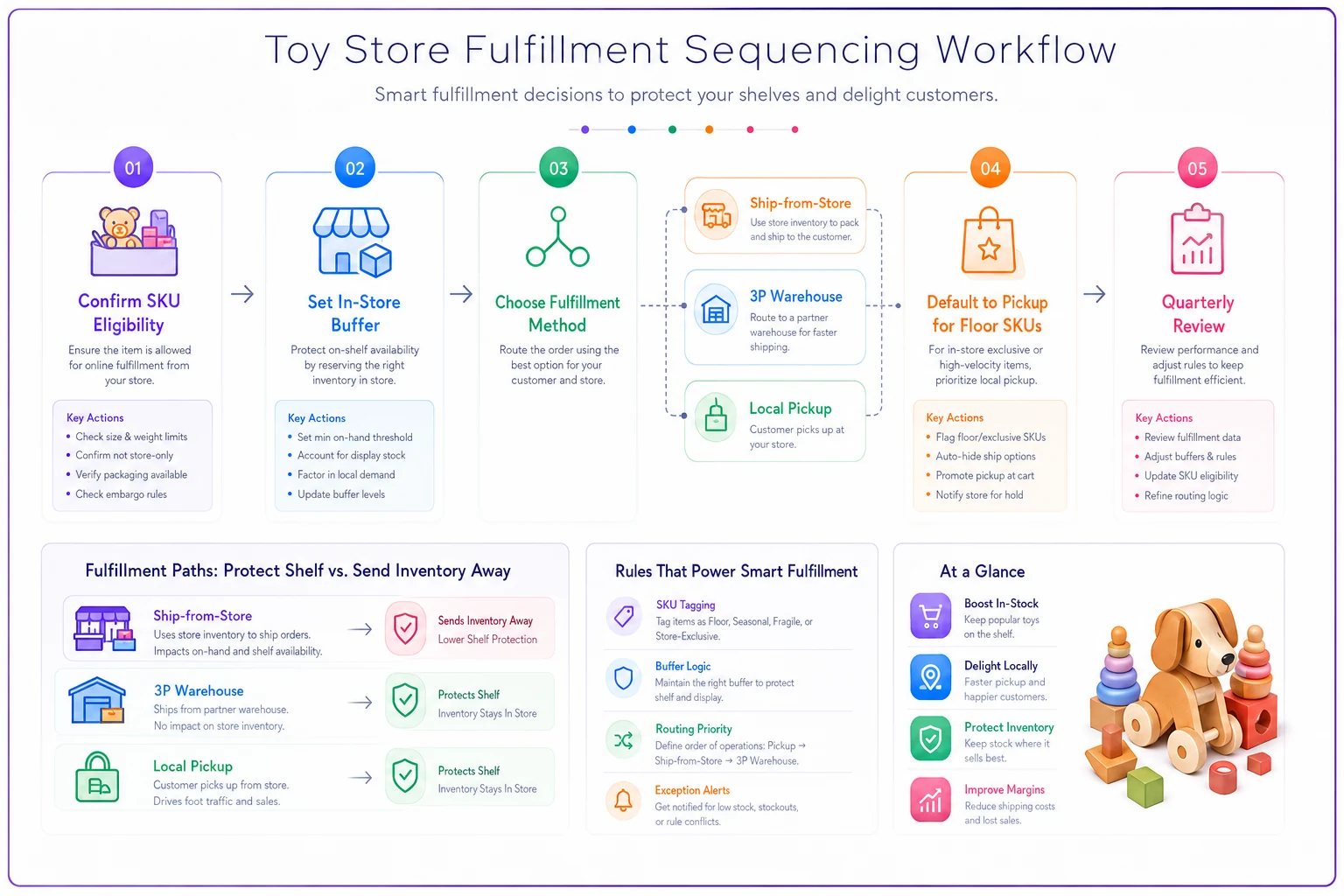
A simple way to think about fulfillment sequencing:
-
Confirm the SKU is eligible for online listing (channel decision matrix above).
-
Check that the in-store buffer is set and active before the listing goes live.
-
Choose the fulfillment method based on local velocity — high-velocity items should never go to a 3P warehouse.
-
Set the pickup option as the default for any SKU also stocked on the floor.
-
Review fulfillment method quarterly, especially before Q4.
Getting this sequence right upfront avoids most of the firefighting that happens when channels start stepping on each other.
Here's a quick workflow diagram to visualize the fulfillment sequencing.
Getting this sequence right upfront avoids most of the firefighting that happens when channels start stepping on each other.
Preventing channel conflict with your suppliers
There's a second kind of conflict that can quietly end your best supplier relationships: listing products your distributor or the brand didn't authorize you to sell online.
Plenty of brands — especially in specialty toys and collectibles — have reseller agreements that either prohibit marketplace sales entirely or restrict them to authorized channels. Independents violate these constantly, usually by accident, because they list everything and never re-read the terms.
A short checklist before any SKU goes live online:
-
Does the supplier agreement permit online / marketplace sales at all?
-
Is there a MAP policy, and is my floor price set to respect it?
-
Am I authorized to sell this specific brand on this specific platform?
-
Would listing this item undercut the brand's own direct channel in a way they'd notice?
-
Is this an allocation/exclusive item where scarcity is the whole point?
If any answer is uncertain, the item stays off the marketplace until you've confirmed. The upside of listing one more SKU is never worth the downside of losing a supplier line.
Who should NOT be doing this yet
Not every store is ready to open a marketplace channel, and pushing into it prematurely creates more problems than revenue.
Hold off if:
-
Your in-store inventory counts aren't reliable. If your on-hand numbers are already off, buffers and cross-channel availability will be pure fiction, and you'll oversell immediately.
-
You don't have staff time to handle pick/pack and returns. Marketplace returns are more frequent and more procedural than in-store, and they'll swamp a one-person operation.
-
Your margins are already thin. Marketplace fees — often 12–15% — plus fulfillment can turn a modest in-store margin into a loss online.
-
Your best products are relationship- or scarcity-driven. If your store's whole edge is being the place people come to, a marketplace can dilute exactly what makes you special.
The stores that succeed online almost always fixed their in-store inventory accuracy first. The channel amplifies whatever discipline — or chaos — already exists.
A short real scenario
A single-location toy store, somewhere in the $600k–$700k annual revenue range, decided to list a curated set of around 40 deep-stock SKUs online — no collectibles, no allocation items, nothing brand-restricted.
They set velocity-based buffers, a hard in-store parity gate so nothing ever priced below shelf, and used ship-from-store for aging stock with local pickup for everything else. Nothing exotic.
Over the following six months, the online channel added a modest but real chunk of revenue — low four figures monthly — mostly by clearing slow movers that would've otherwise sat and eventually gotten marked down harder. In-store stockouts on hot items also dropped, because the buffers forced inventory discipline they hadn't had before. The pickup orders brought a handful of new families into the store who became repeat walk-ins.
The revenue bump was nice. The bigger win was that the online channel stopped fighting the store and started feeding it.
The rules that actually matter
Marketplaces aren't inherently good or bad for independents — undisciplined marketplace behavior is. The stores that get hurt are the ones that list everything, let a repricer run wild, share one inventory pool across channels, and never check their supplier terms.
The ones that win treat the online channel as a narrow, governed extension of the store: a small list of the right SKUs, protective buffers scaled to local demand, hard pricing gates, fulfillment choices that either protect the shelf or drive traffic to it, and a supplier-agreement check before anything goes live.
Write these rules down before you list a single product.
The framework is boring and a little restrictive on purpose — that's exactly why it works.
Ready to elevate your toy store operations?
Join 500+ toy retailers using GoToyvio to increase sales, reduce stockouts, and enhance customer loyalty.