



Most owner-to-operator transitions in small retail don't fail because the operator is bad. They fail because the owner never actually handed anything over — they just stopped showing up and hoped the muscle memory would hold. For a single shop, that sometimes works. The owner knows every regular, every supplier quirk, every weird thing about the Tuesday restock. When that owner steps back from a micro-chain of two to five stores, the gaps aren't personal anymore. They're structural. Nobody knows who approves a markdown. Nobody knows which vendor gets paid first when cash is tight. The "system" was living in the owner's head, and heads don't scale.
This is the part of the owner operator transition in small retail that nobody preps for. You can replicate inventory and pricing across locations — that's mechanical. What's hard is replicating judgment. The operator needs to make the same 40 small decisions a day the owner used to make on instinct, and they need to make them without texting the owner at 9pm. The way you solve that isn't a 90-page manual. It's three things working together: a time-boxed handover sprint, a decision-rights matrix, and KPI contracts short enough to actually read.
These pieces fail when you do them in isolation — so here's how the whole thing connects.
Why handovers break at the micro-chain level specifically
A single-store handover is forgiving. If the operator misses something, the owner is usually nearby and catches it before it compounds. At 2–5 stores, the owner is spread across locations, and the error you don't catch in week one becomes the policy nobody questions by month three.
The pattern that keeps showing up: the owner hands off "operations" as one big blob — open the stores, manage the people, order the stuff, watch the money. The operator does their best, but "manage the money" is not a task. It's dozens of decisions with different stakes. Can they comp a damaged item? Up to what value? Can they reorder a collectible line that sold out, or does that need sign-off because it ties up cash? Without clear boundaries, operators do one of two things, and both are bad:
-
They over-escalate, pinging the owner constantly, which means the owner never actually got their time back and the "handover" was fake.
-
They over-decide, making calls outside their authority, and the owner finds out six weeks later when a $4,000 order of slow-moving plush shows up that nobody planned for.
What breaks at scale is the feedback loop. In one store, a bad decision is visible fast. Across three stores, bad decisions hide inside aggregate numbers until the quarter closes. The handover didn't create the problem — it removed the person who used to notice it, without replacing the noticing.
The 60/30/7-day handover sprint
Most handovers drag on for months because they have no finish line. "I'm training the new manager" becomes a permanent state. A sprint fixes that by forcing a countdown with specific gates. The numbers aren't magic — they're just long enough to cover a full operational cycle and short enough that nobody coasts.
Never run out of bestsellers again.
GoToyvio helps you monitor inventory and sales to keep your shelves stocked and customers happy.
- Real-time stock tracking
- Automated reorder alerts
- Sales and promotion analytics
No credit card required
Think of it as three shrinking windows, each with a different owner mindset.
Days 60 to 31: Shadow and document the real process
This is the "watch and write it down" phase, but with a twist most people miss. The operator isn't shadowing to learn the ideal process. They're shadowing to document the actual one — including the shortcuts and exceptions the owner forgot they even do.
A typical example: the owner always holds back a few units of hot preorder items for walk-in regulars, off the system, in a drawer behind the counter. That's not in any SOP. It's a relationship decision the owner makes by feel. During this window, the operator's job is to surface stuff like this and ask, "What's the rule here?" — turning a gut call into something repeatable, or deciding to kill it altogether.
By day 31, you should have a working draft of how the business actually runs, not how it's supposed to.
Days 30 to 8: Operator runs it, owner is on call
Now the operator runs daily operations and the owner shifts to answering questions, not making decisions. This is the uncomfortable phase, because the owner has to sit on their hands while watching things get done 80% the way they'd do them.
The hard discipline here: when the operator asks a question, the owner answers with the rule, not the action. Bad: "Just comp it this time." Good: "Anything under $25 damaged, you comp without asking. Over that, flag it." Every question in this window is a chance to convert a one-off answer into a permanent decision right. If you're still giving one-off answers by day 10, your matrix isn't built yet.
Days 7 to 0: Live fire, owner silent
The last week, the owner goes quiet on purpose. No answering operational questions — the operator has to use the matrix, the KPI contracts, and the documented process. Anything they can't resolve gets logged, not escalated. On day zero, you review the log together. That log is your gap list. If it's long, the handover isn't done and you extend. If it's three items about genuinely rare edge cases, you're there.
This phased mindset mirrors what works when you're replicating stores themselves — the phased replication checklist for scaling from 1 to 3 stores uses the same logic of proving each stage before moving on, instead of flipping everything at once.
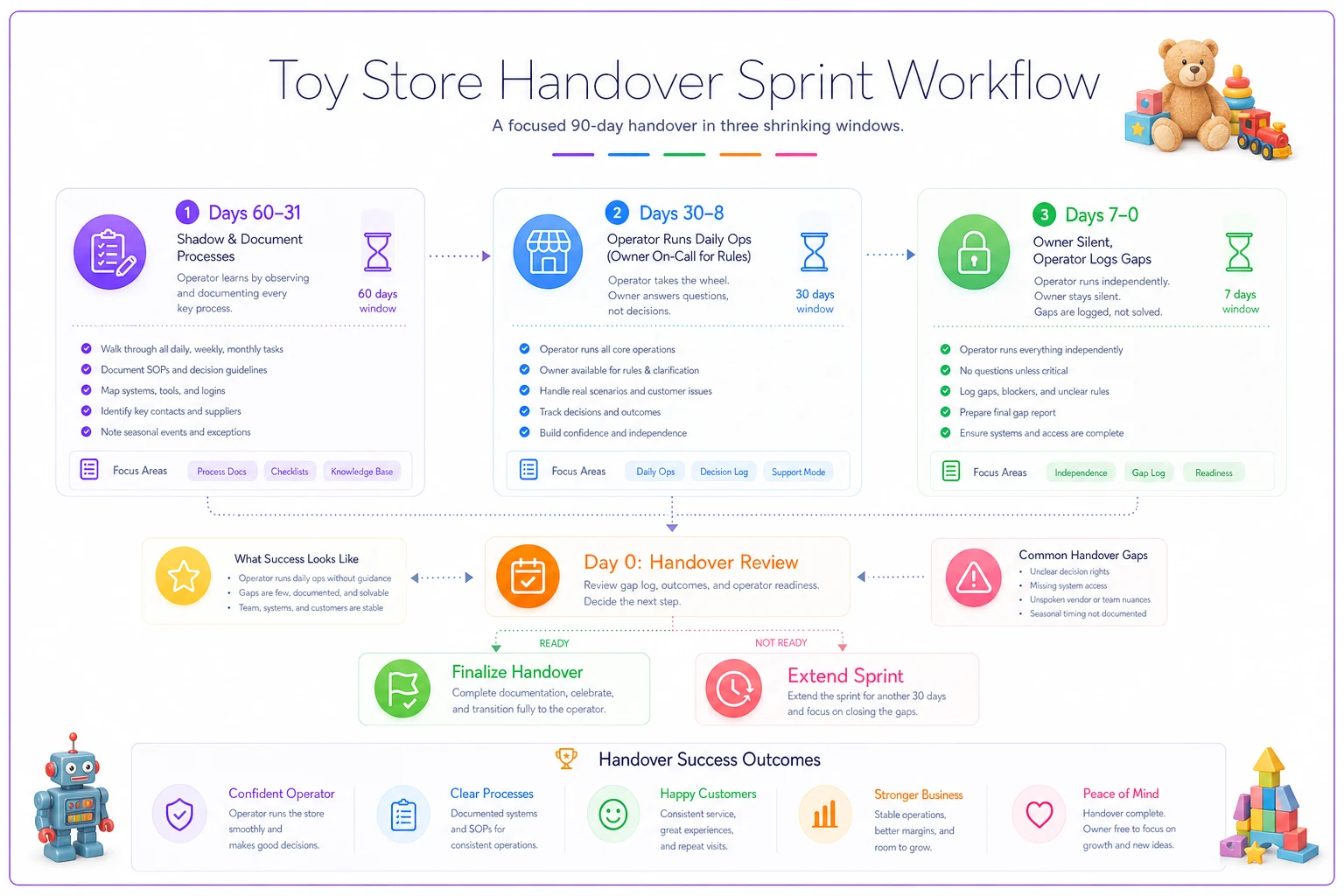
[GRAPH: 60/30/7 Handover Sprint] Days 60–31: Shadow phase → operator documents real processes Days 30–8: Operator runs daily ops → owner answers with rules, not actions Days 7–0: Owner goes silent → operator logs gaps, no escalation Day 0: Review gap log together → extend or finalize handover
The decision-rights matrix: the actual core of the handover
If you only build one artifact, build this. A decision-rights matrix answers a single question for every recurring decision: who decides, and up to what limit? Without it, every ambiguous moment flows back to the owner, and the handover never completes.
The mistake people make is building this as a vague org chart. "The manager handles store operations." That's useless. The matrix has to be specific enough that the operator never has to guess. Here's the shape of a usable one for a small chain:
| Decision | Operator alone | Operator + notify owner | Owner approval required |
|---|---|---|---|
| Comp / refund a damaged item | Up to $25 | $25–$75 | Over $75 |
| Markdown on aging stock | Up to 20% off | 20–40% off | Over 40% |
| Reorder existing SKU | Within normal reorder band | 1.5x normal quantity | New vendor or 2x+ quantity |
| New SKU / line introduction | — | — | Always |
| Staff shift swaps & scheduling | Full authority | — | — |
| Hiring a part-timer | Screen & recommend | — | Final approval |
| Firing / disciplinary action | Document only | — | Always |
| Spending (non-inventory) | Up to $150 | $150–$500 | Over $500 |
| Local promo / event under $200 | Full authority | — | — |
A few things worth calling out about how this plays across multiple stores.
The dollar thresholds should be per-store consistent but reviewed centrally. If Store A's operator comps $25 items freely and so does Store B's, that's fine — but someone needs to see the aggregate, because three stores each comping "a little" is a real number by month's end. The matrix sets the boundary; your reporting catches the drift.
Notice the "notify owner" middle column. That's the pressure-release valve. It lets operators act fast on medium-stakes calls while keeping the owner informed without making them a bottleneck. The owner reads the notification, and if a pattern looks wrong, they adjust the threshold — they don't claw back the decision.
Who should NOT get a wide matrix: a brand-new operator hired externally who hasn't worked a full season with you yet. Start their thresholds low and widen them as trust builds. An internal promotion who's run your floor for two years can start with much higher limits. Same matrix, different starting numbers.
One-page KPI contracts, sized for the operator who can't ignore them
A KPI contract is a single page that says: here's what you own, here's the target, here's the review cadence. The word contract matters. It's not a dashboard the operator glances at. It's an explicit agreement about what "doing the job well" actually means.
The reason it has to fit on one page is brutally practical. Operators running a store floor don't read dashboards with 30 metrics. They'll ignore all of them. A one-pager with four or five numbers they're accountable for actually changes behavior, because they can hold it in their head.
A workable operator KPI contract for a toy store usually covers:
-
Sales vs. target (store-level, weekly) — the obvious one, but paired with the next item so it's not gamed by discounting.
-
Gross margin % — because an operator can hit a sales number by marking everything down. Margin keeps that honest.
-
Inventory accuracy / shrink — the number that quietly bleeds micro-chains. If the operator owns receiving and counts, they own this.
-
Labor as % of sales — their main controllable cost. Scheduling authority sits with them, so this number sits with them too.
-
One relationship/service metric — repeat customer rate, event attendance, or something tied to the store's local value. This stops operators from optimizing purely for the spreadsheet and ignoring the thing that makes an independent toy store worth visiting.
Keep the targets as ranges, not single points. "Labor between 12–15% of sales" is more honest than "14%," because real weeks vary — a big event week and a dead January week shouldn't both be judged against one static figure.
The KPI contract and the decision-rights matrix are two halves of the same thing. The matrix says what you're allowed to do. The contract says what you'll be measured on. If those two don't line up — if an operator is held accountable for margin but not allowed to approve markdowns — you've built a trap. When you design them, lay them side by side and check that every number they're accountable for maps to a decision they actually control.
Stick to four or five numbers on the one-page contract so operators can realistically hold them in their head.
For the mechanics of keeping those numbers consistent and reviewable across locations without drowning in reports, one-page reporting and governance for toy stores pairs naturally with these contracts — same philosophy of putting the few decision-driving numbers on one page instead of burying them.
Runnable handover scripts: the part everyone skips
Owners build the matrix and the KPIs, then leave the actual conversations to improvisation. And the handover lives or dies in those conversations. So write scripts — not word-for-word speeches, but a runnable sequence for the recurring moments.
A few that matter:
The escalation script (for the operator). When something falls in the "owner approval" column, the operator shouldn't send a vague "hey can we talk?" text. The script forces structure: What's the decision, what are the options, what do you recommend, what's the deadline? Example framing — "Vendor X wants a $3,200 reorder of the dragon plush line before Friday. Last batch sold through in nine days, but it ties up cash during a slow stretch. I lean yes at half the quantity. Need your call by Thursday noon." That's a 20-second decision for the owner instead of a 15-minute back-and-forth.
The weekly review script (for both). A fixed 20–30 minute agenda: KPI contract numbers first, then anything from the "notify owner" column, then the operator's open questions, then exactly one thing to improve next week. Same order every week. The predictability is the point — it trains the operator to come prepared and stops the meeting from sprawling.
The "I disagreed but did it anyway" script. This one's underrated. When the operator makes a call within their rights that the owner would've made differently, the owner's job is to not override it after the fact unless it's genuinely dangerous. The script is a note, not a correction: "I'd have gone the other way on the clearance timing, here's why, your call going forward." Overriding in-rights decisions is the fastest way to teach an operator to stop deciding — and then you're back to running everything yourself.
A real scenario: a three-store plan that almost stalled
A toy retailer with three neighborhood locations wanted to step back to roughly two days a week after years of being in-store daily. First attempt had no structure — just promoted a strong floor lead to operator and said "you've got it." Within a month, the owner was fielding 15–20 texts a day. Comp questions, reorder questions, "is it okay if I…" questions. The owner was arguably busier than before, because now they were managing by interruption across three stores instead of just working one.
The reset: they built the matrix and two KPI contracts over a weekend, then ran a compressed sprint. In the 30-day window, every text the operator sent got answered with a rule, and the rule got written into the matrix. By the end, the matrix had grown from the initial dozen rows to around twenty, because real operations surfaced decisions they hadn't thought of upfront.
The result wasn't dramatic in a headline way — it was dramatic in the owner's calendar. Escalations dropped to a handful a week, mostly genuine owner-level calls like new vendor lines. The operator's margin number held steady because the markdown limits were explicit. The owner got their two days back for real, not in theory. What made it stick wasn't any single document — it was the sprint forcing the messy judgment calls out into the open while the owner was still around to codify them.
When this makes sense — and when it doesn't
A full sprint-plus-matrix handover is the right move when you've got 2–5 stores, when the owner genuinely wants to reduce daily involvement, and when there's a specific person stepping into the operator seat. It's overkill for a single store where the owner plans to stay hands-on indefinitely. In that case, you want governance and reporting, not a handover.
Don't run this sprint during peak season. Don't hand off the keys in November. The whole point is to stress-test judgment in normal conditions, and peak distorts everything — numbers spike, exceptions multiply, and you can't tell if the operator is struggling or just drowning in holiday volume like everyone else. Run the sprint in a shoulder season so the review log reflects real recurring decisions, not once-a-year chaos.
And if you genuinely don't trust the person to make a single comp decision without you, no matrix fixes that. That's a hiring problem, not a handover problem, and you'll just rebuild the bottleneck with extra paperwork.
Bringing it together
The owner-to-operator transition in small retail isn't a document drop or a training week — it's the deliberate transfer of judgment, boundaried by a decision-rights matrix, measured by KPI contracts the operator can actually hold in their head, and forced to completion by a sprint with a real finish line. The scripts are the connective tissue that makes the handoff survive contact with a messy Tuesday.
Across a micro-chain, what you're really building is the ability to be absent without the business drifting. Get the three pieces working together — authority, accountability, and a countdown — and the operator makes the calls you'd make, at the limits you set, measured on the numbers you care about. The business keeps running the way you built it, even on the days you're not in the room.
Ready to elevate your toy store operations?
Join 500+ toy retailers using GoToyvio to increase sales, reduce stockouts, and enhance customer loyalty.