

Most toy store buyers don't get burned by their bestsellers. They get burned by the "maybe" SKUs — the six-pack of a new craft kit, the licensed plush line a rep swore would move, the fidget thing that looked hot at the trade show. Those small bets pile up. And when they don't sell, they sit on the shelf collecting dust while your cash sits locked inside them until you finally mark them down to nothing in January.
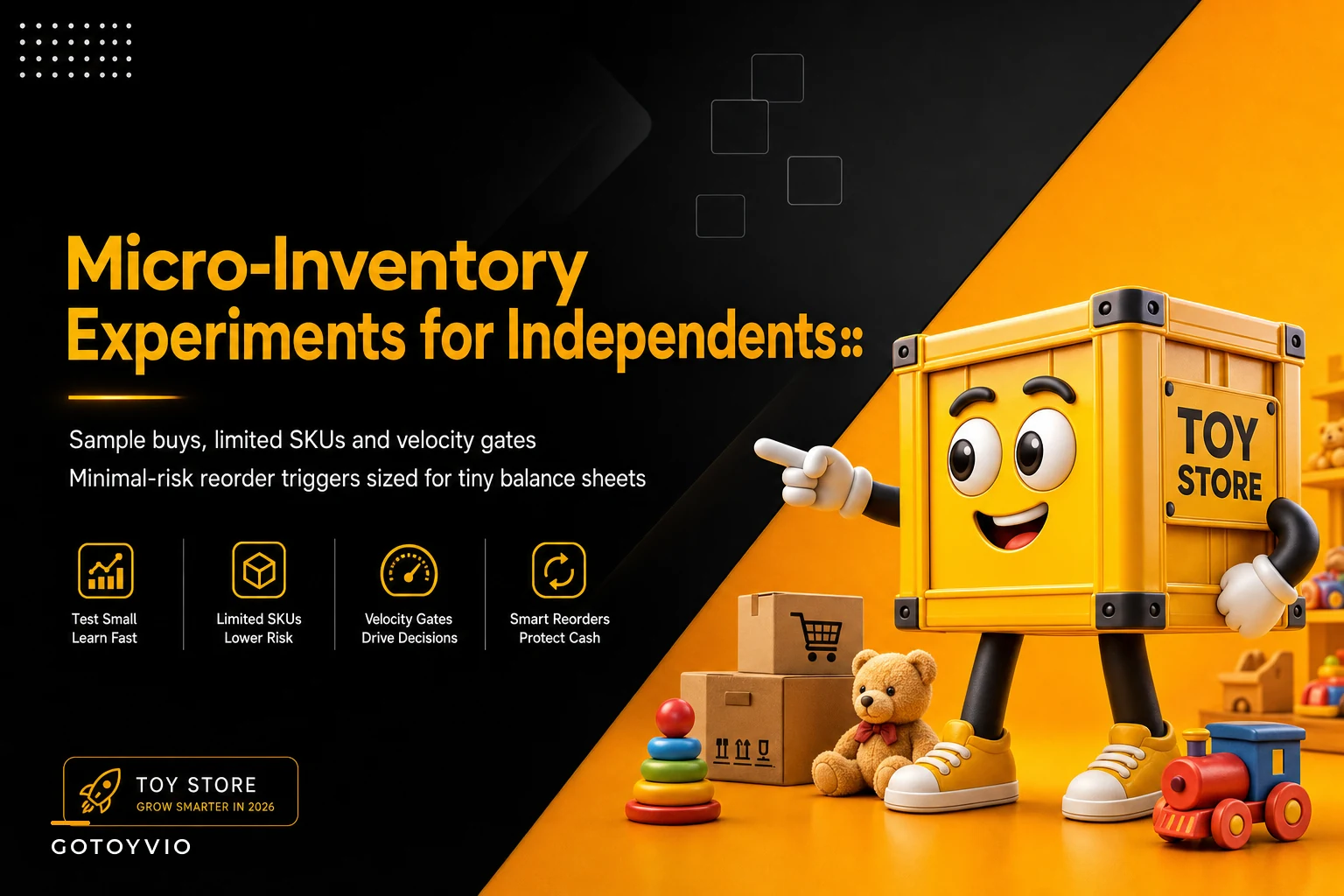
The fix isn't a better crystal ball. It's a testing method that keeps each bet small, sets clear rules for when to reorder, and — this is the part most people skip — sets equally clear rules for when to walk away. That's what micro inventory experiments in retail actually are: controlled, small-dollar bets with pre-decided exit and scale-up triggers.
The real reason "maybe" SKUs turn into deadstock
Deadstock rarely comes from one big mistake. It comes from a hundred small buys where nobody defined what "working" looked like before the order went out.
The pattern is pretty consistent. A rep pitches a new line. You like it. You order a "starter" quantity — usually whatever the case pack forces you into, say 12 units. You put it on the shelf. Three weeks later you're not thinking about it because you're busy. Six weeks later you notice it hasn't moved much, but by then you've also placed a follow-up order because the rep called and you didn't want to "run out." Now you have 20 units of something selling one a week.
The core problem is that there was no velocity gate. Nobody said, upfront, "this SKU needs to sell X units in Y days or we don't reorder." Without that number written down somewhere, every reorder decision becomes a gut call made under mild pressure from a sales rep. And gut calls are exactly how you end up with a stockroom full of stuff that felt promising in the moment.
There's a related trap: the case pack tricks you into a bigger first bet than you'd ever choose on purpose. If the minimum is 12 and it costs you $6 a unit, that's a $72 experiment before you've sold a single one. Do that across 15 new lines a season and you've quietly committed over a thousand dollars to unproven inventory — money a small balance sheet feels immediately.
Sizing the bet to your balance sheet, not the case pack
The first rule of a micro experiment is that you decide the exposure, not the vendor. If the case pack is bigger than your test budget, that's a negotiation conversation or a "no," not an automatic yes.
Never run out of bestsellers again.
GoToyvio helps you monitor inventory and sales to keep your shelves stocked and customers happy.
- Real-time stock tracking
- Automated reorder alerts
- Sales and promotion analytics
No credit card required
A workable way to size test buys: cap any single unproven SKU at what you'd be genuinely fine writing off. For most small toy stores that's somewhere in the $50–$150 range per SKU for a first test. Not because that's a magic number, but because if the whole thing dies, you shrug instead of losing sleep.
Here's a simple exposure framework depending on price point:
| Retail price per unit | Suggested test quantity | Total cash at risk (approx cost) | What "pass" looks like |
|---|---|---|---|
| Under $10 | 8–12 units | $40–$70 | Sells through in ~3–4 weeks |
| $10–$25 | 6–8 units | $50–$100 | Sells through in ~4–6 weeks |
| $25–$50 | 4–6 units | $80–$150 | Sells through in ~5–7 weeks |
| $50+ (collectible/premium) | 2–3 units | $100–$200 | Sells through in ~6–8 weeks |
The higher the price, the fewer units you test, because a single dead $60 item costs you as much as a dozen dead $5 items. Velocity expectations loosen as price climbs — expensive items naturally sell slower, and that's fine. You're not expecting a $60 building set to move like a $4 mystery pack.
One thing worth saying plainly: if a rep won't break a case for a first test, that's useful information. Some will, especially on newer lines they want placed. If they won't budge, you can still test — you just treat the full case as your experiment and set your reorder bar higher to justify the deeper first commitment.
Velocity gates: the number that makes the decision for you
A velocity gate is a sell-through threshold with a deadline attached. It exists so that at the end of the test window, the reorder decision is already made — you're just reading the result.
The math is deliberately simple. Take your test quantity, decide what fraction needs to sell in the window, and note the date. For example:
-
Bought 8 units of a $15 slime kit on the 1st
-
Gate
5 of 8 sold by the 28th (roughly 60% in four weeks)
-
On the 28th, you check the number and act — no debate
What you do at the gate:
-
Hit the gate early (sold out before the window) Strong signal. Reorder, and consider going slightly deeper than the test quantity.
-
Hit the gate on time Working. Reorder at the same or slightly higher quantity.
-
Missed the gate but showing some life (say 3 of 8) Borderline. Give it one more short window with no reorder, or move it to a better shelf spot first and re-test.
-
Missed badly (0–1 sold) Dead. Don't reorder. Start planning the markdown before it ages further.
The mistake people make here is fuzzing the number after the fact. "It sold 3, but two people asked about it, and it was tucked behind the register…" Maybe. But the whole point of setting the gate beforehand is to protect you from your own optimism. Note the excuses if you want, but let the number lead. If you genuinely think placement killed it, that's a re-test with better placement — not a reorder anyway.
Different categories move at different natural speeds, so don't force one universal gate across the store. Impulse items near the register should move fast or not at all. A niche hobby product might legitimately need a longer runway. Set the window to the category, then hold the line once it's set.
Reorder triggers that don't over-commit you
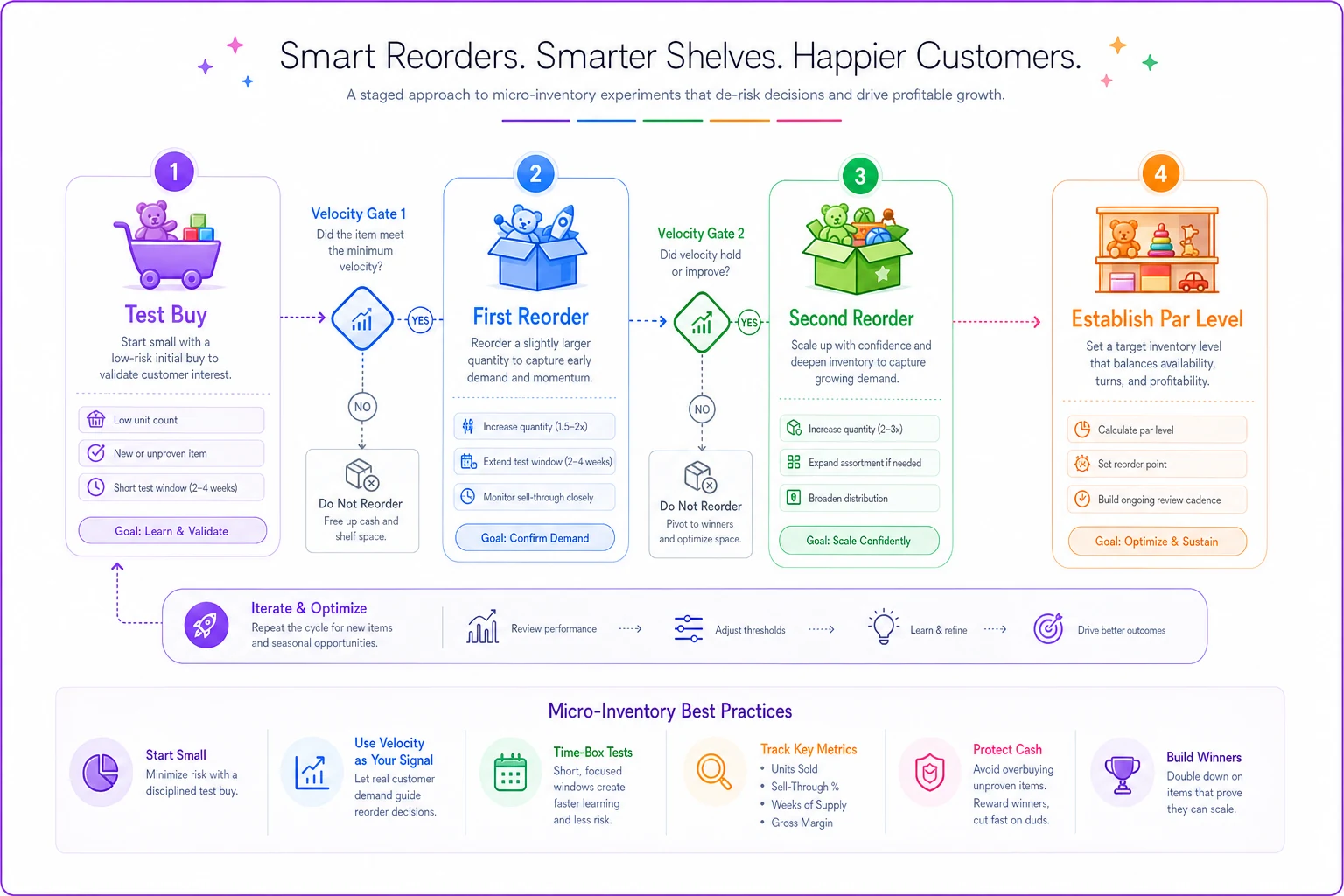
Passing the first gate doesn't mean you scale straight to a full display. Micro experiments work best as a staircase — each successful step earns a slightly bigger next step, so you never make a large commitment on a SKU that's only proven itself once.
A staged reorder process:
Here's a quick visual to think about how each reorder step builds on the last.
-
Test buy — smallest quantity that lets you read real demand (see the table above).
-
First reorder — only if the velocity gate passes. Match or slightly exceed the test quantity. You now have two data points on sell-through.
-
Second reorder — if velocity holds across the first reorder, this is where you can go deeper, maybe 1.5–2x, and give it real shelf presence.
-
Establish a par level — once a SKU has passed two or three cycles consistently, it graduates out of "experiment" status and into your normal replenishment rules, with a reorder point tied to lead time.
That last step matters because experiments aren't supposed to run forever. The goal is to promote winners into your regular assortment and quietly retire the rest. If you're still "testing" the same SKU after four months, it's not a test anymore — it's just slow inventory you haven't admitted to.
For how proven items fit into your broader replenishment and seasonal buying rhythm, it's worth pairing this with a structured approach like the one in Build a seasonal inventory system that prevents stockouts and protects cash — micro experiments feed the top of that funnel, and the seasonal system handles the SKUs that graduate.
When micro experiments make sense — and when they don't
This method is built for genuine uncertainty. It's overkill for some situations and inappropriate for others.
When this actually makes sense:
-
New lines from a rep you haven't tested before
-
Trend-driven items where demand could evaporate fast
-
Higher-priced items where a wrong guess ties up real cash
-
Anything you're "curious about" but can't confidently forecast
When this is a bad idea:
-
Proven core SKUs — you already know these sell, so don't artificially cap them and create stockouts on your winners
-
Deep seasonal buys with long lead times, where you can't reorder fast enough for a test-then-scale rhythm to work
-
Exclusive or one-shot collectible drops, which follow their own scarcity logic rather than velocity gates
Who should NOT run this at all: If you don't have a reliable way to see per-SKU sell-through by date, you can't run real experiments — you'll be guessing at the gate. Fix your visibility first. Running "experiments" you can't measure just gives false confidence to buys you didn't actually validate.
That measurement point is the quiet backbone of this whole thing. The reason most stores don't run disciplined micro experiments isn't that they disagree with the concept — it's that pulling sell-through-since-order-date for 15 test SKUs by hand is tedious, so it doesn't get done. This is exactly where AI-assisted operational software earns its place: the platform tracks each test SKU's order date and units sold, flags when a velocity gate is approaching or has been missed, and surfaces the borderline cases that need a human decision. You're not handing over judgment — you're just no longer relying on memory and a spreadsheet you forgot to update.
A worked example
A small store — two-person operation doing roughly $30k–$35k a month — was carrying around 18 unproven SKUs at any given time, most bought at whatever the case pack demanded. At end-of-season markdowns, they were writing down close to $1,400 in slow "maybe" buys, plus the shelf space and attention those items ate up all season.
They switched to sized test buys with written velocity gates. First-test quantities dropped, so each new SKU risked $50–$120 instead of a full case. Gates were set by category — four weeks for impulse, six for mid-price. At each gate, they read the number and either reordered or stopped.
Two seasons in, the results weren't dramatic on the winners — good SKUs are good SKUs. The difference showed up in the losers. Deadstock markdowns fell to somewhere around $500–$600, roughly a 55–60% cut, mostly because dead SKUs got caught after one small test instead of two or three reflexive reorders. Freed-up cash went into deeper buys on the items that were actually passing gates, which is where it should have been the whole time.
Nothing about that requires a bigger budget. It requires smaller first bets and the discipline to honor the gate.
Keep the losers small, let the winners earn their space
The whole philosophy here is boring on purpose. You're not trying to predict which new toy becomes a hit. You're building a system where being wrong is cheap and being right compounds — small test, clear gate, staged reorder, graduate the winners, retire the rest without drama.
If you want to go one level deeper on how test SKUs interact with the rest of your shelf and cash position, the framework in A cash-aware assortment framework for toy stores: SKU triage, lifecycle rules and a one-page scorecard pairs naturally with this — micro experiments are how new SKUs earn a spot in that assortment in the first place.
Start with your next three "maybe" buys. Write the quantity, the gate, and the date on each before the order goes out. Then, when the date comes, do the hardest and simplest thing in retail buying: read the number and act on it.
Start with your next three "maybe" buys. Write the quantity, the gate, and the date on each before the order goes out. Then, when the date comes, do the hardest and simplest thing in retail buying: read the number and act on it.
Ready to elevate your toy store operations?
Join 500+ toy retailers using GoToyvio to increase sales, reduce stockouts, and enhance customer loyalty.