
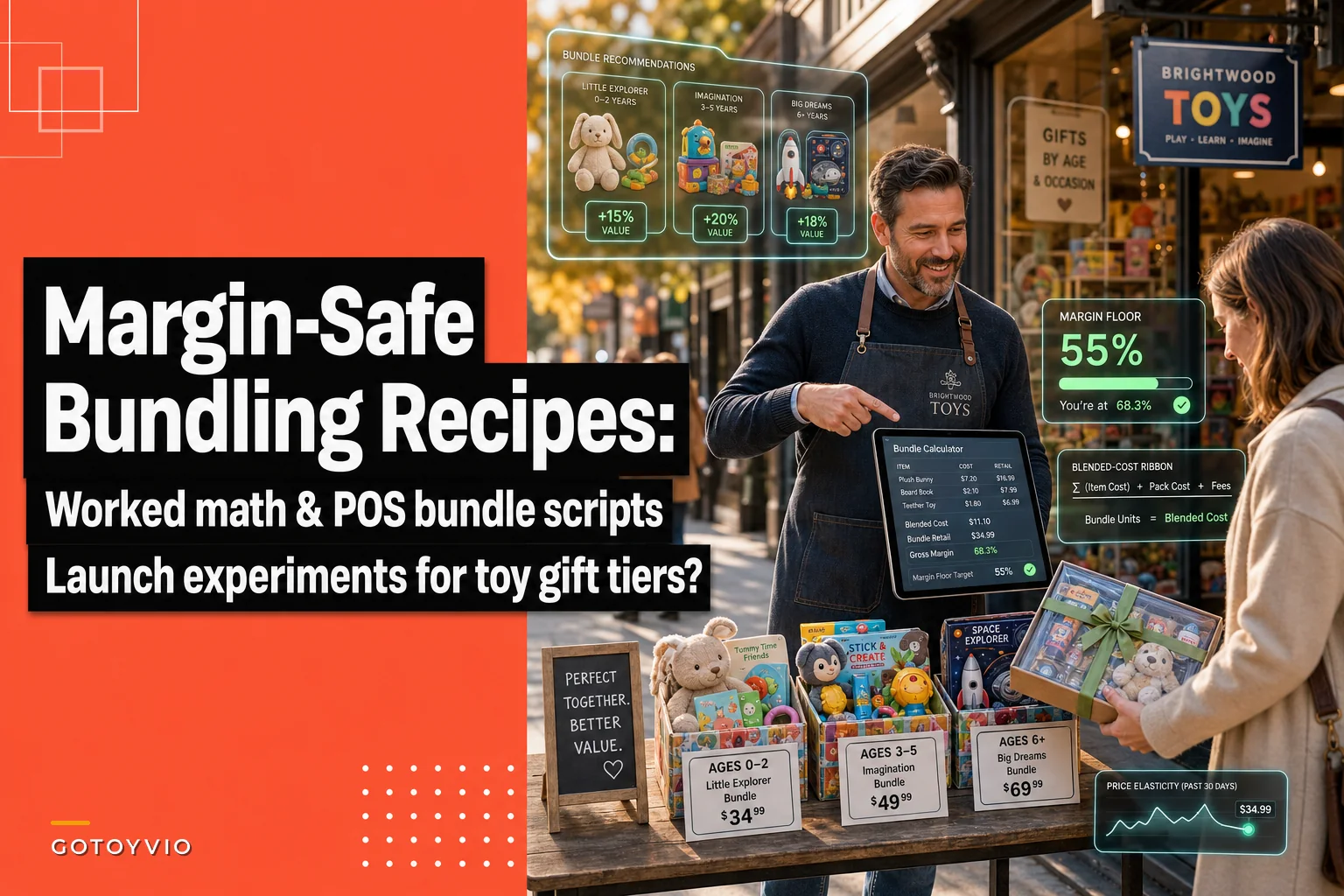

Most bundles fail in one specific way: the store owner picks three cute items, adds them up, knocks off 15%, and calls it a gift set. Then two months later they wonder why gross margin dipped even though average order value went up.
That's the trap. A bundle can lift your ticket and shrink your profit at the same time, and unless you're doing the math at the SKU-cost level, you won't see it until the quarter closes.
This walks through the actual arithmetic, the POS setup language that keeps discounts from stacking, and a couple of small-test designs for age-and-occasion gift tiers — so you're not committing a full season's inventory to a guess.
The margin math nobody does before launch
A store bundles three items with a combined retail of $60 and sells the bundle at $50. Feels like a fair 17% discount. But look at what happens to margin dollars.
Say the cost breakdown looks like this:
| Item | Retail | Cost | Margin $ |
|---|---|---|---|
| Wooden puzzle | $24 | $12 | $12 |
| Plush animal | $18 | $9 | $9 |
| Board book | $18 | $8 | $10 |
| Standalone total | $60 | $29 | $31 |
Sold separately, you make $31 on $60 — just over 51% margin.
Now bundle it at $50. Your cost is still $29. Margin dollars drop to $21. Margin percentage falls to 42%. You gave away $10 of profit to move three items that might have sold on their own anyway.
The number that matters isn't the discount percentage. It's the margin dollars per bundle versus margin dollars if those items sold separately at expected rates. A bundle only earns its discount if it either (a) sells items that would've otherwise sat, or (b) increases units-per-transaction enough that total margin dollars go up despite the lower rate.
A cleaner version of the same bundle: swap the $18 plush for a $14 plush that costs you $5.50. Standalone retail drops to $56, cost becomes $25.50. Bundle at $48 and your margin is $22.50 — better than the original $50 bundle, at a lower price that reads as a nicer deal to the customer. Same perceived value, better economics. Build the recipe around cost, not retail. That's the whole game.
A bundle recipe framework that holds its margin
The recipes that survive a real season follow a floor rule. Set a minimum blended margin you won't go below — say 45% — and build every bundle backward from it.
Never run out of bestsellers again.
GoToyvio helps you monitor inventory and sales to keep your shelves stocked and customers happy.
- Real-time stock tracking
- Automated reorder alerts
- Sales and promotion analytics
No credit card required
-
Set your margin floor. Pick the lowest blended margin % you'll accept. For most independent toy stores this lands somewhere between 42% and 48%.
-
Anchor with one hero item. Every bundle needs one thing the customer actually came for. That item can carry a thinner margin because it's driving the purchase.
-
Pad with high-margin fillers. Add one or two items with 55%+ margin — stickers, small plush, activity books, craft kits. These pull the blended number back above your floor.
-
Calculate blended cost, not blended retail. Total the costs first. Divide by your target margin to find your minimum viable bundle price.
-
Round to a psychological price above the minimum. If the math says $46.20, price at $49, not $45. Never price below the calculated floor.
-
Check against standalone velocity. If all three items sell fine separately, the bundle needs to earn its discount through added units, not just repackaging.
The filler step is where most stores leave money on the table. A $6 sticker sheet that costs $1.80 carries a 70% margin. Adding it to a bundle actually raises your blended margin while making the gift feel more complete. Two of those in a mid-tier bundle can offset a thin-margin hero item almost entirely.
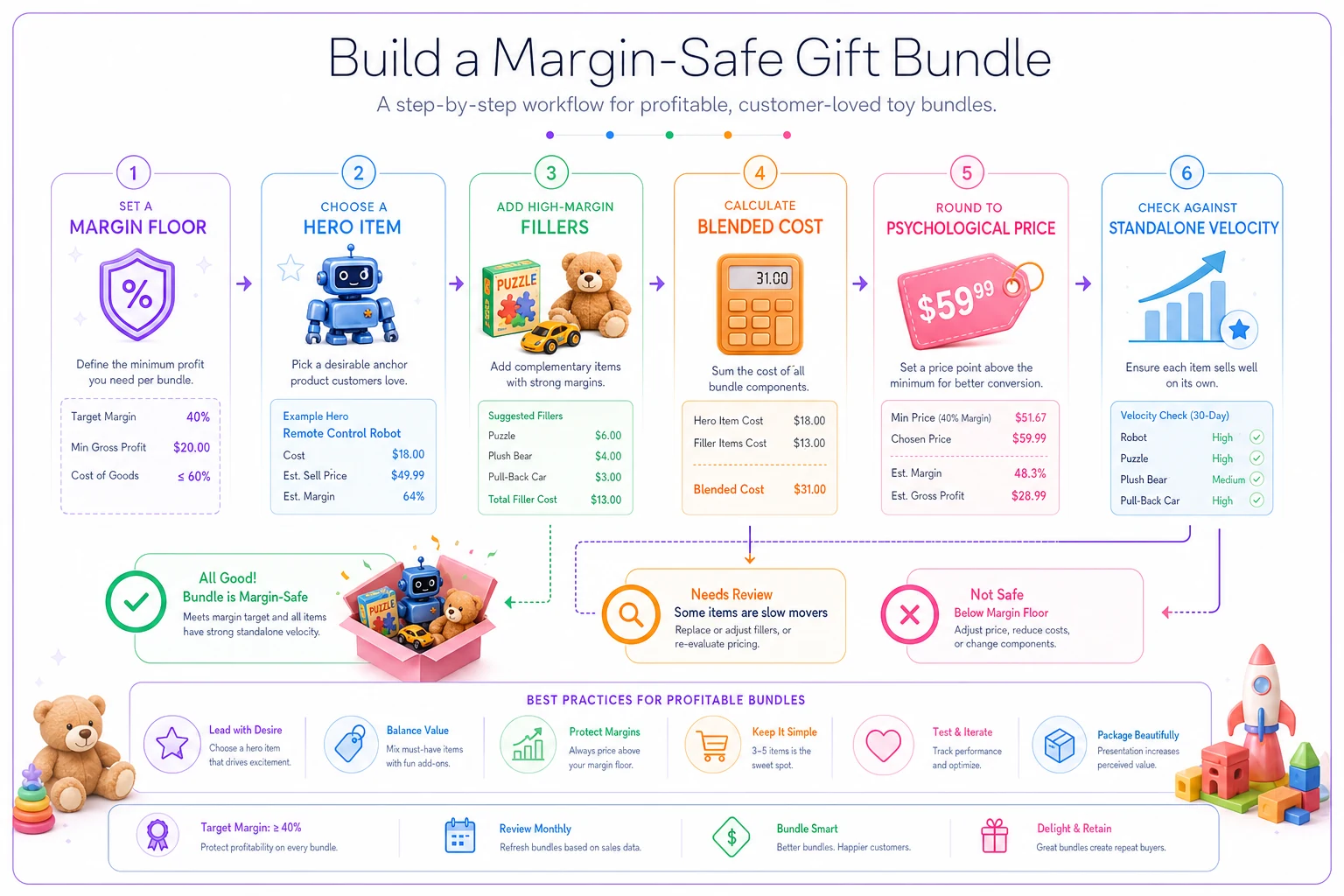
A quick visual of that workflow.
If the math says $46.20, price at $49, not $45.
Most store owners skip this step because they're thinking about what looks good in the basket, not what the cost sheet looks like. Both matter, but the cost sheet is the one that determines whether you're still in business next season.
POS bundling scripts that stop discount stacking
The quiet killer of bundle margin isn't the bundle discount itself. It's the second discount that lands on top of it.
A typical failure: you build a $49 bundle, a customer walks in during a "20% off everything" weekend, and your POS applies the storewide discount to the already-discounted bundle. Now your $49 set rings up at $39.20 and your 45% margin just became 30%.
Create the bundle as its own SKU. Don't ring up three separate items and manually key a discount. That opens the door to cashier error and makes reporting useless. Build a single "Toddler Birthday Bundle – Age 2-3" SKU with its own fixed price and its own cost listed as the sum of component costs.
Flag bundle SKUs as discount-exempt. Most modern POS systems have a field or tag for "exclude from automatic discounts," or let you carve out a product category from promo rules. Put every bundle in a category like BUNDLES and write your storewide promo to exclude that category.
Decrement component inventory, not the bundle. This is the part people miss. If your bundle SKU has its own stock count, your shelf inventory and your bundle inventory drift apart fast. The clean setup ties the bundle to its components so selling one bundle removes one puzzle, one plush, one book from real inventory counts. Systems that support "kit" or "assembly" SKUs handle this automatically. If yours doesn't, you're doing manual counts — which usually breaks by week three.
Simple cashier-facing script for the register, printed on a card near the terminal:
-
Bundle prices are fixed. No additional coupons, loyalty discounts, or storewide promos stack on bundle SKUs.
-
If a customer asks to split a bundle, ring items individually at full price — don't apply the bundle price to a partial set.
-
If the POS tries to apply a discount to a bundle, void and re-ring. Flag it to the manager; the promo rule needs fixing.
That third line matters more than it looks. When a promo rule accidentally catches a bundle, it usually catches every bundle sold that weekend — silently — until someone notices the numbers are off. Catching it at the register the first time saves the whole promo period.
If your product data lives cleanly in your POS to begin with, most of this configuration is straightforward. Stores that struggle with bundle setup are usually the ones whose master SKU data is already messy, which is a separate problem worth fixing first, and one that a single source of truth built on clean assortment records makes far easier.
Gift tiers by age and occasion: the assortment logic
Bundles sell best when the customer doesn't have to think. A grandparent walking in for a 4-year-old's birthday wants to point at "the one for a 4-year-old birthday" and be done. That means your tiers should map to how people actually shop — by age band and occasion — not by product category.
A workable tier grid:
| Tier | Age band | Occasion | Target price | Blended margin target |
|---|---|---|---|---|
| Starter | 0–2 | New baby / first birthday | $29–$35 | 47%+ |
| Classic | 3–5 | Birthday | $39–$49 | 45%+ |
| Big Kid | 6–8 | Birthday / reward | $49–$65 | 44%+ |
| Premium | any | Holiday centerpiece | $75–$95 | 43%+ |
The margin target drops slightly as price rises — intentionally. Higher-ticket bundles can absorb a thinner rate because the margin dollars are larger. A 43% margin on an $89 bundle is $38 in profit; a 47% margin on a $32 bundle is only about $15. Both are fine, but you don't need to chase the same percentage at the top of the range.
The occasion label does real work here. "Birthday" and "new baby" bundles sell year-round at steady volume. "Holiday centerpiece" bundles are seasonal and should be built and stocked against your seasonal cadence — the same discipline you'd apply when you build a seasonal inventory system that protects cash rather than over-committing to sets that only move six weeks a year.
Keeping that distinction clear in your assortment planning matters. Treating a seasonal bundle the same as an evergreen one usually means you're carrying components through spring that should have been cleared in January.
Small-test designs so you're not guessing
Committing a season's worth of inventory to an untested bundle is how stores end up with 40 half-assembled gift sets in February. Test small first.
The two-week shelf test. Build 8–12 units of a single bundle. Place it somewhere visible with a clear age/occasion sign. Track two things only: units sold, and how many customers picked it up and put it back. If it moves 6+ units in two weeks with your target margin intact, it's worth scaling. If it moves 1–2, break it down and move on before you build more.
The A/B price test. Same bundle contents, two price points a week apart — say $45 one week, $49 the next. Toy buyers are less price-sensitive on gifts than you'd expect. More often than not the $49 version sells nearly as many units at a better margin. You only learn this by testing; guessing usually leaves you underpriced.
The swap test. Keep the hero item fixed, rotate the filler. Run "puzzle + plush + stickers" against "puzzle + plush + mini craft kit." Whichever fillers move faster tell you what to stock deeper on. Cheapest test you can run because your hero item stays constant and only one variable changes.
A realistic small-store example: a shop running four Classic-tier birthday bundles built 10 units each. Two performed well — the dinosaur set and the art set moved through in about ten days. The other two barely moved and got broken back into shelf stock. Total tied-up capital during the test was maybe $600–$700. The store walked away knowing exactly which two bundles to scale for the birthday season instead of betting on all four. Those two winners added somewhere around $1,400–$1,800 in bundle sales over the next two months at a blended margin that held near 45%.
The losers cost almost nothing. The winners told you where to put real inventory. That's the whole point.
When bundling makes sense — and when it doesn't
Bundling isn't free. Every bundle you build is capital tied up in a pre-assembled unit that can only sell as a set until you break it apart. Worth being honest about when it's actually the right move.
When it makes sense:
-
You have slow-moving inventory that pairs naturally with a proven seller.
-
Gift-buying customers — grandparents, occasion shoppers — are a meaningful chunk of your traffic.
-
You have high-margin filler items to blend the math back above your floor.
-
You want to raise units-per-transaction during a steady season.
When it's a bad idea:
-
Every item in the bundle already sells fine on its own at full price. You're just discounting things that didn't need discounting.
-
Your margins are already thin storewide — bundling compresses them further.
-
Your inventory data is unreliable, so component tracking will drift and you'll oversell.
Stores that can't yet track component-level inventory accurately should probably skip bundling altogether for now. If you don't know your real cost per item and your counts are off, bundle math is fiction. You'll be making margin decisions on bad numbers. Fix the data foundation first, then bundle.
Every recipe that protects margin comes from the same habit: build from cost up, not retail down. Set a margin floor, anchor with a hero item, blend the number back up with high-margin fillers, and configure your POS so no second discount ever lands on a bundle price. Then test in batches of ten before you commit to a season.
Do that, and bundles stop being a slow leak and start being one of the few levers that lifts both ticket size and total margin dollars at the same time. Skip the math, and you're just repackaging profit and handing it away with a bow on top.
Ready to elevate your toy store operations?
Join 500+ toy retailers using GoToyvio to increase sales, reduce stockouts, and enhance customer loyalty.