
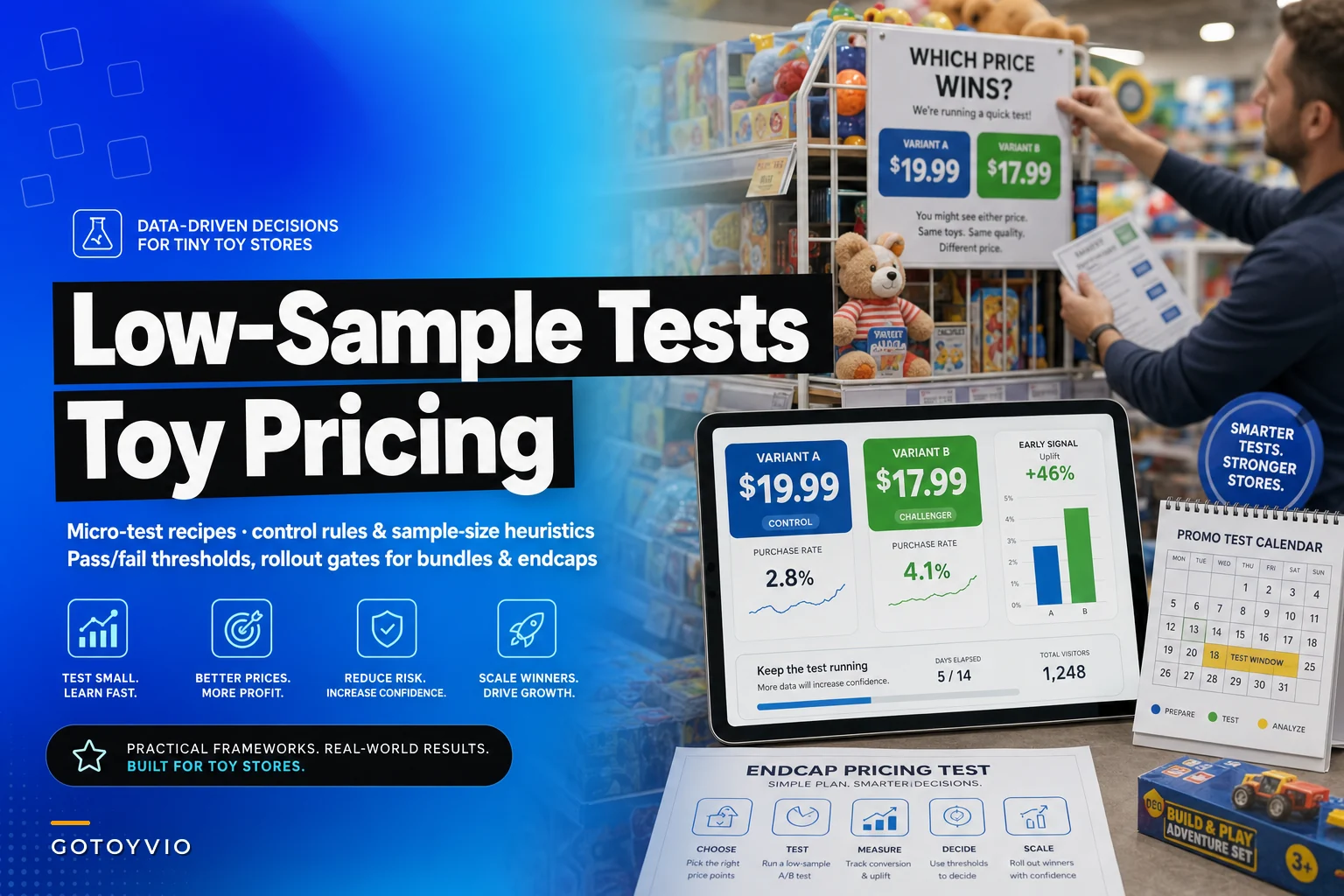

Running a pricing test at a toy store that moves 6 units of a SKU in a good week is nothing like running one at a chain. The textbook A/B advice assumes you'll hit statistical significance in a weekend. You won't. If you wait for "significance" on a $34 wooden train set that sells 20 units a month, you'll be waiting until the product is discontinued.
The real question isn't "how do I run a clean A/B test." It's "how do I make a confident-enough pricing or promo decision with 30 data points instead of 3,000, without fooling myself?"
That's a different discipline. It's less about math purity and more about building guardrails so a lucky weekend doesn't trick you into a permanent price change. Below are the actual test recipes — the control-group rules, the low-sample heuristics, and the pass/fail thresholds — written for the volume a real neighborhood toy store actually does.
The core problem with small-sample tests (and why most owners get it wrong)
There's a trap almost everyone falls into. You bump the price on a popular puzzle from $24.99 to $27.99 on a Saturday. You sell five of them. "Great, demand held, let's keep the higher price." Next week you sell one. Now you're confused.
At low volume, weekly noise is bigger than the effect you're trying to measure. A single birthday party buying three of the same gift can swing your "test result" by 60%. A rainy weekend can erase it. Your sample isn't telling you about price sensitivity — it's telling you about the weather and one grandmother's shopping list.
-
Longer test windows (measuring in weeks and units sold, not days)
-
Bigger effect sizes (testing a $3 move, not a 40-cent move, so the signal is loud enough to see)
If you're going to test, test things that are big enough to matter and run them long enough to trust.
The three test types worth running (and the two that aren't)
Not every pricing question deserves a formal test. At your volume, a test "costs" you weeks of lost clarity, so reserve it for decisions that are reversible, repeatable, and meaningful to margin.
Never run out of bestsellers again.
GoToyvio helps you monitor inventory and sales to keep your shelves stocked and customers happy.
- Real-time stock tracking
- Automated reorder alerts
- Sales and promotion analytics
No credit card required
| Test type | Worth testing? | Why |
|---|---|---|
| Base price change on a steady seller | Yes | Repeats weekly, compounds over the year |
| Bundle vs. individual pricing | Yes | Affects attach rate and average basket |
| Endcap placement + promo | Yes | Cheap to run, fast to read on traffic |
| One-off clearance price | No | You're dumping it anyway; just move it |
| Price on a brand-new SKU | No | No baseline to compare against |
The last two trip people up. Testing clearance pricing is pointless — the goal is to clear, not to optimize. And testing a brand-new product's price has no control because you have nothing to measure "normal" against. For new items, you're better off with a staged velocity read, which overlaps with the approach in our micro-inventory experiments playbook.
For new items, you're better off with a staged velocity read, which overlaps with the approach in our micro-inventory experiments playbook.
Recipe 1: The base-price test (control-group rules for a single location)
You only have one store, so you can't run a true geographic control group. Your control is time. The cleanest version:
The before/after-with-matched-weeks method:
-
Pick a SKU that sells at least 15–20 units a month. Below that, skip it.
-
Record 3 "before" weeks at the current price. Note units sold and total traffic if you track it.
-
Change the price (aim for a 10–15% move so the signal is readable).
-
Record 3 "after" weeks.
-
Compare units sold per 100 store transactions, not raw units. This strips out the "slow week vs. busy week" noise that wrecks raw comparisons.
Why units-per-100-transactions matters: if your store did 400 transactions the before weeks and 520 the after weeks (hello, holiday creep), raw unit comparison lies to you. Normalizing to traffic is the single biggest fix for small-store test accuracy.
Pass/fail threshold: Keep the higher price only if gross margin dollars per 100 transactions improve by at least 10%, and units don't fall more than ~25%. That second rule protects you from winning on margin while quietly killing a product's role as a traffic driver.
A worked example
-
Before (3 weeks) 54 units across 1,180 transactions → 4.58 units per 100 transactions → margin of about $50.30 per 100 transactions.
-
Raise price to $22.99 (margin now $13.99).
-
After (3 weeks) 41 units across 1,090 transactions → 3.76 units per 100 transactions → margin of about $52.60 per 100 transactions.
Margin per 100 transactions went up roughly 4.5%. Units dropped about 18%. Under the threshold above, this is a borderline fail — the margin lift is under 10% and units took a real hit. The honest read: the price move barely helped and cost you volume. Roll it back, or test $21.99 as a middle point.
That "barely helped" conclusion is the whole point. A naive owner sees "margin went up, keep it." The threshold stops you from locking in a move that's within the noise.
Recipe 2: The bundle test (A/B without a control store)
Bundles are the best thing a small toy store can test, because the comparison lives inside the same week. You're not comparing time periods — you're comparing attach behavior on the same traffic.
The setup: offer the bundle at the register and on the shelf, and track how often it's taken versus the component items sold separately. For the margin math behind building bundles that don't quietly bleed profit, our margin-safe bundling recipes walks through the per-unit math — this section assumes you've already built a bundle that's margin-positive and you just want to know if it sells.
Low-sample heuristic for bundles: You don't need significance. You need a clear directional read over ~40 relevant transactions. Watch two numbers:
-
Attach rate of customers who bought the anchor item, what % added the bundle partner?
-
Basket margin did average margin on those baskets go up or down?
Pass threshold: attach rate above ~20% and basket margin flat-or-up. If attach is high but basket margin drops, your discount is too deep — you're buying attach you'd have gotten anyway.
Worked bundle example
Anchor item: a $29.99 ride-on toy. Partner: a $12.99 helmet. Bundle at $38.99 (a $4 discount).
Over three weeks, 46 people bought the ride-on. 11 took the bundle. That's a 24% attach rate — above threshold. The discount costs you $4 per bundle, but each bundle moves a helmet you were selling to maybe 1 in 10 of those buyers anyway. Net, you're pulling helmet attach from roughly 10% to 24%, and the incremental helmets more than cover the discount.
Pass. Roll it out. But note what you'd miss without tracking the baseline helmet attach — if helmets were already attaching at 22% organically, the bundle gained you almost nothing and you just gave away $4 eleven times.
Recipe 3: The endcap test (placement as a variable, not just price)
Endcaps are the cheapest test you can run because you're not risking margin, just shelf real estate. The variable is visibility, and the read is fast.
The rule most owners skip: test one endcap variable at a time. If you move a product and change its price and add a sign, and sales go up, you have no idea which lever worked. Change one thing.
-
Week 1–2 product sits in its normal aisle slot. Record units.
-
Week 3–4 same product, same price, moved to the front endcap. Record units.
-
Compare units-per-100-transactions.
Pass/fail: an endcap "earns" its spot if the featured product's velocity roughly doubles while it's up there, and it doesn't cannibalize a higher-margin item that used to live there. Endcap space is scarce — the bar should be high, not "it did a little better."
A common mistake: stores leave winning products on the endcap forever. Endcaps work partly because they're novel. Rotating them every 2–4 weeks keeps the lift alive; a static endcap slowly fades back to baseline within about six weeks.
Rollout gating: don't let one test become store policy
This is the part almost nobody builds, and it's where small stores lose money. A test passing once is not permission to change your pricing system forever. You need a gate between "this test passed" and "this is now how we price."
A simple three-gate structure:
-
Gate 1 — Directional pass. The test cleared its threshold once. Status: promising, not confirmed.
-
Gate 2 — Repeat pass. Re-run it in a different month or season. Toy demand is brutally seasonal; a price that held in October can collapse in February. Only things that pass twice, in different conditions, graduate.
-
Gate 3 — Rollout. Apply the change permanently and set a reminder to re-check it in 90 days.
The reason this matters: a single November test is contaminated by holiday urgency. People buy at prices in December they'd never accept in March. If you promote a holiday-window result straight to permanent policy, you've baked a seasonal fluke into your everyday pricing.
When a formal test is actually a bad idea
Not everything deserves this machinery. Skip the formal test and just decide when:
-
The item sells fewer than ~10 units a month. You'll never get a readable signal; use judgment.
-
The decision is reversible in one click. Just try it and watch for a week.
-
You're clearing dead stock. Price to move, not to optimize.
-
The margin difference between options is under a dollar and volume is low — the test costs more clarity than it's worth.
Who should not run these at all: if you're not already tracking units sold per SKU and total transaction counts cleanly in your POS, fix that first. Every recipe here depends on normalizing to traffic, and you can't do that without reliable transaction data. Running tests on messy data just gives you confident wrong answers.
A real scenario
A single-location store, mostly wooden toys and craft kits, wanted to raise prices across their craft line because costs had crept up. Instead of a blanket 15% increase, they ran base-price tests on their four best-selling kits over about six weeks, using the units-per-100-transactions method.
Two kits passed clearly — margin per 100 transactions improved around 12–14% with only minor unit softening. One was a borderline fail like the example above. The fourth actually dropped hard: a 12% price bump cut units by more than a third, because that kit was the one parents compared against a big-box equivalent down the road.
They raised prices on the two winners, held the borderline one, and kept the fourth cheap on purpose as a known price-comparison item. Net effect was a modest margin gain — somewhere in the low single-thousands annually — but more importantly they avoided an across-the-board hike that would've quietly bled volume on the one SKU customers actually price-check.
That's the real value of low-sample testing at this scale. It's not about finding huge wins. It's about not making a confident, expensive mistake across your whole assortment based on a hunch.
Keeping the tests organized without drowning in spreadsheets
The operational headache isn't the math — it's remembering which test is in which gate, when it started, and when it's due for a re-check. Most stores run two good tests, get busy with a holiday rush, and lose the thread completely. Six months later nobody remembers whether the $22.99 price "passed" or just never got reverted.
A lightweight tracking sheet with five columns handles most of it:
-
SKU and the exact variable being tested
-
Start date and current gate (1, 2, or 3)
-
Baseline number (units per 100 transactions)
-
Current result
-
Re-check date
Whether that lives in a spreadsheet, your POS notes, or an operations tool that nudges you when a re-check date hits, the format matters less than actually closing the loop. The stores that improve margin over time aren't the ones running the fanciest tests — they're the ones that finish the ones they start, gate them honestly, and re-check the winners before trusting them for good.
Here's a simple workflow for tracking tests and gates.
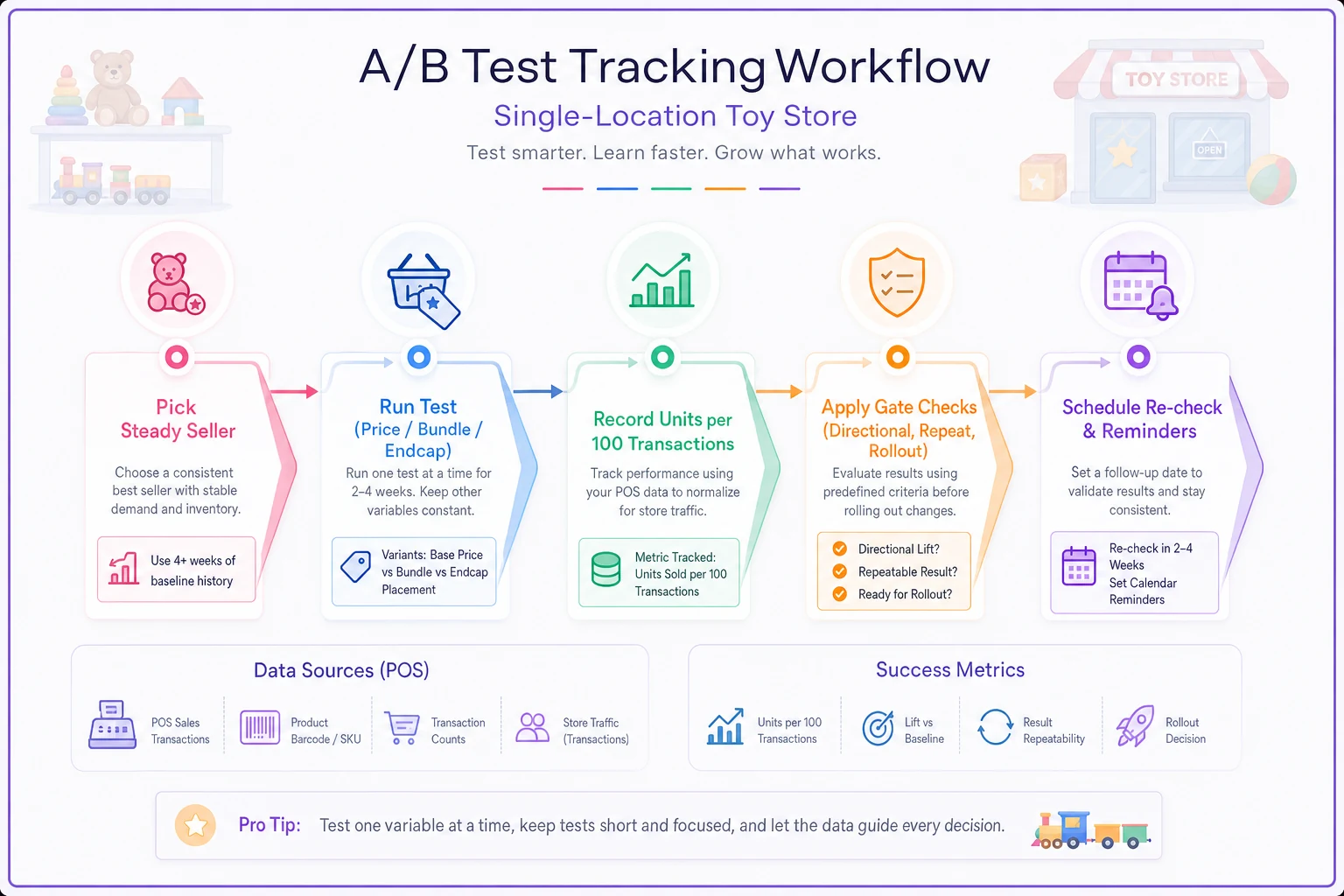
Set re-check reminders in your POS or calendar the moment you promote a test to Gate 3 so winners don't get forgotten.
Start with one test. Pick a steady seller, run the base-price recipe over three before-weeks and three after-weeks, normalize to traffic, and hold it to the threshold. One honest test beats ten half-finished ones every time.
Start with one test. Pick a steady seller, run the base-price recipe over three before-weeks and three after-weeks, normalize to traffic, and hold it to the threshold. One honest test beats ten half-finished ones every time.
Ready to elevate your toy store operations?
Join 500+ toy retailers using GoToyvio to increase sales, reduce stockouts, and enhance customer loyalty.