

Most toy store owners treat gift cards as a checkbox feature. Someone asks for one during the holidays, you dig up a stack of plastic cards from the back office, load $50, and forget about it until the customer comes back in March to redeem it. That works fine until you scale — and then it starts creating problems you can't see on the sales report.
A gift card isn't a product. It's a loan your customer gives you, and how you handle that loan touches your pricing, your accounting, your fraud exposure, and your fulfillment flow all at once. Get the design wrong and you'll have breakage sitting on your books that you can't legally recognize, angry customers holding cards your POS can't read, and a fraud hole big enough to lose a few hundred dollars a month through.
This is how a toy store gift card program actually works as a system — where the money sits, where it leaks, and what changes when you go from selling ten cards a season to a few hundred.
Start with what a gift card really is on your books
When a customer hands you $50 for a gift card, that money is not revenue. You haven't sold anything yet. You're holding a liability — a promise to hand over $50 worth of toys later.
In accounting terms it sits in a deferred revenue (or "gift card liability") account. It only becomes revenue when the card gets redeemed. This matters more than it sounds because it changes how you read your own numbers. A store that sold $8,000 in gift cards during December looks like it had a monster month, but a big chunk of that is borrowed against future inventory you still have to buy and sell.
A simple way to think about the flow:
-
Card sold → cash goes up, gift card liability goes up. No revenue.
-
Card redeemed → liability goes down, revenue goes up, you recognize cost of goods sold.
-
Card partially redeemed → liability goes down by the spent amount only. The remaining balance stays as a liability.
-
Card expires or goes unredeemed ("breakage") → after a legally defined period, you can recognize the leftover as revenue, but the rules vary by state.
That breakage line is where a lot of small stores get sloppy. Some states prohibit expiration on gift cards entirely, or require you to escheat — turn over unused balances to the state as unclaimed property — after a set number of years. You don't want to be quietly booking breakage as profit if your state says that money belongs to the customer forever. Check your state's rules once, write down the answer, and move on.
Why the "cash now" excitement hides the real risk
Selling stored value feels great because the money hits your account immediately. But there are two connected problems underneath that.
Never run out of bestsellers again.
GoToyvio helps you monitor inventory and sales to keep your shelves stocked and customers happy.
- Real-time stock tracking
- Automated reorder alerts
- Sales and promotion analytics
No credit card required
The first is a timing mismatch. Gift cards spike hard in November and December, then get redeemed January through spring — often on discounted or clearance inventory. So you collect full-price cash in Q4 and give away product during a lower-margin window. If you spend that December cash on rent and payroll without reserving for redemption, you've essentially borrowed from your February self.
The second is margin dilution you don't notice. When a customer redeems a $50 card, they rarely spend exactly $50. They spend $63, so you capture an extra sale — good. But plenty redeem $41 and never come back for the last $9, and others use the card entirely on sale items. The pattern that shows up consistently: gift card redemptions skew slightly toward markdown product because people treat "free money" more loosely than their own cash.
Neither of these kills you at small volume. Both compound quietly as volume grows.
What breaks when you scale from a stack of plastic to a real program
At ten cards a season, everything is manual and everything is fine. You know the customers. You remember which cards you sold. Fraud isn't really a concern because there's no volume to hide in.
-
Balance tracking fragments. Physical cards, e-gift codes, and store credit from returns all become "stored value," but if they live in three different systems, nobody can tell a customer their real balance without hunting.
-
Redemption across channels breaks. A customer buys a card online and tries to redeem it in-store. If your e-commerce and POS don't share a balance ledger, that card is dead weight at the register.
-
Fraud finds the seams. Once codes are digital and volume is up, the classic scams start: buying cards with a stolen credit card then reselling them, or card-number harvesting on cheap sequential codes.
-
Returns get weird. Someone returns a $40 toy they originally paid for with a gift card. Do they get cash back? Store credit? If your policy isn't written down, your part-time weekend staff will improvise — and improvising with money is how you lose money.
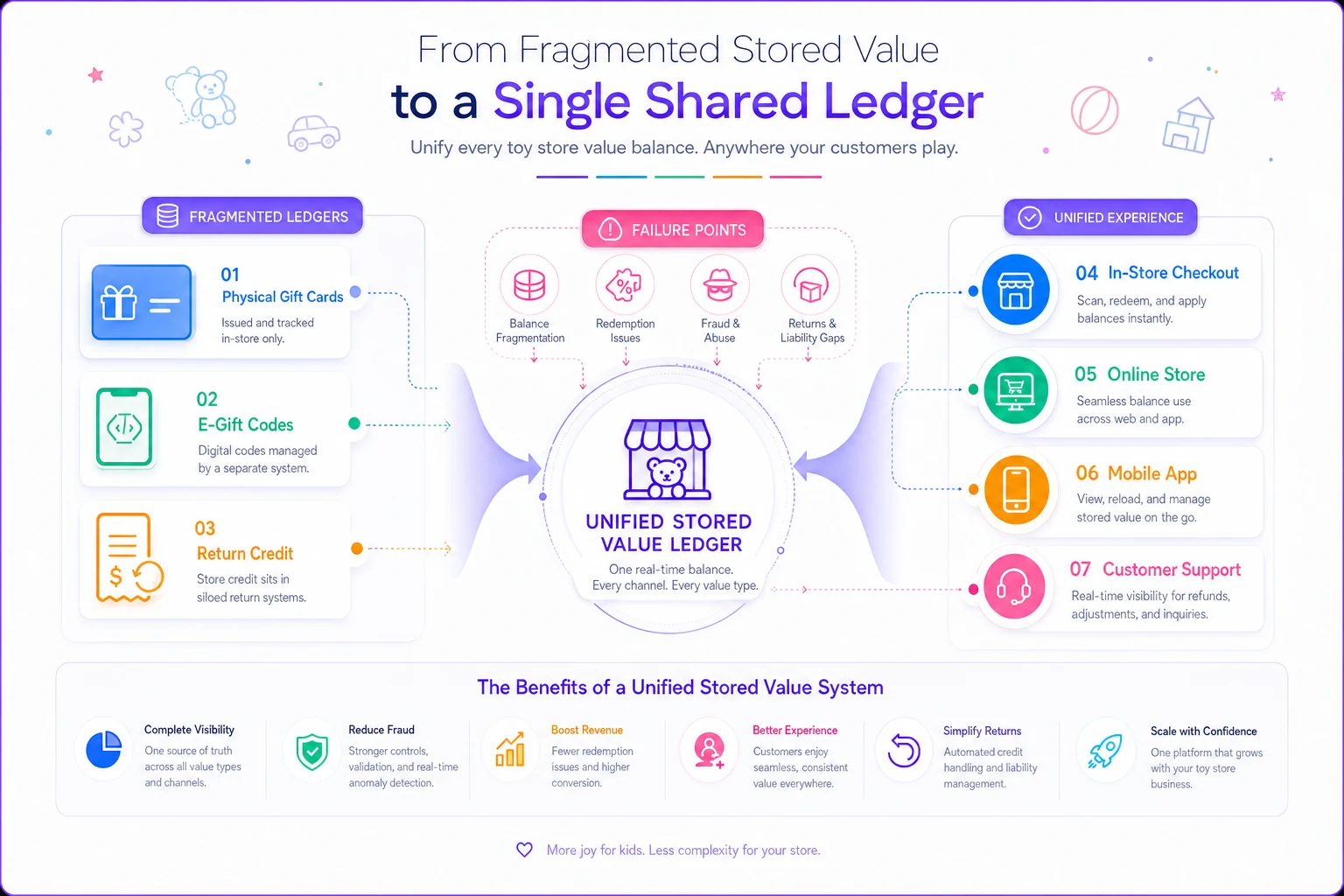
This shows where balances get lost and how a single ledger fixes the seams.
The through-line is that stored value is only safe when there's a single ledger every channel reads from. Same principle as treating your POS as the source of truth for inventory — the balance has to live in one place, and every sale, redemption, and refund has to write back to that one place.
A low-friction product design that owners can launch in a day
You don't need a fancy program. You need a simple design that doesn't create edge cases. Here's a workable default:
-
Denominations Offer fixed tiers ($25, $50, $100) plus one "custom amount" option. Fixed tiers speed up checkout and make corporate bulk orders cleaner. Custom covers the "I want exactly $65 for my nephew" crowd.
-
No expiration, no fees. Even where fees are legal, they generate complaints and chargebacks that cost more than the breakage they recover. Skip them.
-
One card type for everything. Store credit from returns, promotional credit, and purchased gift cards should all use the same stored-value mechanism so your staff learns one flow, not three.
-
Digital-first, plastic optional. E-gift cards email instantly, cost nothing to stock, and are trackable. Keep a small run of physical cards for walk-in gifters who want something to hand over.
Offer fixed tiers and a custom amount to speed checkout and make bulk orders simpler.
The design goal is fewer decisions at the register. Every extra variable — an expiration date, a bonus rule, a special holiday card — is one more thing a stressed employee can get wrong on Black Friday.
The pricing math: bonus card promotions done right
The most common gift card promotion is the "spend $100, get $120" holiday bonus. It works, but you have to actually run the numbers or you'll give away margin you can't afford.
Say your blended gross margin is 45%. A customer buys a $120-value card for $100. Eventually they redeem the full $120 on product.
| Line item | Amount |
|---|---|
| Cash collected | $100.00 |
| Value the customer can redeem | $120.00 |
| Product cost when redeemed (55% of $120) | $66.00 |
| Gross profit on the redemption | $54.00 |
| Effective margin on the promo | ~35% |
So a 45% margin drops to roughly 35% when you factor the bonus. Still profitable — but only if you're pulling in customers who wouldn't have bought otherwise, or if the bonus card gets spent on higher-margin items. The trap is running this promo for existing customers who would've bought the $100 card anyway. In that case you just handed loyal buyers $20 for free and dented your Q1 margin.
A cleaner rule: run bonus promotions as a customer-acquisition tool, not a loyalty reward. Advertise it to bring new gifters in the door, cap the bonus tiers, and don't stack it with other discounts.
Fraud controls that don't slow down the register
Fraud on gift cards is boring and preventable, but only if you build the controls in from the start rather than after you've already been hit.
-
Stolen-card purchases. Someone uses a stolen credit card to buy $500 in e-gift cards, resells the codes before the chargeback lands. You eat the chargeback and the redeemed product.
-
Balance-checking bots hitting your online balance-lookup page to guess valid card numbers.
-
Return-fraud laundering — buying with a stolen card, returning for store credit, then spending clean.
Practical controls:
-
Randomized, long card numbers. Never sequential. Sequential codes are trivial to guess.
-
Velocity limits. Flag any single transaction buying more than, say, $300 in cards, and any customer buying cards multiple times in a short window.
-
Delay on large e-gift redemptions. Hold high-value online card purchases for a short review window before the code activates. Most legit gifters don't mind a few minutes; fraudsters need instant.
-
Return policy tied to original tender. If a purchase was made with a gift card, the refund goes back to gift card or store credit — never cash. Write this on the receipt.
-
Require a code or the physical card to check a balance — no open lookup that returns balances from a number alone.
AI-assisted fraud flagging in operational software helps here without adding friction for real customers — it watches redemption and purchase patterns in the background and surfaces the handful of transactions worth a human glance, rather than forcing you to manually review everything or skip it entirely.
A real scenario: what changed for one store
A single-location store selling mostly educational toys and building sets ran gift cards off a plastic-card stack and a spreadsheet. Volume was around 250–300 cards a year, spiking hard at the holidays.
Their problems weren't dramatic — they were the quiet kind. Staff couldn't reliably tell customers a card's balance, so they'd honor "I think there's about forty on it" and occasionally overpay. Online-purchased cards couldn't be redeemed in-store without a phone call to the owner. Nobody was tracking the liability, so December looked like a blowout month and February felt inexplicably tight.
After moving stored value into one ledger inside their POS and writing a one-page policy, the changes were unglamorous but real. Balance disputes basically disappeared. The owner could finally see gift card liability as a separate line and stopped spending redemption money early. They also caught that a chunk of December's "record" revenue was actually deferred — somewhere in the $3k–$4k range sitting as a liability that hadn't been earned yet. Knowing that alone changed how they planned Q1 buying.
No revenue miracle. Just fewer leaks and a clearer picture.
Where gift cards connect to the rest of your operation
Stored value isn't a standalone feature — it plugs into things you're probably already working on.
Gift cards are one of the better hooks for capturing customer information, since a gifter and a recipient are two potential contacts from one transaction. If you've set up consent-first checkout and birthday capture, a redeemed card is a natural moment to tag a new family and start understanding their kids' ages.
They also reinforce repeat visits. A recipient who redeems a card and spends a little extra is the beginning of a relationship — and that ties directly into family purchase cadence and lifetime value. The grandparent who buys a card every birthday becomes a predictable revenue rhythm you can actually plan inventory around.
When a stored-value program makes sense — and when it doesn't
When it's worth building out:
-
You have meaningful gift occasions (which every toy store does — birthdays and holidays are basically the whole business).
-
You sell across more than one channel and need balances to travel between them.
-
You're getting corporate or bulk gift requests you currently handle awkwardly.
When to keep it dead simple:
-
You're doing under roughly 50 cards a year and everyone in the shop knows the regulars. A single POS gift card feature is plenty; don't over-engineer.
Who should slow down before launching bonus promos:
-
Any store with margins under about 35%. A "get $20 free" promo on thin margins can wipe out the profit on the whole redemption. Run the table math first.
Any store with margins under about 35%. A "get $20 free" promo on thin margins can wipe out the profit on the whole redemption. Run the table math first.
A gift card program lives or dies on three unglamorous things: a single balance ledger every channel reads from, a written policy your weekend staff can actually follow, and honest accounting that keeps deferred revenue out of your spending plans. Nail those and gift cards become a genuine cash-flow and customer-acquisition tool. Skip them and you're running a small, leaky bank without meaning to.
Start with the accounting treatment and the one-page policy — both can genuinely get done in an afternoon. Fraud controls and bonus math can layer in as your volume grows. The point isn't to build something elaborate. It's to make sure the money you're holding on someone else's behalf is tracked, protected, and eventually earned.
Ready to elevate your toy store operations?
Join 500+ toy retailers using GoToyvio to increase sales, reduce stockouts, and enhance customer loyalty.