

Most toy stores run demos the same way: free in-store event, big crowd on a Saturday, a few impulse buys, and then nothing. The event was fun. The register bump was real. But three weeks later you can't point to a single repeat buyer who came back because of that demo.
That gap — between a packed free event and actual recurring revenue — is where almost all event monetization retail efforts fall apart. Not because the events are bad, but because there's no structured path from "free attendee" to "paying regular." People show up, enjoy themselves, and leave with no real reason to come back.
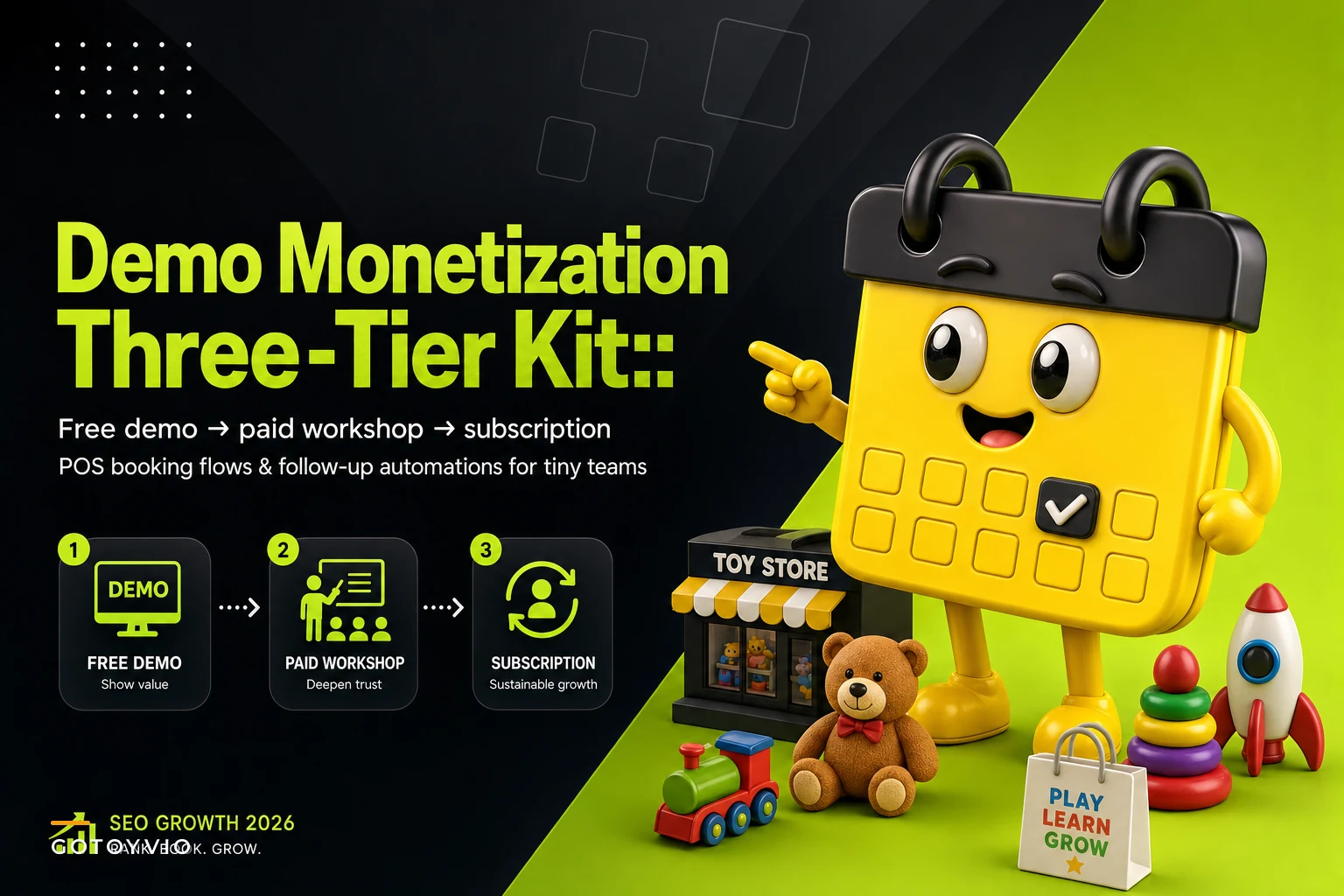
This post is about building that path. Specifically, a three-tier recipe: a free demo that feeds a paid workshop that feeds a low-tier subscription. Each tier has a job. Each tier has a POS booking flow and a follow-up template that a tiny team can actually run without a marketing department.
The core problem: your free event is a dead end
Walk the typical toy-store event funnel and you'll notice it has exactly one step. There's a free thing. That's it.
A free LEGO build night, a free slime demo, a free "meet the author" story hour. Great top-of-funnel energy. But the next question — what do these people do next? — has no answer baked into the operation. Staff isn't capturing who came. There's no paid offer waiting. There's nothing pulling that parent back through the door next Tuesday instead of just ordering the same kit on Amazon.
What tends to happen across a lot of small retailers is that the free event converts fine on the day. Sales are up. The problem is everything after. The attendee list evaporates because nobody logged it, and the one natural next step — a paid, higher-value experience — was never built.
The fix isn't "do fewer free events." Free events are your cheapest acquisition channel. The fix is giving each free event a destination.
The three tiers and what each one is actually for
Think of this less as a marketing funnel and more as three products that feed each other. Each has a different job, a different price, and a different conversion goal.
Never run out of bestsellers again.
GoToyvio helps you monitor inventory and sales to keep your shelves stocked and customers happy.
- Real-time stock tracking
- Automated reorder alerts
- Sales and promotion analytics
No credit card required
| Tier | Format | Price | Real job | Conversion target |
|---|---|---|---|---|
| Tier 1 | Free demo / drop-in | $0 | Capture contacts + create a "wow" moment | 15–25% book a paid workshop |
| Tier 2 | Paid workshop | $18–$35 per kid/family | Prove the experience is worth paying for | 20–30% join subscription |
| Tier 3 | Subscription / club | $12–$29/month | Recurring revenue + repeat visits | Retain 4+ months |
The numbers in that table matter less than the structure. The free demo exists to collect names and plant the idea of a paid version. The paid workshop exists to prove the paid experience is genuinely better — more hands-on, smaller group, a take-home result. The subscription exists to turn a one-off buyer into someone who walks through your door every single month.
The mistake most stores make is collapsing these. They either run only free events (no revenue ladder) or jump straight to a subscription pitch before any real trust is built. The middle tier — the paid workshop — is the piece almost everyone skips, and it's the most important one. It's where someone decides whether your store is worth paying for experiences, not just products.
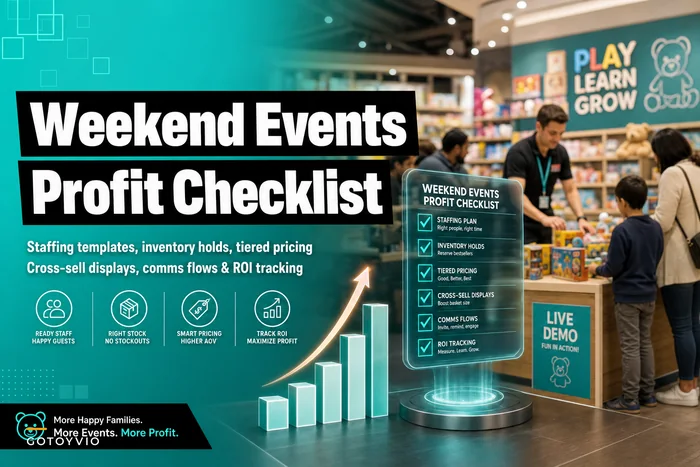
For the operational side of actually running these sessions profitably, the weekend event operations checklist covers the staffing and margin math that keeps each tier from losing money on setup time.
Tier 1 recipe: the free demo that doesn't leak attendees
The entire point of the free tier is capture plus a teaser. If you run a free demo and don't walk away with a contact list and a next-step offer, you ran an event, not a funnel.
Here's the booking flow worth setting up:
-
Require a free "ticket" even though it's free. Set up a $0 booking in your POS or event tool. This forces a name, email, and kid's age. A walk-in crowd gives you nothing. A reservation list gives you everything.
-
Cap the free event slightly below demand. If your space holds 20, book 16. Scarcity on the free tier makes the paid tier feel natural. "This one filled up — the paid workshop has guaranteed spots" is an easy upsell.
-
At the event, mention the paid workshop once, physically. A small sign at the demo table: "Loved this? The full build workshop is Saturday — 8 spots." No hard pitch. Just a visible next step.
-
Log every attendee's kid age at checkout. Age is the single most useful tag for later targeting. A 4-year-old's parent and a 9-year-old's parent want completely different workshops.
Use a $0 ticket in your POS to require name, email, and kid's age.
> Subject: Thanks for building with us today! > > Hi [Name] — so glad [Kid] joined the slime demo today. If they had fun, our hands-on Slime Lab workshop goes deeper — they take home three custom jars and a kit. It's $24 and we keep it to 8 kids so everyone gets help. Here's the link to grab a spot: [link]. Only a couple left for Saturday.
That's it. One email. One offer. The job of the free event was never to sell on the day — it was to earn permission to send that email.
Tier 2 recipe: the paid workshop that converts to subscription
The paid workshop is where your store proves it's worth money for more than products. This is the tier that justifies the whole ladder.
-
The paid version must be visibly better. Smaller group, a take-home result, more one-on-one time. If the paid workshop feels like the free demo with a price tag, nobody converts up.
-
Price it where "yes" is easy but it's not free. The $18–$35 range tends to land for a single-session kids' workshop. Low enough for an impulse yes, high enough that attendees treat it as a real commitment and actually show up.
-
End every workshop with the subscription offer, in person. This is the single highest-converting moment in the whole funnel — a parent who just watched their kid have a great time, standing at your counter.
The in-person pitch at the end of a workshop sounds something like: "If [Kid] wants to do one of these every month, we have a club — one workshop a month plus 10% off in-store, $19 a month, cancel anytime." You're not pitching a product. You're pitching more of the thing they just paid for and enjoyed.
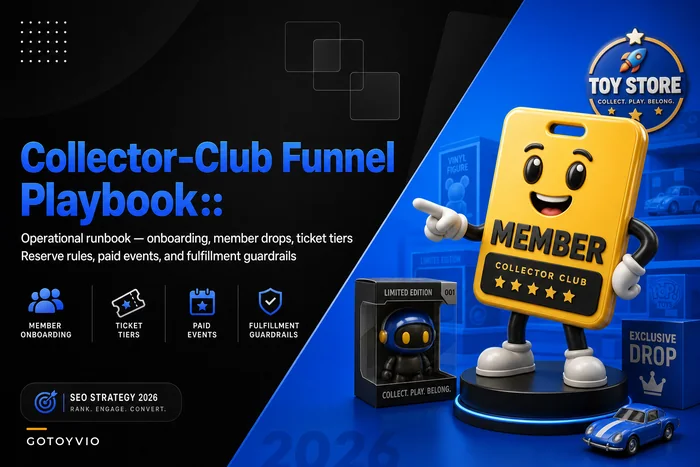
The collector-club mechanics behind making that recurring membership sticky — member-only drops, early access, the psychology of belonging — are worth borrowing from the collector-club funnel playbook, especially if you want the subscription to feel like a club rather than a billing arrangement.
> Subject: [Kid]'s spot in next month's workshop > > Hi [Name] — [Kid] did great at the build workshop. If they want to keep going, our monthly club holds a guaranteed spot each month plus 10% off everything in-store, for $19/month. Most families cover the cost with one or two visits. Want me to hold [Kid]'s spot for next month's session?
The subscription pitch reframes the price as already paid for by normal shopping. For a family that visits a toy store even occasionally, 10% off plus a workshop isn't really a cost — it's a rounding error with benefits.
Tier 3 recipe: the subscription that survives past month two
Subscriptions are easy to sell and hard to keep. The churn problem in a kids' subscription is almost always the same: the parent forgets the value exists. They signed up at an emotional high, then life happened, and by month three they're canceling because they "haven't used it."
The operational fix is making the value visible every month without it becoming a manual task:
-
Auto-reserve the member's workshop slot each month. Don't make them re-book. Pre-book them and send a confirmation. Opt-out, not opt-in.
-
Send a monthly "here's what you got" note. "This month your club saved you $14 in-store and [Kid]'s workshop spot is held for the 18th." Make the math obvious.
-
Track member visit cadence. A member who hasn't come in for 6 weeks is a churn risk. Flag them for a personal "we miss [Kid]" message before they cancel, not after.
Here's a quick visual of the workflow that keeps value visible each month.
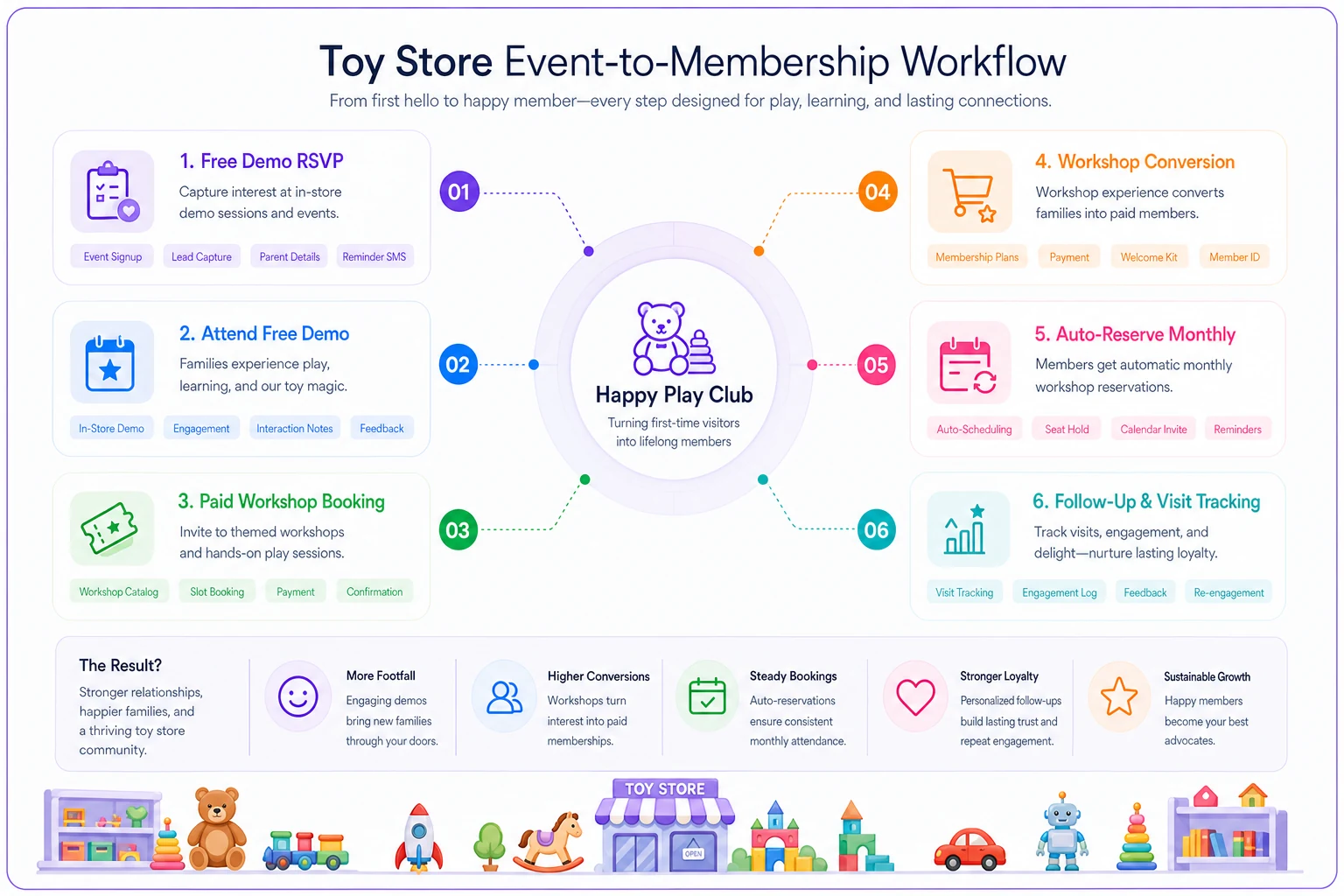
That last point is where a lot of small teams quietly lose their recurring revenue. Nobody's watching which members have gone quiet, so the first signal you get is the cancellation email — too late to do anything about it.
This kind of tracking is painful to do by hand across even 40–50 members. Logging who attended which workshop, which members are overdue for a visit, who needs a nudge before renewal — spreadsheets technically work, but they don't remind you. A booking-and-follow-up setup that pulls attendance from your POS and flags quiet members automatically turns that from a weekly manual chore into something that just surfaces the names you need to act on. The point isn't fancy automation; it's that the list builds itself instead of depending on someone remembering to check.
A real scenario: the slime-and-build store
Consider a small store running two free demos a month — a slime night and a LEGO build. Decent turnout, maybe 15–18 kids each, a nice sales bump on the day, but zero structured follow-up. Revenue from events was basically just same-day impulse sales.
They added the middle tier: a $24 paid workshop two weeks after each free demo, capped at 8, pitched with a single sign and one follow-up email. Then an end-of-workshop subscription offer at $19/month.
After a few months: of roughly 32 free-demo attendees a month, around 6–7 booked a paid workshop. Of those, about 2 joined the monthly club. That's only a handful of new subscribers a month — but they stack. By month four there were somewhere around 18–20 active members, a few hundred dollars of predictable monthly revenue that didn't exist before, and those members were coming in more often and spending beyond their discount.
Nothing about that is a revenue explosion. It's a slow, compounding base of recurring buyers built entirely from free events they were already running. That's the whole point.
When this makes sense — and when it doesn't
This works well when:
-
You already run free events and have the space for small paid sessions.
-
Your products support a "take-home result" workshop (craft kits, building sets, science toys).
-
You have at least one staff member who can run a small group comfortably.
This is a bad idea when:
-
You can't reliably staff a recurring monthly session. A subscription you can't deliver on is worse than no subscription.
-
Your demos are purely passive (a demo table nobody interacts with). You need a real hands-on experience to justify the paid tier.
-
You're launching all three tiers at once. Build Tier 1's capture habit first, add Tier 2 after a month or two, and only introduce Tier 3 once paid workshops are running smoothly.
Who should skip this entirely: stores with no event capacity and no one to run sessions. Forcing a subscription model onto a store that can't deliver monthly experiences just creates churn and refund headaches.
The one habit that makes the whole thing work
If you take one operational change from this, make it the $0 ticket on your free events. Everything downstream — the paid workshop upsell, the subscription pitch, the churn-prevention nudges — depends on knowing who came.
A store that captures its free-event attendees has a funnel. A store that lets them walk in and out anonymously just has nice afternoons.
The three-tier recipe isn't about running more events or grinding harder on Saturdays. It's about making sure every free event has a paid destination, every paid workshop has a recurring offer, and every member has a visible reason to stay. Build those three connections and your demos stop being one-day register bumps and start becoming a steady base of repeat buyers.
Ready to elevate your toy store operations?
Join 500+ toy retailers using GoToyvio to increase sales, reduce stockouts, and enhance customer loyalty.