

There's a specific kind of customer who walks into a toy store already knowing more about the product than the person selling it. They know the wave number. They know which variant had the misprint. They know the resale ceiling on last year's exclusive. These are the people who should be funding a significant chunk of your revenue, and in most stores they aren't—because the store treats them like walk-in traffic instead of members of something.
A toy collector membership program is the fix, but not the version most owners imagine. It's not a punch card with a fancier name. It's a funnel that moves an enthusiast from "I follow your Instagram" to "I paid $40 to get in the room early," and then keeps them cycling through drops, events, and reserves without the whole thing feeling like a cash grab. Getting people to join isn't usually the hard part. Keeping the perceived value from leaking is.
This is a runbook for the operational side of that: onboarding, tier design, reserve rules, drop mechanics, and the fulfillment guardrails that keep the exclusivity real.
Start with the funnel, not the perks
Most membership programs die because the owner designs backwards. They pick the perks first—10% off, early access, a birthday freebie—then try to bolt a funnel on later. What you end up with is a discount club that attracts bargain hunters, not collectors, and bargain hunters churn the second the discount stops feeling generous.
-
Attract — free followers, email list, in-store regulars who don't yet pay for access.
-
Convert — the moment someone pays to become a member (even a small annual fee).
-
Monetize — paid events, member-only drops, reserve deposits.
-
Retain — the cadence that keeps them coming back before they drift.
The convert step is where perceived value is created or destroyed. If joining is free, membership is worthless, and everything downstream feels cheap. A small paid barrier—say $25–$50 a year—does two things at once: it filters out people who were never going to spend anyway, and it makes the member feel like they've already invested, which raises how much they value what follows.
Stores that charge nothing for membership typically see somewhere around 3–5% of members actually buy from a drop. Stores that charge even a modest annual fee often see that closer to 15–20%, because the people in the room self-selected into caring.
Here's a quick visual workflow of the funnel stages to map operational decisions to each step.
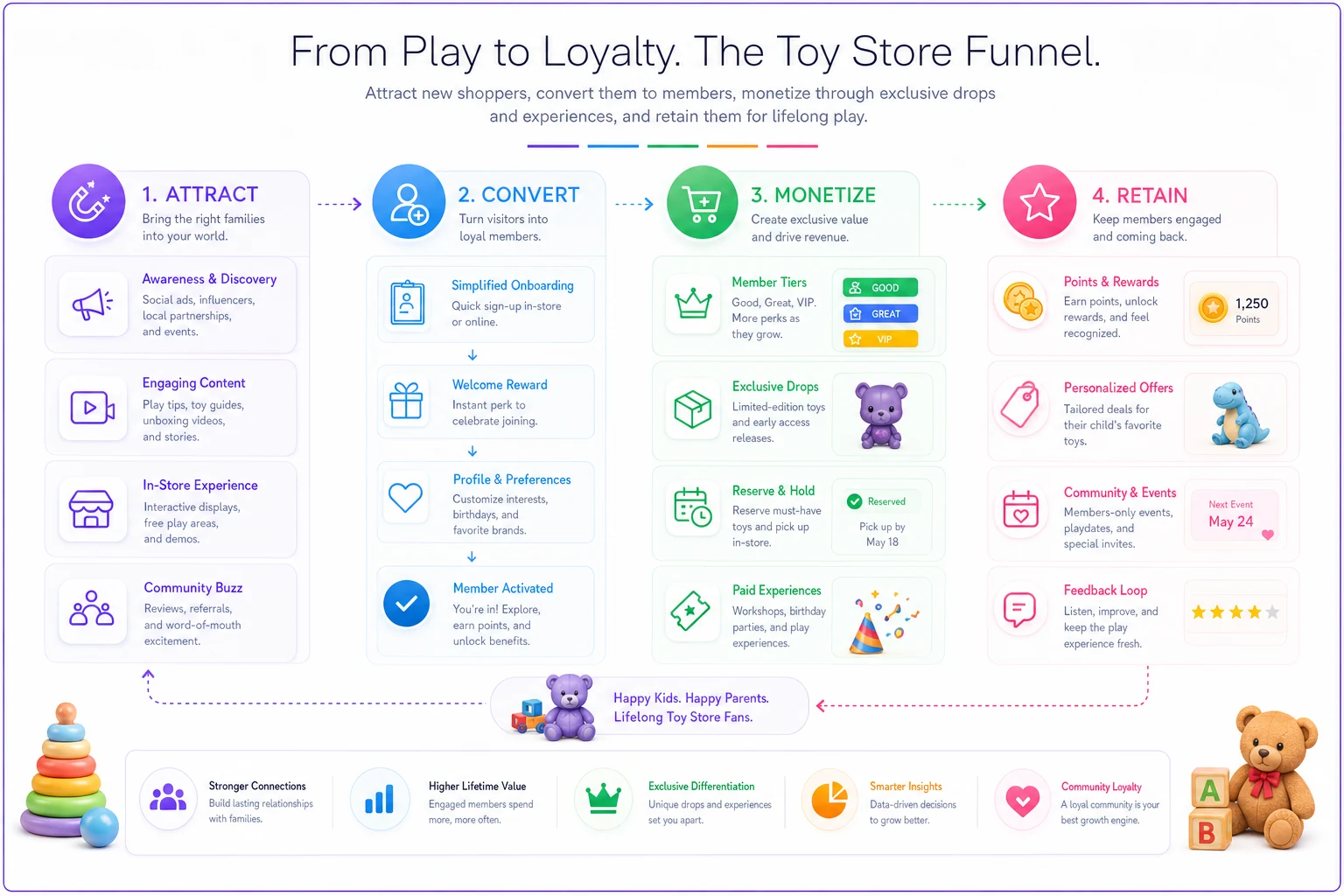
Use this to make sure every operational choice—pricing, caps, onboarding—maps back to one of the four stages.
Tier design: keep it to three, make the middle obvious
The temptation is to build five or six tiers because more options feels like more revenue. In practice, more than three tiers confuses people at exactly the moment they're deciding whether to pay, and confusion at the decision point kills conversion.
Never run out of bestsellers again.
GoToyvio helps you monitor inventory and sales to keep your shelves stocked and customers happy.
- Real-time stock tracking
- Automated reorder alerts
- Sales and promotion analytics
No credit card required
Here's a tier structure that holds up across collectible categories—funko-style vinyl, TCG, model kits, high-end action figures:
| Tier | Annual price | Core value | Who it's for |
|---|---|---|---|
| Standard | Free | Email drops, general event access | Casual buyers, list-builders |
| Collector | ~$40/yr | 24-hr early drop access, member pricing on non-exclusives, 1 reserve slot | Regulars who buy monthly |
| Vault | ~$120/yr | Guaranteed allocation on capped drops, priority reserve, invite-only events, free event entry | Serious collectors, resellers, whales |
The middle tier is doing the heavy lifting. It's priced so a member who buys even a couple of times a year comes out ahead, which makes it the obvious choice. Vault is intentionally expensive—it's not for everyone, and that's the point. When Vault sells out its cap (yes, cap the top tier), the scarcity signals that membership itself is a limited thing.
One mistake worth calling out: don't put your best exclusives only behind the top tier at launch. If an entry-level member never gets a taste of a good drop, they never climb the ladder. Give Collectors a real shot at some capped items—just a smaller allocation than Vault.
Onboarding: the first 14 days decide everything
The window right after someone joins is where most programs quietly fail. Somebody pays, gets a "welcome to the club" email, and then nothing happens for three weeks. By the time the first real drop hits, they've half-forgotten they joined.
A tight onboarding sequence matters more than any single perk. What actually works is front-loading a small win inside the first two weeks—not a discount, a demonstration that membership does something.
-
Day 0 Instant confirmation + a member number. The number sounds trivial. It isn't. "Member #0147" makes the thing feel finite and real.
-
Day 1 A short "here's how drops work" message. Explain the reserve rules, how allocation works, when drops happen. Collectors respect clear rules; ambiguity is what makes them feel scammed later.
-
Day 3–5 A member-only access moment—not necessarily a purchase. Early look at an upcoming release, a poll on which exclusive colorway to stock, something that signals their voice counts.
-
Day 7–10 First small member-only offer, ideally something with a genuine cap.
-
Day 14 A personal check-in, even a templated one, asking what they collect. This feeds every future allocation decision.
That "what do you collect" question is doing real operational work. If you know a member chases Gundam kits and never touches TCG, you don't waste a limited allocation offering them the wrong drop—and you don't burn goodwill spamming them with irrelevant releases. Keeping those preference tags accurate over time is its own small discipline, and it pays off every single drop.
Member-only drops without wrecking the value
This is the part where good programs separate from cash-grab programs. A drop is only special if the constraints are real and enforced. The fastest way to kill a collector program is to run a "limited" drop, sell out, then quietly restock the same item two weeks later. Do that once and your most valuable members stop trusting every future "limited" label.
The guardrails that preserve perceived value:
-
Hard caps, published in advance. "150 units, no restock." Then honor it. If you genuinely can reorder, call it a general release, not a member drop.
-
Per-member purchase limits. One or two per member on capped items. This isn't just fairness—it's what keeps a single reseller from vacuuming the allocation and leaving twenty real collectors empty-handed.
-
Tiered access windows. Vault gets the first hour, Collector gets the next 24, then whatever remains goes public. This makes each tier's value visible without needing to explain it.
-
No surprise discounting on exclusives. If a member paid full price for a capped item and sees it marked down later, you've told every member that waiting beats participating.
The pricing side of exclusives is its own rabbit hole, and easy to get wrong in ways that quietly erode trust. If you're setting numbers on limited runs, the logic in the pricing rules for limited-edition and collectible toys is worth working through before you publish a single cap.
Reserve rules that protect you and the member
Reserves are where members and cashflow both get burned if the rules are loose. A member "reserves" an item, you hold it, they ghost, and now you've got dead stock you could've sold during the hype window.
-
Deposits, not promises. A reserve without money down isn't a reserve, it's a wish. Even a small non-refundable deposit (10–20% of item price) filters out the flakes.
-
Time-boxed pickup. Held for a set number of days after arrival, then the deposit converts to store credit and the item releases back to inventory. Publish the window; don't negotiate it case by case.
-
Tier-linked reserve limits. Collectors get one active reserve, Vault gets several. This ties a concrete benefit to the upgrade.
-
Automatic waitlist promotion. When a reserve expires, the next member in line gets notified immediately, while the item is still hot.
That fourth point is where a lot of stores quietly leak revenue. The item comes back into stock, but nobody's watching, so it sits for a week before someone notices. By then the release window has cooled. The whole reserve system leans heavily on the preorder discipline covered in the preorder and reservation SOP for small toy retailers—the membership layer just adds tiers and deposits on top of that foundation.
Monetizing events without turning members into an audience
Paid events are the highest-margin thing a collector program can run, and also the easiest to overdo. Members will pay to get into a launch night, a grading workshop, a signing, a trade-and-buy session. But the moment an "event" feels like a thinly disguised sales pitch, attendance craters and doesn't recover.
The distinction that matters: members pay for experience and access, not for the privilege of being sold to. A launch night where members get first pick, a drink, and 30 minutes in the room before doors open to the public—that's an experience. A "members event" that's just the store open late with a table of stuff for sale is not, and collectors can tell instantly.
Paid events make sense when you have a genuine capped item to anchor the night, or a real reason to gather—a signing, a tournament, a reveal. The ticket price should feel like it buys access, and ideally it includes something tangible: a redeemable credit, an exclusive-per-attendee item, guaranteed allocation.
They're a bad idea when you're using them to move slow inventory, or when your member base is still thin. A paid event with eight attendees feels sad and damages the brand more than skipping it would. Below a certain critical mass, run free member gatherings first and build density before you charge admission.
A real scenario
A single-location store that leaned heavily on Funko and TCG had a solid social following—around 4,000 followers—but was converting almost none of it into predictable revenue. Drops happened whenever inventory showed up, announced the day of, first-come-first-served in the DMs. Chaos. The owner was manually tracking reserves in a notebook and regularly losing track of who paid what.
They launched a two-tier membership: a ~$40 Collector tier and a ~$120 Vault tier, with Vault capped at 60 seats. Onboarding was a five-message sequence over two weeks. Drops moved to a published monthly cadence with hard caps and tier windows. Reserves required a deposit.
In the first few months, roughly 180 people paid into Collector and Vault filled to its cap. Membership fees alone brought in somewhere in the $14k–$16k range up front—money that used to not exist at all. More importantly, drop sell-through on capped items went from "eventually" to under an hour, and the reserve no-show rate dropped sharply once deposits were required. The owner stopped running the whole thing out of a notebook, which mattered more than any single revenue number.
The paid events took longer to work, though. The first one under-attended. It wasn't until the member base got dense enough—and the store anchored a night around an actual exclusive—that ticketed events started generating real money.
Where the operational load actually lives
Running this by hand is fine at 40 members. At 200, the coordination gets ugly fast: tracking who's in which tier, whose deposit is where, which reserve expires when, who to promote off the waitlist, which member collects what so allocations go to the right people. This is where the program either scales or the owner burns out and lets the rules slip—and slipped rules are exactly what destroys perceived value.
There's an honest case for putting the membership, reserve, and drop mechanics onto AI-powered operational software that tracks tiers, deposits, allocation caps, and preference tags in one place rather than spread across a notebook, a spreadsheet, and memory. Not because software is magic, but because the guardrails only work if they're enforced every time, and human attention doesn't scale to every-time. Automated reserve expirations, waitlist promotions, and per-member purchase limits keep the rules consistent when volume climbs—which is the whole game with a collector base that notices everything.
Prioritize automating reserve expirations and waitlist promotions first; they protect revenue windows and member trust without large upfront investment.
Automated systems aren't a substitute for good rules, but they make it possible to enforce those rules at scale without burning out the owner or staff.
The one thing not to compromise
If you take nothing else from this: the value of a toy collector membership program lives entirely in the credibility of its constraints. Caps that are real. Reserves that require skin in the game. Drops that don't get quietly restocked. Tiers that mean something.
Get the funnel right and the perks almost design themselves. Get the constraints right and members trust you with their money on the next drop, and the one after that. Break a constraint for a quick sale and you spend the next year rebuilding trust with the exact people who were funding your best months. The enthusiasts are already there. The job is building something worth paying to be part of—and then not cheapening it the first time it's inconvenient.
If you take nothing else from this: the value of a toy collector membership program lives entirely in the credibility of its constraints. Caps that are real. Reserves that require skin in the game. Drops that don't get quietly restocked. Tiers that mean something.
Get the funnel right and the perks almost design themselves. Get the constraints right and members trust you with their money on the next drop, and the one after that. Break a constraint for a quick sale and you spend the next year rebuilding trust with the exact people who were funding your best months. The enthusiasts are already there. The job is building something worth paying to be part of—and then not cheapening it the first time it's inconvenient.
Ready to elevate your toy store operations?
Join 500+ toy retailers using GoToyvio to increase sales, reduce stockouts, and enhance customer loyalty.