

Most retail customer-service advice assumes you're selling sweaters or coffee mugs. Toys are different. When a parent walks up to your counter, there's a real chance the issue involves a choking hazard, a recalled battery compartment, or a grandmother who bought a 3+ building set for an 18-month-old and is now furious about "misleading packaging." These aren't vibe complaints. Some of them carry legal weight, and the way your part-time weekend staffer handles them in the first 90 seconds determines whether you're writing an apology email or filing a report.
The Problems That Need a Script Before the Customer Finishes Their Sentence
The gap in most small toy shops isn't that owners don't care about service. It's that the knowledge lives in one person's head — usually the owner's — and nobody else knows what to say when a wrong-age complaint, a recall question, or a warranty claim lands while that person is at a trade show. Staff improvise. Improvising on a safety issue is how you end up refunding, apologizing, and still getting a bad review.
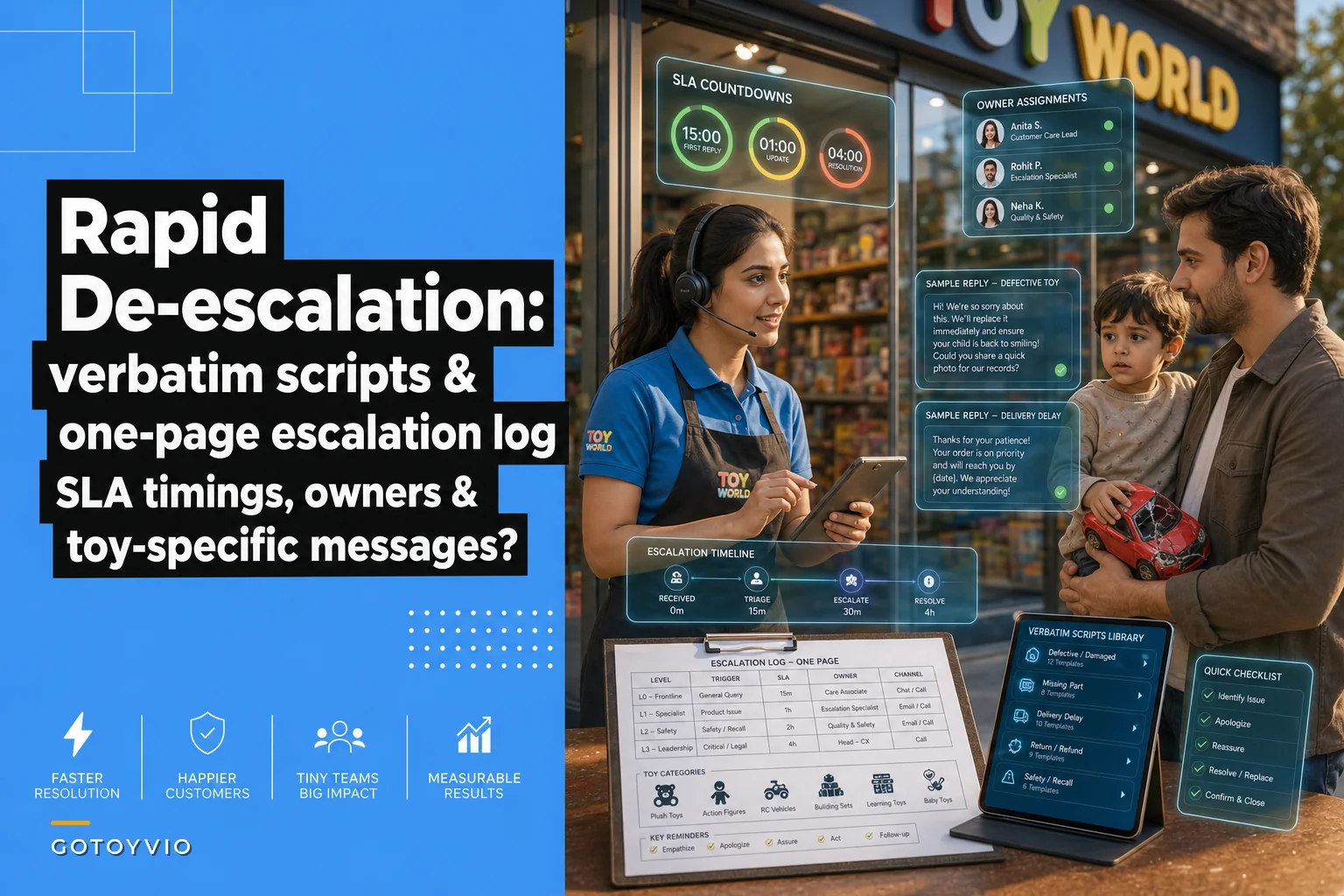
This post gives you verbatim scripts for the three scenarios that actually blow up in toy retail, plus a one-page escalation log with SLA timings and named owners so nothing falls through the cracks. The whole point is that a 19-year-old on their third shift can handle a recall question correctly without calling you on your day off.
Why Toy-Store Service Breaks Down Specifically
Three things make toy complaints harder than normal retail returns.
Never run out of bestsellers again.
GoToyvio helps you monitor inventory and sales to keep your shelves stocked and customers happy.
- Real-time stock tracking
- Automated reorder alerts
- Sales and promotion analytics
No credit card required
First, emotional stakes are high. A parent isn't returning a toaster. They're often scared ("is this dangerous for my kid?") or embarrassed (they gifted the wrong thing) or both. Staff who treat it like a routine return come across as dismissive, and the interaction escalates fast.
Second, some issues have a compliance clock attached. If someone reports that a product injured a child, or references a recall, you can't just "handle it." There may be supplier notification and documentation obligations. A casual "oh just bring it back for a refund" skips the paper trail you'll wish you had later. If you don't already have the underlying process behind this, build it first — this article pairs well with a simple warranty, recall and safety SOP for toy stores that covers intake and supplier escalation in more depth.
Third, the person at the counter usually isn't the decision-maker. In a small team, the owner holds the authority to approve refunds over a threshold, pull product from shelves, or contact a supplier. When they're not there, the floor staffer either overpromises or stalls. Both are bad.
Scripts fix the first problem. The escalation log fixes the second and third.
The Three Scenarios That Actually Need Scripts
Forget trying to script everything. In practice, these three cover the overwhelming majority of toy-specific blowups:
-
Wrong-age complaints — a gift given to a child outside the recommended age range, or a parent who feels the age label was misleading.
-
Recall questions and reports — "I heard this was recalled," or "my kid's toy broke in a way that seems dangerous."
-
Warranty / defect claims — "it stopped working after two weeks," "a piece snapped," "the motor died."
Each one needs a different tone and a different escalation path. Lumping them into one "returns script" is the mistake.
Scenario 1: Wrong-Age Complaints
The Verbatim Opener
> "I totally understand — nobody wants a gift to sit in a closet or feel like it's not the right fit. Let's sort this out. Can I ask how old the little one is, and whether the box has been opened?"
Notice what this does. It validates, moves to practical next steps, and gathers the two facts you actually need (child's age, opened vs. sealed) without sounding like an interrogation.
If the Item Is Sealed and in Sellable Condition
> "Since it's unopened, I can do an exchange or store credit right now, and I'll help you pick something that'll actually get played with. Want me to grab a couple of options for their age?"
Turn the return into a re-sell. A wrong-age return is a cross-sell opportunity the majority of the time — if staff are trained to pivot instead of just processing the refund.
If the Parent Claims the Age Label Was Misleading
> "Good question — that age mark is actually a safety guideline from the manufacturer, usually about small parts, not about how hard the toy is. So for a younger child it's really a safety thing, not us saying your kid couldn't handle it. I'd steer you toward something in a safer range, and I'm happy to do that swap."
That one line — "it's a safety guideline, not a difficulty rating" — defuses more arguments than any refund policy. Train every staffer to say it.
Train every staffer to say it.
Escalation trigger: If the customer insists the labeling was deceptive and threatens a complaint or review, that moves up the log. Don't let a floor staffer argue it out.
Scenario 2: Recall Questions and Injury Reports
This is the one where improvising is genuinely risky. There are two sub-cases, and staff must tell them apart.
Sub-Case A: "I Heard This Might Be Recalled"
> "Thanks for flagging that — I want to get you accurate info, not guess. Let me check our recall list and the manufacturer notice right now. If you have the item or the receipt, that'll speed it up. Give me two minutes?"
Then actually check. Never say "no it's fine" from memory. Never say "yeah probably" to be reassuring.
Sub-Case B: "This Toy Hurt My Child" or "This Broke Dangerously"
> "I'm really sorry to hear that, and I'm glad you came in. I want to make sure this is handled properly, not just swapped out. I'm going to take a few details and get our manager/owner involved directly. Is your child okay right now?"
Lead with the child, then signal that it's being taken seriously and escalated. Do not let the staffer offer a quick refund as a way to make the problem disappear — that can look like you're trying to bury an incident. Document it, escalate it, and let the owner follow the safety process.
Escalation trigger: Any mention of injury, choking, or "dangerous" goes straight to the owner, same day, no exceptions.
Scenario 3: Warranty and Defect Claims
The Opener
> "Sorry it gave out on you — that's frustrating, especially if it was a gift. Let's figure out whether it's a quick swap or a manufacturer warranty thing. Do you remember roughly when it was bought, and do you have the receipt or the box?"
The Decision Table
Warranty claims need a simple internal rule so staff don't have to guess who pays:
| Time since purchase | Condition | Staff action | Who approves |
|---|---|---|---|
| ≤ 30 days | Defect, has proof of purchase | Direct exchange or refund | Floor staff |
| ≤ 30 days | No receipt, POS lookup confirms | Exchange or store credit | Shift lead |
| 31–90 days | Defect | Store credit OR route to manufacturer warranty | Shift lead / Owner |
| > 90 days | Any | Manufacturer warranty claim only | Owner |
| Any | Possible safety defect | Stop — treat as incident | Owner (same day) |
The POS lookup row matters. A lot of toy purchases are gifts with no receipt, and if your system can pull the sale by card or loyalty record, you avoid the "no receipt, no return" standoff that wrecks goodwill. Clean transaction records also make supplier claims credible — the same discipline covered in the fast receiving and QC SOP, which flags defective stock before it ever reaches a customer.
The Supplier-Recovery Piece
Don't forget your side of it. A defective unit should trigger a supplier note so you're not eating the cost repeatedly. If three customers return the same SKU for the same failure in a month, that's not bad luck — that's a batch problem worth a supplier conversation.
The One-Page Escalation Log
This is the piece most shops are missing. A script tells staff what to say. The escalation log tells them what to do next and who owns it. Keep it printed by the register and as a shared doc.
Columns to track for every escalated issue:
-
Date / time
-
Staff member handling
-
Customer name + contact
-
Scenario type (wrong-age / recall / warranty / injury)
-
Product + SKU
-
What was said / promised
-
Escalation level reached
-
Owner assigned
-
SLA deadline
-
Resolved? (Y/N + date)
SLA Timings and Escalation Owners
| Scenario | First response | Resolution target | Escalation owner |
|---|---|---|---|
| Wrong-age exchange (sealed) | Immediate | Same visit | Floor staff |
| Wrong-age "misleading label" dispute | Immediate | 24 hrs | Shift lead |
| Recall question | Within the visit | Same day | Shift lead → Owner |
| Injury / safety incident | Immediate | Same day, logged | Owner, no delay |
| Warranty ≤ 30 days | Immediate | Same visit | Floor staff |
| Warranty > 90 days (manufacturer) | Within visit | 5–7 business days | Owner |
The SLA column isn't bureaucracy. It's what stops a warranty claim from sitting in someone's apron pocket for two weeks until the customer gives up and posts about it.
How an Issue Should Move Through Your Team
Here's the basic flow for any escalated complaint, from first contact to resolution:
-
Customer raises issue at the counter — staffer uses the relevant script opener
-
Staffer identifies scenario type — wrong-age, recall, warranty, or injury
-
Staffer applies the decision table — acts within their authority or flags up
-
Issue gets logged — name, SKU, what was said, escalation level
-
SLA deadline is set — based on scenario type
-
Named owner follows up — shift lead or owner, depending on the table
-
Resolution recorded — log updated with outcome and date
Most issues that "fall through the cracks" aren't complicated — they just never got written down with a deadline attached to them.
Here's a simple visual of that workflow.
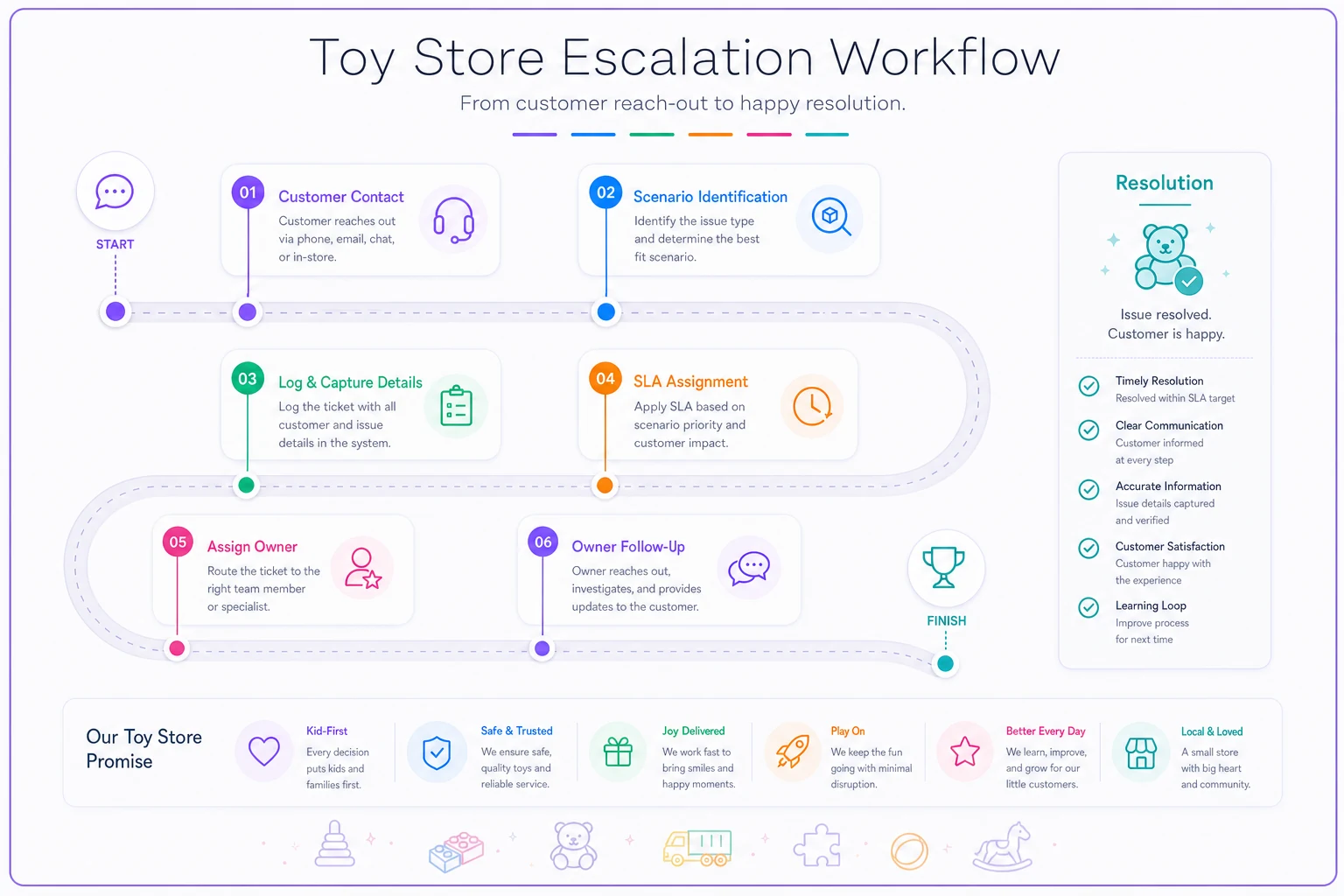
Keep the visualization simple: customer -> staff script -> identify scenario -> log issue -> assign SLA and owner -> follow-up -> resolution.
When Tight Scripting Is a Bad Idea
Scripts are guardrails, not cages. Two situations where you want staff to go off-script:
-
A regular, high-value customer with a small issue. If someone who spends real money every month wants a $12 exchange, don't make them watch your staffer consult a decision table. Approve it and move on.
-
A genuinely novel situation. If it doesn't fit the three scenarios, the correct move is "let me get the owner," not forcing it into a template.
The staffer who should NOT be improvising is the brand-new hire on a recall or injury question. That's exactly where the script and the escalation log earn their keep.
A Quick Real Scenario
A single-location shop — somewhere in the $40k–$50k monthly revenue range, three part-timers plus the owner — kept running into the same pattern during the holidays. Staff would quietly refund defective or wrong-age items to avoid friction, nobody logged anything, and the owner had no idea the same remote-control car had come back four times until she was reconciling returns in January.
They put in the three scripts and a printed escalation log at the register. Two things changed within a couple of months. Wrong-age returns that used to be straight refunds became exchanges roughly two-thirds of the time, because staff were now trained to pivot to an age-appropriate swap. And that repeat-defect car got caught — four returns, one SKU, one supplier conversation, and a credit back on the next order. Nothing dramatic, just fewer silent losses and a clearer trail when something safety-related came up.
Bringing It Together
The reason toy-store service goes sideways isn't bad staff — it's that high-stakes, compliance-adjacent moments get handled by whoever happens to be on shift, with no agreed words and no agreed next step. Give them the exact opener for each scenario, a simple warranty decision table, and a one-page log with SLA deadlines and named owners. Laminate the scripts. Keep the log by the till. Review the escalated entries weekly for the same SKU showing up twice.
Do that and the next time a scared parent walks in on a Saturday asking about a recall, your newest hire says the right thing, logs it, and the issue reaches you before it reaches a review site.
Ready to elevate your toy store operations?
Join 500+ toy retailers using GoToyvio to increase sales, reduce stockouts, and enhance customer loyalty.