

Most toy store loyalty programs die quietly. They start with a punch card or a "spend $100, get $10" scheme, run for a season, and then nobody at the counter remembers to mention them. The customer forgets too. Six months later you're paying for a plastic card printer that sits in a drawer.
The problem isn't that loyalty doesn't work in toy retail. It's that most owners treat it as a discount mechanic instead of what it actually is: a way to lock in family purchase cadence, fill your event calendar, and turn your neighborhood into a channel you don't rent from Meta or Google. The stores that get this right run something closer to a membership, where the economics are deliberate and every perk, event, and local partnership feeds a number you can actually track.
This is a systems piece. Not "20 loyalty ideas." We're going to look at why the usual programs leak money, what breaks when you scale them past a few hundred members, and how to build a local community program toy store owners can run on their own without a marketing budget — plus a one-page annual plan tying it all to an ROI tracker.
Why most toy-store loyalty programs quietly lose money
There's a pattern that shows up over and over. A store launches points or a discount card. Redemption is low at first, so it feels free. Then a chunk of regulars — the families who were already coming in every 5–6 weeks — start redeeming rewards on purchases they'd have made anyway. Now you're discounting your best customers for behavior you already had.
That's the core mistake: rewarding purchases you already own instead of buying new behavior. A loyalty program only creates value if it changes something — visit frequency, basket size, the number of new families walking in, or the number of seats you fill at a paid event.
The second failure is that most programs are built around the transaction and ignore the relationship. A toy store isn't a coffee shop. Families don't buy daily. They buy on a cadence tied to birthdays, holidays, milestones, and the occasional "we need to bribe a Tuesday into being calmer." If your program doesn't map to that cadence, it's fighting the natural rhythm of how people actually shop for kids.
And the third: no owner can tell you what the program earns. Ask ten independent retailers what their loyalty program's ROI is and maybe one has a number. The rest have a vibe. A membership system without a tracker is just a coupon habit with extra admin.
Membership economics: what you're actually buying
Think of membership as a trade. The family gives you money and permission — email, birthdays, kid ages, consent to contact them. You give them status, access, and a few perks that cost you less than they're worth to the customer. The whole thing only works if the perceived value is high and the actual cost is low.
Never run out of bestsellers again.
GoToyvio helps you monitor inventory and sales to keep your shelves stocked and customers happy.
- Real-time stock tracking
- Automated reorder alerts
- Sales and promotion analytics
No credit card required
The best perks in toy retail follow that gap. Early access to a hot restock costs you nothing but a held-back allocation. A free gift-wrap station for members costs pennies. First-dibs seating at a build night costs nothing because the event was happening anyway. Compare that to a flat 10% off everything, which hits your margin on every single sale and trains customers to wait for the discount.
| Perk type | Cost to you | Perceived value | Changes behavior? |
|---|---|---|---|
| Flat % off all purchases | High (margin on everything) | Low–medium | Trains discount waiting |
| Early access to restocks/drops | Near zero | High | Yes — drives urgency + visits |
| Members-only event seats | Low | High | Yes — fills events, deepens loyalty |
| Free gift wrap / small add-on | Very low | Medium | Mildly, but great for retention |
| Birthday perk (kid-specific) | Low | High | Yes — anchors annual cadence |
| Partner perks (local businesses) | Zero (partner pays) | Medium–high | Yes — expands reach |
The stores with healthy membership economics lean heavily on the bottom-cost, high-value rows. The stores that struggle default to the top row because it's the easiest to explain at the register.
Paid vs. free membership tiers
A question every owner hits: do you charge for membership?
A paid tier — say, $25–$40/year — does two useful things. It filters for families who actually value the store, and it creates a small pool of prepaid cash you can plan around. Sign up 200 families at $30 and that's roughly $6k in the door before anyone buys a toy — cash you can put toward event supplies or a deeper buy on a hot line.
But a paid tier only works if the perks clearly clear the price. If a family can't look at the membership and immediately see "yeah, we'll get $30+ back in value," it flops. A common middle path: free basic tier to capture data and build the list, paid tier for the collectors and frequent families who want early access and event priority. If you already run enthusiast programming, the collector-club funnel playbook covers how to structure paid access without alienating casual shoppers.
Where these systems break as you scale
A loyalty program for 80 members runs fine on goodwill and a spreadsheet. At 800 it becomes an operational problem, and the breakpoints are predictable.
Coordination breaks first. When you've got one part-timer who "just knows" who the members are, that knowledge doesn't survive a schedule change. New staff don't mention the program. Perks get applied inconsistently — one cashier gives early-access holds, another doesn't. Members notice the inconsistency faster than you'd think, and inconsistency is what kills the feeling of belonging that membership is supposed to create.
Event capacity breaks second. Once your community grows, popular events oversell or turn chaotic. If members were promised priority seating and a walk-in family grabbed the last chair, you've damaged the exact relationship you paid to build. You need a reservation and seating flow that respects tiers — and it has to be simple enough that a Saturday temp can run it without asking twice.
Data hygiene breaks third, and it's the quiet killer. Duplicate profiles, wrong birthdays, kids who aged out of the age band you tagged them in three years ago. When the underlying data rots, your birthday reminders go to the wrong kid's age and your restock alerts go to families who bought that line last year. The program starts feeling spammy, and unsubscribes climb.
Tracking breaks last, because it was never really built. By the time you've got hundreds of members, a string of events, and a couple of partner deals, nobody can untangle what's actually driving revenue. Was it the build nights? The birthday perk? The partnership with the pediatric dentist down the street? Without a tracker built in from the start, you're flying blind on the one thing that justifies the whole system.
The better system: perks + events + partnerships feeding one tracker
Stop thinking of loyalty as a card. Think of it as three connected engines, all reporting to a single ROI view.
Engine one — perks that anchor cadence. Birthday perk tied to each kid's actual birth month, early access to drops, members-first event seating. The job of perks is to keep families on their natural buying rhythm and to reward incremental behavior, not baseline behavior.
Engine two — events that create reasons to show up. Build nights, demo days, seasonal make-and-take sessions, collector meetups. Events are where membership stops being abstract. They're also the cheapest customer-acquisition tool a toy store has, because members bring friends who become next quarter's members. If your event operations aren't already dialed in, that's a prerequisite — the whole system leans on running them profitably.
Engine three — local partnerships that expand reach for free. This is the most underused lever. A partnership is any arrangement where another local business gives your members something (or vice versa) at no cost to you. The children's bookstore two blocks over cross-promotes your build night. The local birthday-party venue hands new parents your membership flyer. The pediatric clinic's waiting room stocks your event calendar. You're trading audiences, not dollars.
The point of connecting all three is compounding. Events grow the member list. Members unlock partner deals. Partners send new families to events. Every interaction drops data into the tracker, which tells you which engine to lean into next quarter. It's a slower, sturdier version of customer acquisition than paid ads — closer in spirit to the calendar-driven local marketing system that runs on rhythm instead of ad spend.
How the workflow actually runs day to day
Walk it through as an operator would.
A family checks out. The cashier asks if they're a member; if not, a quick signup captures email, consent, and kid birth months. That data lands in the same system as your POS, so the profile is tied to purchase history from day one. When a hot restock arrives, members with matching interests get the early-access window before the general announcement. When you schedule the next build night, members get the reservation link first, seats fill, and leftover seats open to the public — which brings in new families who get asked to join at checkout. Meanwhile, your partner businesses are quietly funneling parents toward that same signup. Every one of those touches — signup source, event attendance, redemption, partner referral — is a row in the tracker.
The magic isn't any single step. It's that the loop closes on itself and you can see it closing.
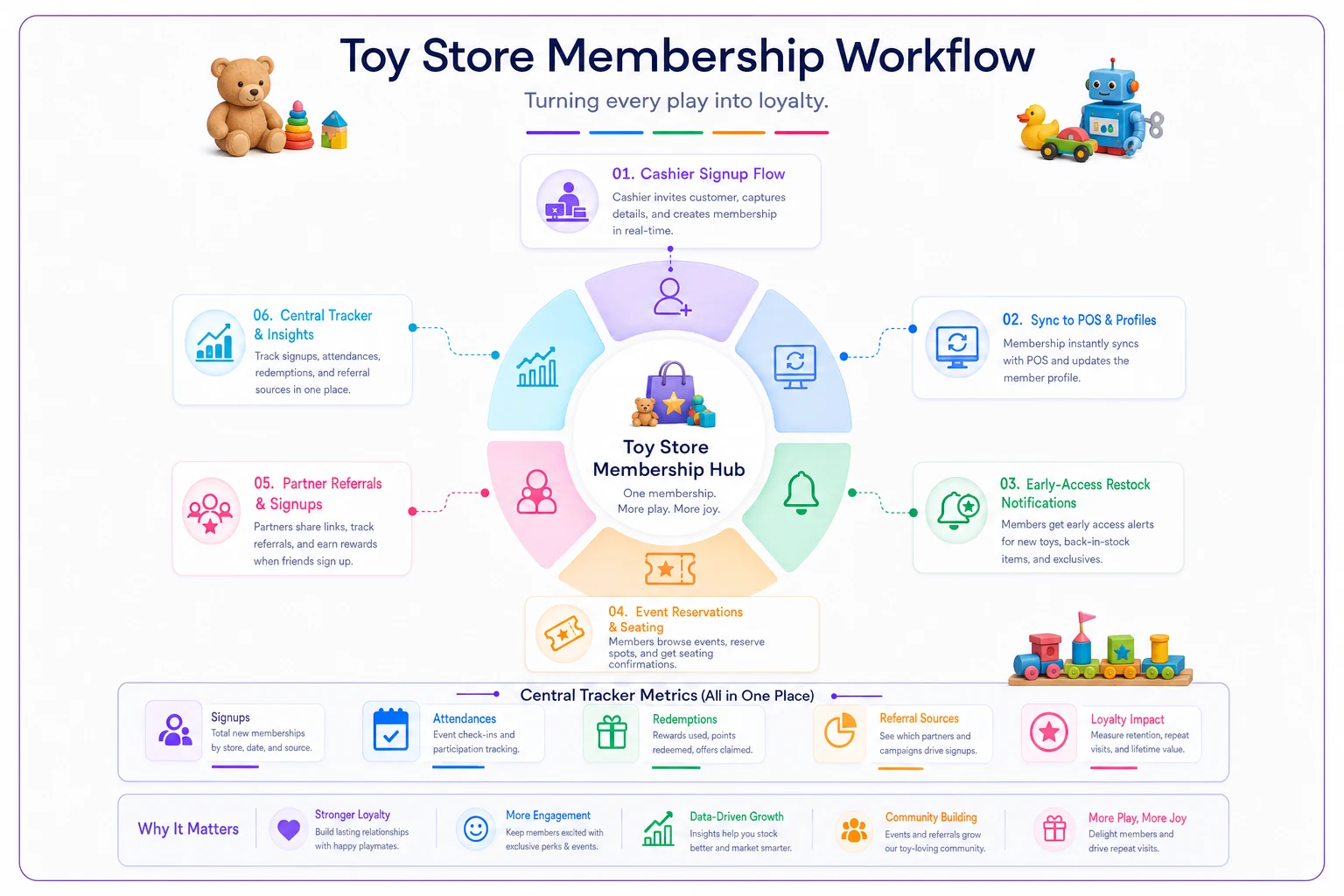
Here's a simple visual of that daily loop.
Building the ROI tracker you can actually run
You don't need a data team. You need a handful of numbers reviewed monthly. The mistake owners make is tracking activity — signups, likes, attendance — instead of outcomes. Activity feels good. Outcomes pay rent.
-
Member vs. non-member average basket. The whole thesis is that members spend more per visit. If they don't, your perks aren't working.
-
Member visit frequency vs. non-member. Are members actually returning on a tighter cadence?
-
Event contribution margin. Revenue from event day (tickets + attributable sales) minus event cost. Not just "it was fun."
-
New members per event and per partnership. This tells you which acquisition channel is real.
-
Redemption cost as a % of member revenue. Your leak indicator. If this creeps up, you're discounting baseline behavior again.
-
Annual member value vs. member acquisition + perk cost. The number that justifies the program.
Here's a simple monthly review process:
-
Pull member vs. non-member basket and frequency from your POS.
-
Log each event's revenue and cost; calculate contribution margin.
-
Count new members and tag their source (event, partner, walk-in, referral).
-
Total the month's perk/redemption cost and divide by member revenue.
-
Flag anything moving the wrong way and pick one fix for next month.
-
Update the annual plan with what worked so next year's calendar is sharper.
Automate tagging signup sources so your monthly review doesn't start with data cleanup.
This is where keeping everything in one connected system matters more than any specific tool. When your POS, member profiles, event reservations, and consent records all live in separate places, this review takes a painful afternoon of copy-pasting — so owners skip it, and the program drifts back into vibes. When purchase history, membership status, and event attendance sit together, the review becomes a 30-minute monthly habit. Operational platforms with built-in automation can handle the tedious parts — flagging duplicate profiles, nudging you when a member's cadence slips, auto-tagging new signups by source — so the tracking maintains itself instead of depending on you remembering to do it.
The one-page annual community plan
Map this out once a year and pin it somewhere visible. Keep it to a single page.
-
Anchor events (4–8/year) seasonal build nights, a summer collector meetup, a holiday preview evening. Assign a date, an owner, a rough budget, and a target new-member count to each.
-
Recurring perks birthday perk mechanics, early-access windows, members-first seating rules. Write the rules down so any staffer applies them the same way.
-
Partnerships (2–4/year) name the businesses, what each side gives, and how you'll measure referrals. Refresh the list yearly — dead partnerships are dead weight.
-
Tier structure free vs. paid, price, and the specific perks in each.
-
ROI targets member basket lift %, target member count, event contribution margin goal.
-
Monthly review date a fixed day each month. Non-negotiable.
The one-pager forces the discipline the program needs. It turns "we should do more community stuff" into a set of dated commitments with numbers attached.
When this makes sense — and when it doesn't
When it's worth building: You have a base of repeat families, you already run (or want to run) events, and you're tired of renting attention through ads. If your neighborhood has other family-facing businesses to partner with, even better. A membership system rewards stores that are genuinely embedded in a local community.
When it's a bad idea: If your foundational data is a mess — duplicate profiles, no consent records, wrong ages — fix that first. A loyalty system built on rotten data amplifies the rot. Likewise, if you're barely staffing the floor, a program that adds inconsistent register steps will frustrate everyone. Get the basic operations stable before layering community on top.
Who should not do this yet: Brand-new stores with no repeat base and no idea who their regulars are. You can't run membership economics without members, and you can't identify members without a few months of purchase data. Spend that first stretch capturing clean signups and running one or two small events. Build the list before you build the machine.
A quick real scenario
Take a single-location store doing roughly $600k–$700k a year, mostly walk-in traffic, no real loyalty system. They'd been dabbling in paid social with mediocre returns.
They launched a two-tier membership — free basic, $30/year premium — anchored by a birthday perk and members-first seating at monthly build nights. Two local partners: a birthday-party venue and an indie bookstore. Over about ten months they signed close to 500 members, roughly 120 of them paying. Member baskets ran noticeably higher than non-member baskets, and premium families were visiting on a tighter cadence — closer to every 4–5 weeks versus the store's usual stretch.
Events did the heavy lifting on acquisition. Most new members came through build nights and partner referrals, not the register. And because everything fed one tracker, the owner could see the birthday perk was driving repeat visits while a mid-year "flat 10% weekend" barely moved anything — so they cut the flat discount and doubled down on events. Ad spend dropped to near zero. The community had become the channel.
Bringing it together
A membership program that works isn't a card or a points balance. It's a system where perks anchor family buying cadence, events give people reasons to show up and bring friends, partnerships extend your reach without spending a dollar, and a simple tracker tells you which of those levers to pull next. The pieces reinforce each other, and the whole thing runs on data you already collect at the register.
The stores that struggle are the ones running loyalty on memory and goodwill — inconsistent perks, oversold events, rotting data, and no idea what any of it earns. The stores that win keep it connected and keep score. Start with clean data, pick a handful of anchor events, write your perk rules down so every staffer applies them the same way, line up a couple of local partners, and commit to a 30-minute monthly review. Do that for a year and the neighborhood stops being people who wander in and becomes a community that shows up on purpose.
Ready to elevate your toy store operations?
Join 500+ toy retailers using GoToyvio to increase sales, reduce stockouts, and enhance customer loyalty.