

The two weeks after someone buys from your toy store is probably the easiest follow-on sale you'll ever have a shot at — and most independents burn it by sending one generic "thanks for your order, here's 10% off" email to everybody.
The problem isn't that you're following up. It's that the person who bought a $12 birthday gift for their niece, the parent restocking their own kid's shelf, and the collector who just dropped $180 on a limited figure are all getting the exact same message — one that fits none of them.
A cross-sell sequence works when the timing and the offer match how that specific buyer actually behaves. Gift buyers don't repurchase for the same kid next week. Family buyers come back on a cadence. Collectors are waiting for the next drop, not a discount. When you blast all three the same way, your open rates hold for a couple of sends and then quietly die, and everyone concludes "email doesn't work for us."
It works fine. You're just sending the wrong thing to the wrong person at the wrong time.
Why the generic sequence fails, mechanically
Walk through what actually happens with a one-size sequence over 21 days.
Day 2: "Thanks for your purchase!" — fine, everyone's happy to get it.
Day 7: "Customers also loved these!" with a grid of bestsellers. The gift buyer already gave the gift and has zero reason to buy again. The collector looks at a grid of mass-market plush and mentally files you as "not a store that gets it." Only the family buyer might bite.
Day 14: "Here's 15% off your next order." Now you've trained your best customers — collectors and repeat families — to wait for a discount they never needed. You've just eroded margin on the exact people who would have paid full price anyway.
The mechanical failure is that a single sequence optimizes for the average buyer, and the average buyer doesn't exist. Revenue in the post-purchase window is heavily concentrated across most small retail catalogs — a small slice of buyers (usually collectors and repeat families) drive most of the follow-on sales, and the generic sequence actively annoys them.
Sorting buyers into three cohorts (without a fancy CRM)
You don't need a data science setup for this. You need three buckets, and most POS systems already give you enough to sort them at checkout or shortly after.
Never run out of bestsellers again.
GoToyvio helps you monitor inventory and sales to keep your shelves stocked and customers happy.
- Real-time stock tracking
- Automated reorder alerts
- Sales and promotion analytics
No credit card required
| Cohort | How to identify | Repurchase pattern | What they actually want |
|---|---|---|---|
| Gift buyer | Gift receipt requested, gift wrap, shipping name ≠ billing name, one-off item outside a series | Rare and unpredictable | Convenience, "you nailed it," reassurance the gift was good |
| Family buyer | Repeat customer, age-appropriate spread of items, buys for the same child(ren) over time | Predictable, seasonal + birthday cadence | Next-stage suggestions, restocks, consumables, "grows with them" |
| Collector | Buys within a series/line, higher AOV, brand-loyal, asks about releases | Event-driven (new drops) | Early access, completeness, protection/display gear |
Tagging can happen three ways: a checkbox at checkout ("Is this a gift?"), the wrap/receipt signal, or a quick manual tag when you recognize a regular. If you're still cleaning up your tagging discipline, the approach in our micro-audit walkthrough on keeping tags, birthdays and consent accurate matters more than any template below — a segment is only as good as the tag feeding it.
One thing worth flagging: a lot of stores over-tag "gift." Someone buying in December isn't necessarily a gift buyer for life. Tag the transaction, then let repeat behavior promote them into the family or collector bucket. A gift buyer who comes back twice for the same kid isn't a gift buyer anymore — they're family, and your sequence should treat them like it.
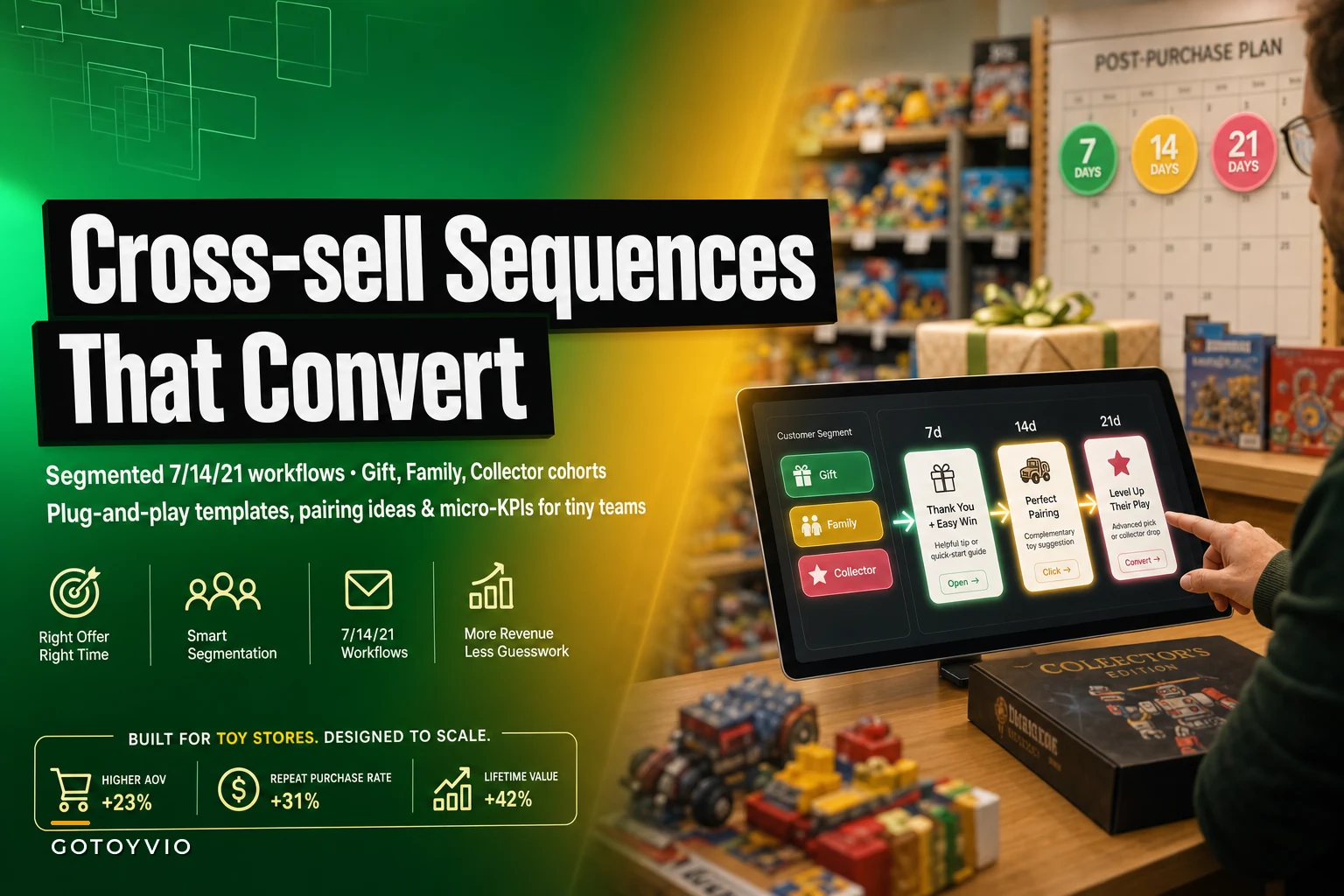
The gift-buyer sequence (7-day, low-pressure)
Gift buyers are on the shortest clock. The gift gets given, the occasion passes, and their interest in your store evaporates unless you give them a reason to think of you as their store — not just the place they bought one thing.
Keep it short: three touches over about a week, and don't push a repurchase of the same item. Push reassurance and a reason to remember you.
Touch 1 — Day 2 (confirmation + reassurance):
> Subject: Your gift is on its way 🎁 > "Nice pick — [product] is one of the [age range] favorites this season. If they end up loving it, there's a great next-step piece in the same line whenever you need a win for the next birthday. We saved a note so you don't have to remember."
Touch 2 — Day 5 (the "did it land" check):
> Subject: Did it get the reaction you wanted? > A one-question reply prompt. This is not a sales email. It surfaces the delighted gift-buyers (who then buy again for their own kids) and catches problems before they become returns.
Touch 3 — Day 7 (soft handoff to occasion reminders):
> Subject: Want us to remind you before the next birthday? > A single opt-in link. This is where a gift buyer becomes a long-term contact instead of a one-off.
Micro-KPI for tiny teams: reply rate on Touch 2. If more than roughly 1 in 8 gift buyers reply, your sequence is doing emotional work, not just selling. That reply rate predicts future repurchase better than click rate does.
Pairing suggestions to attach: same-line "next age up" item, a low-cost add-on like stickers or an expansion pack, or a gift-wrap upgrade for next time. No discount here — gift buyers aren't price-sensitive on an occasion purchase.
The family-buyer sequence (14-day, cadence-aware)
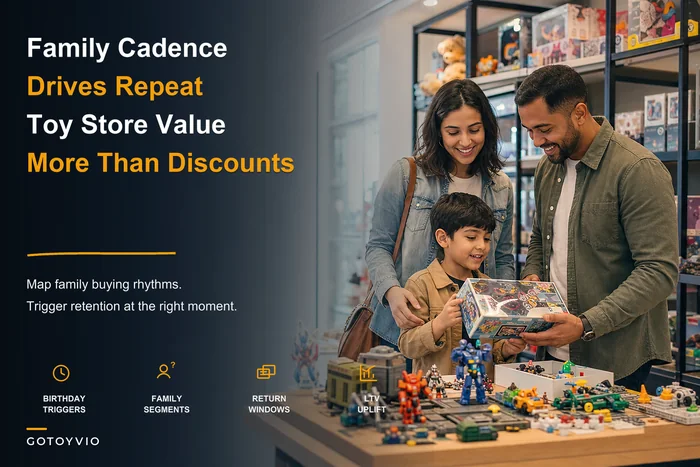
This is your lifetime-value engine, and the cohort where getting the rhythm right matters more than the copy. Families buy on a predictable beat tied to age progression, birthdays, and consumable refills. The whole logic behind that cadence is something we broke down separately in why family purchase cadence drives higher lifetime value — and the sequence below is basically that idea turned into email timing.
The sequence should map to the child's development, not your promo calendar.
-
Day 3 — "Getting the most out of it" a usage tip or activity idea for the item they bought. No sell. This builds the "this store actually knows toys" trust that makes later suggestions land.
-
Day 9 — the natural pairing "Kids who love [item] usually go for [complementary item] next." This is the one real cross-sell, and it converts because it's a genuine next step, not a random bestseller grid.
-
Day 14 — the cadence hook "Building a collection? We can flag when the next set in this series comes in." Or, for consumables like craft kits or playdough, a gentle "running low?" reminder timed to typical burn-through.
Pairing logic that works for families:
-
Building/construction sets → expansion packs, storage, the next difficulty tier
-
Craft/STEM kits → refill consumables, the sequel kit
-
Early-learning toys → the next developmental stage up
-
Board/card games → same-publisher games at a similar complexity
Micro-KPI: repeat purchase within 60 days from the sequence, tracked as a simple percentage. For an engaged family list this tends to land somewhere in the low-to-mid teens, and even a couple of percentage points of movement compounds hard because these buyers come back for years.
The mistake stores make on Day 9 is defaulting to a discount. You don't need one. A family who trusts your recommendation buys the pairing at full margin. Save discounts for reactivating lapsed families, not fresh ones.
The collector sequence (21-day, access-first, discount-never)
Collectors are the cohort most damaged by generic sequences, and the one with the highest upside if you get it right. The cardinal rule: do not discount to collectors in the post-purchase window. A discount signals the line isn't holding value — the exact opposite of what a collector wants to believe. Undercutting a collectible line teaches your best buyers to wait, and to distrust your pricing.
Their sequence is longer and slower because it's oriented around the next release, not the last purchase.
Touch 1 — Day 2 (belonging):
> "You've now got [item] from [line] — nice. Here's where it sits in the full lineup [visual/checklist]. We keep a short list of folks who want first look at [line] drops. Want in?" This does two jobs: it shows completeness (what they're missing) and earns the early-access opt-in.
Touch 2 — Day 10 (protection/display):
> Display cases, protectors, shelf risers. Collectors spend real money protecting what they own, and this is a high-margin, high-fit cross-sell that a family or gift buyer would never touch.
Touch 3 — Day 21 (the drop-radar handoff):
> "Next [line] release lands around [timeframe]. Early-access list gets a heads-up 48 hours before it goes live." This transitions them from a post-purchase contact into your preorder pipeline.
Micro-KPI: early-access opt-in rate from Touch 1. This is the number that predicts collector LTV. If a solid chunk of collectors opt in, your next drop half-sells itself before it's even public.
A pattern worth stealing: stores that route collectors to an early-access list instead of a discount list consistently sell hot releases faster and protect line value. The collector doesn't want a coupon. They want to not miss out.
A real scenario: a two-person shop that stopped blasting everyone
A single-location store, roughly 900 active email contacts, two people running everything. They were sending one post-purchase email to their whole list and watching follow-on order rates drift into the low single digits — the classic "email's dead for us" situation.
They didn't buy new software or hire anyone. They did three things: added a gift checkbox at checkout, tagged their roughly 40 known regulars as family or collector by hand, and split their one email into the three sequences above. Copy was close to the templates here; pairings were pulled straight from what they already stocked.
Over the following couple of months, the collector early-access list grew to somewhere around 60–70 names, and the first drop they promoted to it sold through noticeably faster than usual with zero discounting. Family repeat purchases within 60 days ticked up into the low teens. The gift sequence didn't drive huge direct revenue — but the Day 5 "did it land?" email surfaced two potential returns early and turned a handful of one-time gift buyers into birthday-reminder opt-ins.
Nothing dramatic month-to-month. The point is the shape of it: less volume, more relevance, and the best customers stopped being trained to wait for a coupon.
When segmenting like this is worth it — and when it isn't
When it makes sense:
-
You have at least a few hundred contacts and a genuine mix of buyer types
-
You stock series or lines — collectibles, building sets, ongoing IP — where cohorts diverge sharply
-
You have even basic tagging discipline at checkout
When it's not worth doing yet:
-
Your contact list is tiny (under roughly 150) — just run the family sequence well and skip the rest until you have the volume
-
Your tags are a mess and you can't trust the gift/collector signal — fix tagging first, because segmenting on bad data sends the wrong email to the wrong person and does more harm than a generic blast
-
You sell almost entirely one-off novelty items with no repeat logic — segmentation won't manufacture a cadence that doesn't exist
Who should not bother right now: any store still fighting basic checkout data capture. A wrong-cohort email is worse than a generic one, because it actively signals "you don't know me." Get the tag right, then get fancy.
Setting it up without drowning in manual work
For a two- or three-person team, the realistic failure mode isn't writing the copy — it's maintaining three sequences and keeping tags clean while also running the floor.
This is where a workflow tool that watches your POS tags and triggers the right sequence automatically actually earns its keep. Buyer gets tagged at checkout, the matching sequence fires on schedule, and lapsed or re-promoted buyers move between cohorts without anyone hand-sorting a spreadsheet every Sunday night.
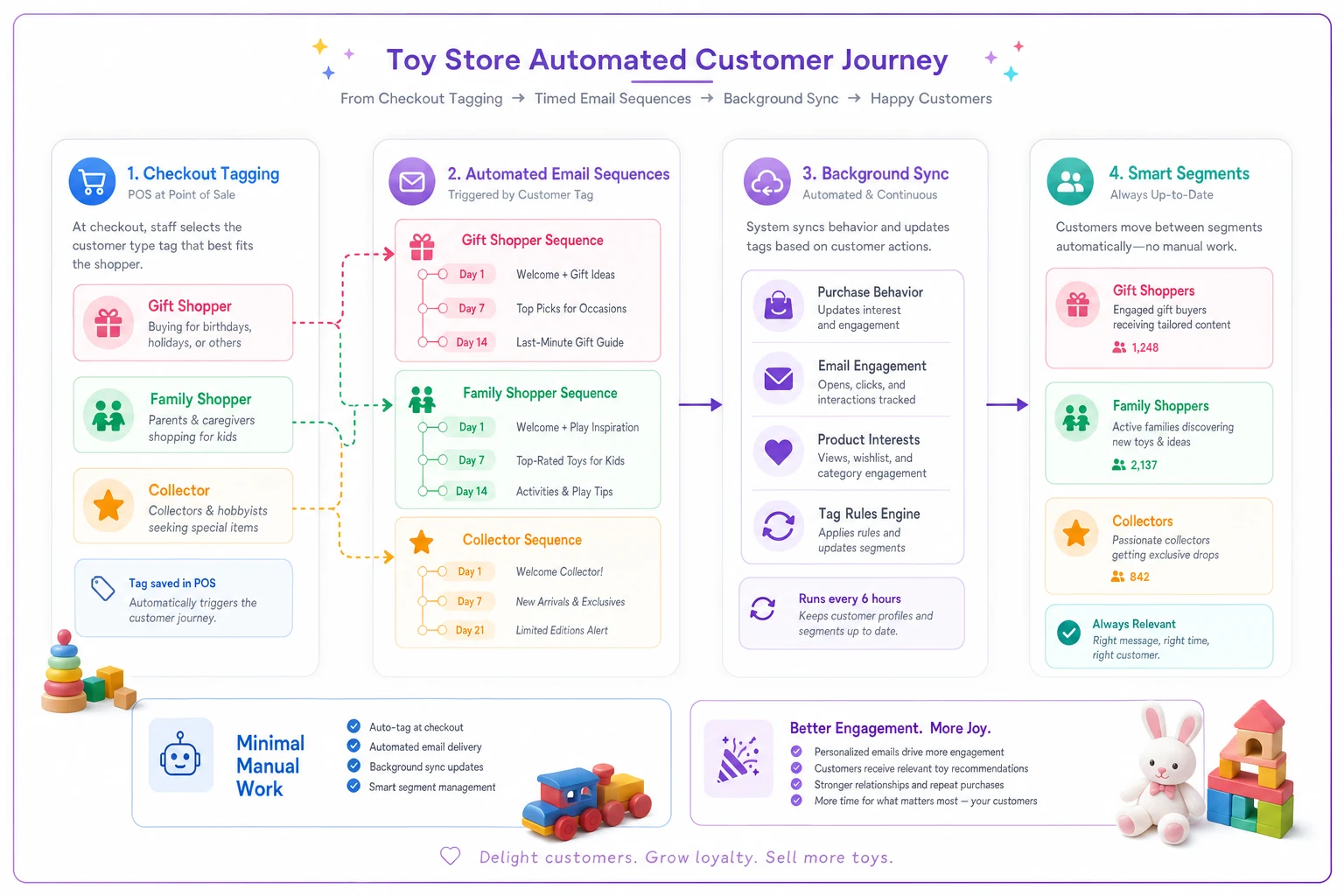
The value isn't automation for its own sake. It's that segmentation only stays worth doing if it doesn't add hours to your week.
If your POS supports it, use a simple checkout checkbox to seed the tag — it's the lowest-friction way to get reliable signals.
If maintaining three sequences means someone's manually exporting and re-tagging every few days, it'll quietly get abandoned by month two. The tagging and triggering running in the background frees the two people in the shop to spend time on the parts that actually need a human: choosing the pairings, writing copy that sounds like your store, and talking to the collector who just walked in.
Stop sending your best customers the email you wrote for your worst-fit buyer. A gift buyer, a family buyer, and a collector are three different relationships on three different clocks. The post-purchase window is the cheapest place you'll ever have to prove you understand the difference. Split the sequence, match the timing to how each cohort actually behaves, and — for the love of margin — keep discounts away from the people who were never going to need one.
Ready to elevate your toy store operations?
Join 500+ toy retailers using GoToyvio to increase sales, reduce stockouts, and enhance customer loyalty.