

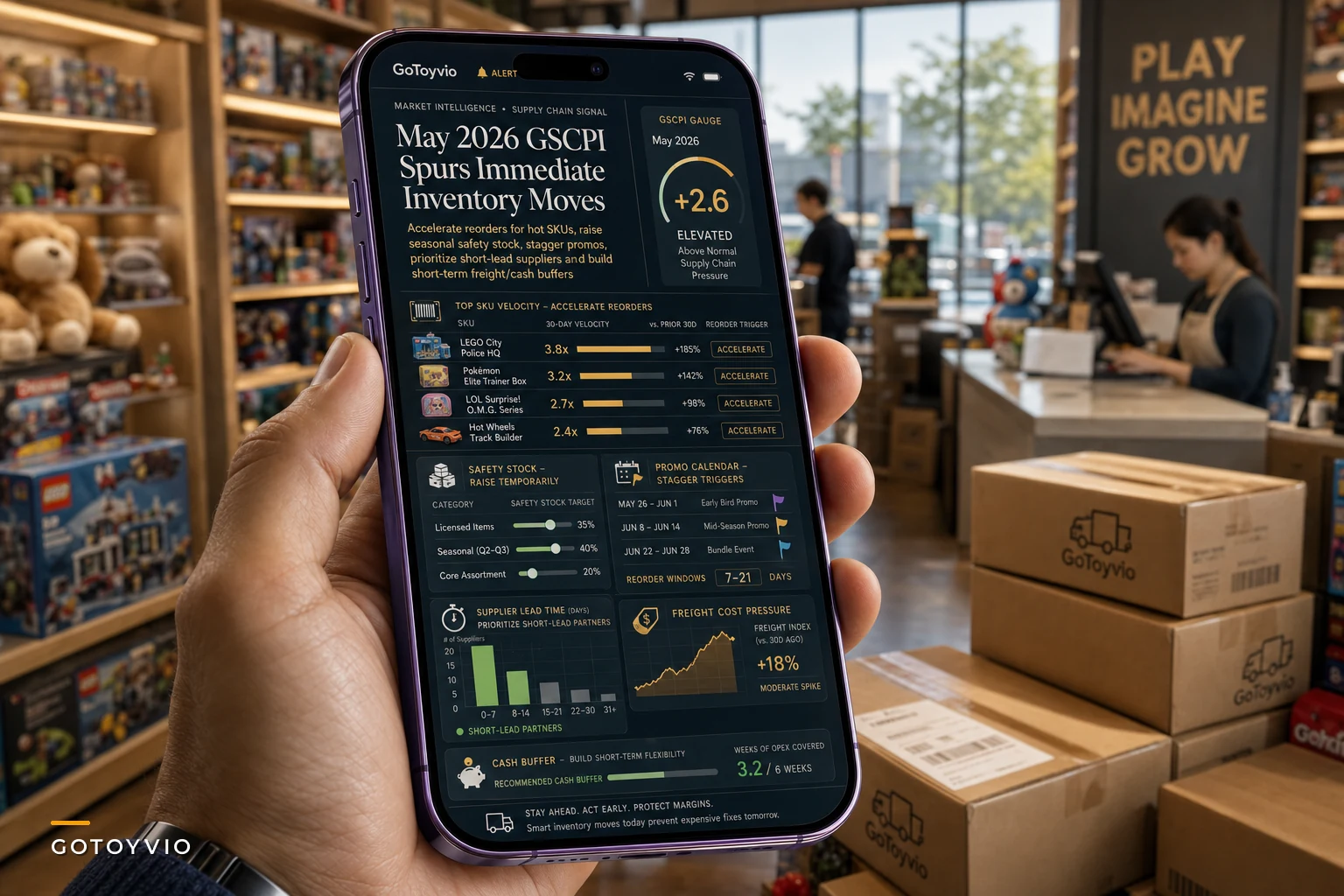

The New York Fed just released their May supply chain pressure numbers, and honestly? The timing sucks for toy stores. Their Global Supply Chain Pressure Index stayed elevated through May, which confirms what you're probably already feeling—getting product is still a nightmare, and it's about to slam into your most critical ordering window.
Another supply chain warning feels like background noise at this point. But this one matters for your summer and back-to-school planning. Toy stores live or die on compressed selling seasons, and when lead times blow out from 8 weeks to 14 weeks right as you need to lock in seasonal orders, you're choosing between awful options. Order too early and eat carrying costs. Order too late and watch customers walk out empty-handed in August.
The real problem isn't just delays. Supply chain pressure creates this cascade of bad decisions that compounds through your entire seasonal cycle. You panic-order extra inventory "just in case," tying up cash you need for other SKUs. You pay expedited freight that destroys margins. You take whatever allocation your supplier offers instead of what actually sells in your market.
The hidden math behind seasonal toy ordering that supply chain stress breaks
Most toy stores operate on what works out to roughly a 60-30-10 split during peak season. About 60% of inventory should be core products that sell year-round—LEGO sets, board games, educational toys. Around 30% should be seasonal hits like pool toys in summer or Halloween costumes in fall. Maybe 10% should be test products for next season.
Supply chain pressure breaks this formula in ways that aren't obvious at first. When your Pokémon card shipment gets delayed three weeks, you can't just slot in extra Barbies and call it even. Different toy categories have completely different velocity patterns, space requirements, and customer expectations.
Delayed shipments cascade through operations in predictable ways:
| Delay Impact | Week 1-2 | Week 3-4 | Week 5+ |
|---|---|---|---|
| Lost Sales | 5-8% of projected | 12-18% of projected | 25-40% of projected |
| Customer Behavior | Multiple store visits | Starts buying elsewhere | Stops checking back |
| Cash Position | Tied up in pending orders | Can't reorder fast-movers | Missing supplier discounts |
| Staff Impact | Explaining delays | Losing credibility | Processing returns/complaints |
The numbers get worse when you factor in seasonal compression. A two-week delay in May means almost nothing for Christmas inventory. That same delay in July for back-to-school products? You might as well not even receive the shipment.
What actually works: aggressive preseason moves most stores avoid
There's this psychological barrier around ordering summer toys in March or back-to-school items in May. Feels too early, right? But operational reality says different. The stores that consistently nail seasonal transitions start their moves 6-8 weeks before competitors even think about it.
Never run out of bestsellers again.
GoToyvio helps you monitor inventory and sales to keep your shelves stocked and customers happy.
- Real-time stock tracking
- Automated reorder alerts
- Sales and promotion analytics
No credit card required
One approach that's been working: create "seasonal bridges." Instead of hard-cutting from spring to summer inventory, you identify products that work across both seasons. Water guns? Obviously summer. But STEM kits, art supplies, outdoor sports equipment—these bridge multiple seasons and reduce risk when shipments get weird.
Build your order calendar backwards from your absolute latest acceptable delivery date, then add buffer time based on current conditions. Reuters reported that pressure index signals aren't improving fast, so whatever buffer you used last year probably needs another 2-3 weeks.
The preorder commitment trap nobody discusses
Suppliers are pushing harder for early commitments with less flexibility on changes. They want firm orders 16-20 weeks out instead of the old 8-12 week windows. This fundamentally changes how you approach seasonal buying.
-
Lock in early with volume commitments - Gets priority allocation but murders cash flexibility
-
Stay loose and pay premium pricing - Preserves agility but kills margins
-
Split orders across multiple suppliers - More complex to manage but reduces single-supplier risk
Most stores default to option 1 because it feels safest. But too many retailers get burned when consumer preferences shift mid-season and they're stuck with 400 units of whatever TikTok decided wasn't cool anymore.
Your competition is already moving (and why that's good news)
Walk into any Target or Walmart right now. Their summer toy sections are already 70% stocked, which seems crazy for early June. But big boxes can afford to be wrong on timing. They've got the floor space and cash reserves to hold inventory for weeks.
You don't have those luxuries, but you have advantages they can't match. Independent toy stores can pivot inventory mix in days, not quarters. You can test products with 12-unit orders instead of 12,000-unit commitments. You can actually talk to customers and adjust buying based on real feedback instead of algorithmic forecasts.
The trick is using supply chain pressure as competitive intelligence. When big retailers commit early to their seasonal sets, they telegraph exactly what won't be available for late-season reorders. That's your opportunity to stock complementary items or alternatives they'll run out of.
Building anti-fragile ordering rules for summer 2026
Traditional safety stock calculations assume somewhat predictable lead times. That assumption is dead. You need ordering rules that get stronger when things get chaotic.
High Flexibility (can pivot easily):
-
Generic outdoor toys
-
Art and craft supplies
-
Classic board games
-
Books and puzzles
Medium Flexibility (some constraints):
-
Licensed products with broad appeal
-
Seasonal sports equipment
-
Educational STEM toys
-
Building sets
Low Flexibility (lock these in now):
-
Exclusive or limited releases
-
Hot license tie-ins
-
Sized items (bikes, ride-ons)
-
Custom or personalized products
Rotate a few high-flex SKUs into front-of-store displays during transition weeks to test cross-season appeal.
Your ordering should inverse-weight these categories based on lead time uncertainty. When supply chains get sketchy, load up on high-flexibility items that can sell across multiple seasons or scenarios. Save firm commitments for low-flexibility items where being out of stock actually kills sales.
The Wednesday morning order review that changes everything
This is stupidly simple but almost nobody does it: every Wednesday morning, spend 30 minutes reviewing pending orders against actual sales from the previous week. Not projected sales, not last year's sales—actual current velocity.
Most stores review orders when they place them, then never look again until product arrives. By then it's too late to adjust. But a weekly review during supply chain chaos lets you cancel or defer orders that aren't urgent, expedite items showing unexpected demand, identify gaps before they become stockouts, and negotiate better terms when suppliers need to move inventory.
The Wednesday timing matters because it gives you two days to act before the weekend (when most toy shopping happens) and suppliers are usually more responsive mid-week than Monday or Friday.
Run this simple workflow during your 30-minute session.
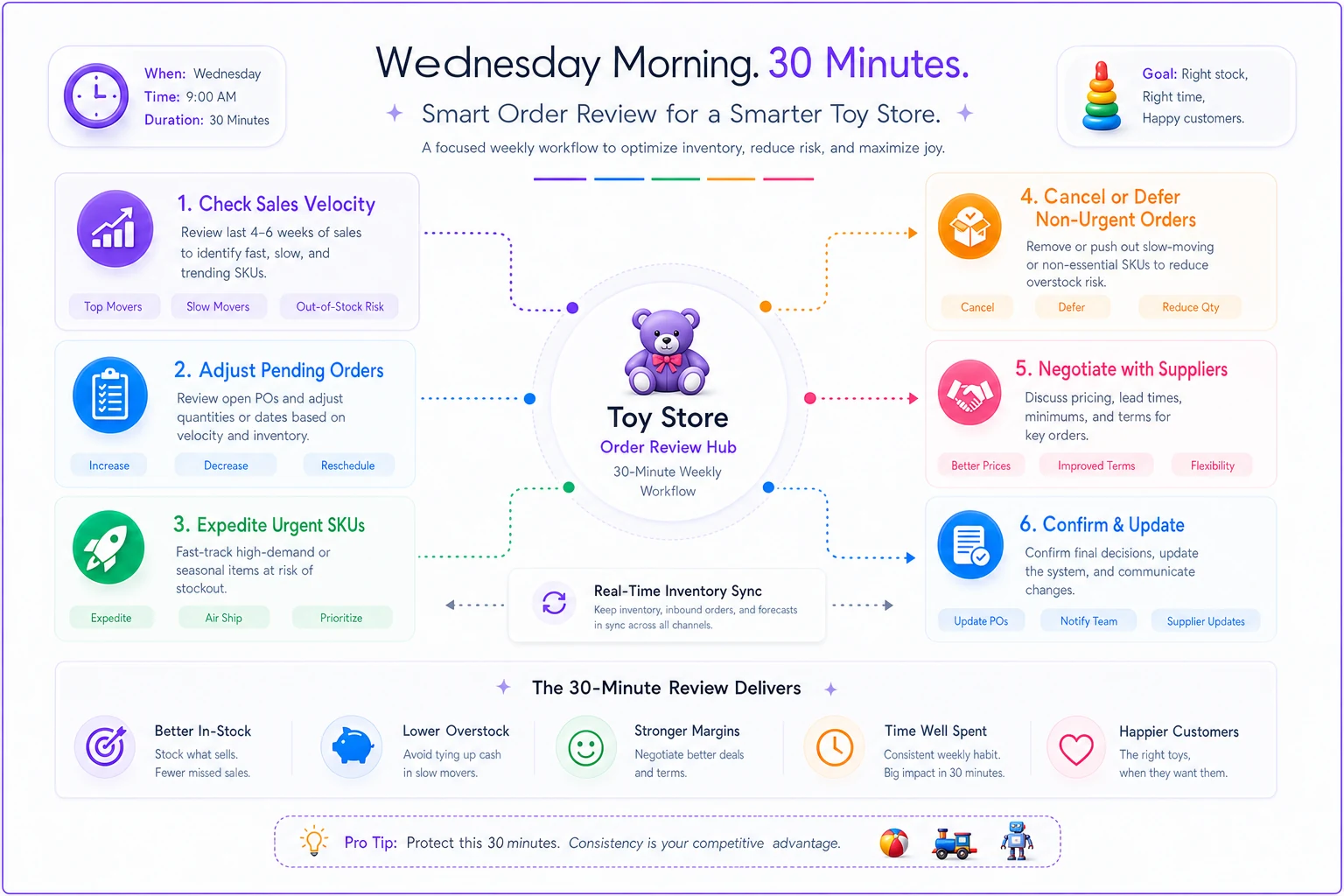
Run through those steps in 30 minutes and you'll be surprised how many costly moves you avoid.
How smart stores flip seasonal transitions into profit centers
Instead of treating the May-to-June transition as inventory replacement, treat it as expansion. Your spring items don't disappear—they get recontextualized for summer activities. That Play-Doh set becomes an outdoor activity. Those puzzles become rainy day vacation essentials.
One store in Connecticut killed it last year by creating "Summer Survival Kits"—basically bundling slow-moving spring inventory with one or two new summer items. Parents grabbed them for vacation trips, camps, whatever. Moved dead inventory while testing new products with basically zero risk.
The operational beauty of this approach is it buys you time. While competitors scramble to completely flip their floors, you're generating cash from existing inventory that funds your new seasonal buys. When those delayed shipments finally show up, you've got space and cash to properly merchandise them instead of panic-dumping them wherever they fit.
Making peace with imperfect information
You're not going to nail every seasonal transition. Accept that now and build systems that minimize damage when you're wrong instead of pretending you'll be right.
This means practical things like never putting more than 20% of your cash into any single seasonal bet, always having a "dump strategy" for items that don't move (donation partners, bulk buyers, etc.), building relationships with multiple suppliers for every major category, and keeping detailed notes on what actually sold vs. what you thought would sell.
That last point matters more than you might think. Most toy stores have terrible institutional memory about seasonal performance. The owner might remember that fidget toys crushed it two summers ago, but nobody documented which specific SKUs, at what price points, during which weeks.
Who shouldn't panic about supply chain pressure (and who absolutely should)
If you're a specialty toy store focused on evergreen educational products, supply chain chaos is annoying but not existential. Your customers aren't shopping on strict seasonal deadlines. They need what they need when they need it.
But if you're relying on licensed products tied to summer movie releases, or your business model depends on having full costume selection by September 15th, you need to move aggressively right now. Not next week. Now.
The stores that get crushed by supply chain pressure treat it like weather—something that happens to them. The ones that thrive treat it like competition—something they can outmaneuver with better preparation and faster decisions.
The tech stack nobody talks about that actually matters
Most toy stores are still tracking inventory in spreadsheets or decade-old POS systems that can't handle modern supply chain complexity. When your supplier sends an email saying, "Your Pokemon shipment is split—half arriving next week, half in three weeks," good luck updating that in your ancient system.
Modern inventory management software that handles seasonal planning isn't just about tracking what you have. It's about modeling different arrival scenarios, automatically adjusting reorder points when lead times change, and flagging when your cash position gets dangerous.
The stores crushing it right now have systems that alert them when a SKU's velocity suggests it'll sell out before the reorder arrives. They're not manually checking stock levels—they're getting Tuesday morning alerts saying, "Based on current sales rate and supplier lead time, you'll run out of Series 3 Pokemon cards by June 18th."
Stop optimizing for last year's supply chain
The biggest mistake stores keep making: using 2023 or 2024 planning assumptions for 2026 reality. Lead times aren't returning to "normal." This is the new operational environment, and fighting it just burns cash and energy.
What works now: order earlier than feels comfortable, hold more cash reserve than seems necessary, build deeper supplier relationships than appears efficient, and create more flexible merchandising plans than looks optimal.
The stores that adapted early are already seeing benefits. They're not stressed about July 4th inventory because they locked it in during April. They're not panicking about back-to-school because they started conversations with suppliers in March.
Your next four moves (in order)
Follow these four moves in order to secure your summer and back-to-school inventory.
-
First, audit every pending order you have right now. Call suppliers and get realistic arrival dates, not hopeful ones. Map these against your selling calendar and identify the gaps that will actually hurt vs. ones you can live with.
-
Second, identify your "must-win" seasonal categories for summer and back-to-school. These are the ones where being out of stock genuinely damages your reputation. Lock these in now, even if it means paying slightly more or committing earlier than ideal.
-
Third, create your bridge inventory strategy. What products work across multiple seasons or scenarios? Load up on these as your hedge against timing uncertainty.
-
Fourth, set up a weekly rhythm for reviewing and adjusting orders. Wednesday mornings, 30 minutes, non-negotiable. This habit alone will save you thousands in expedited freight and dead inventory.
The supply chain pressure we're seeing isn't a crisis unless you treat it like one. It's a forcing function that's making every toy store get operationally tighter. The ones that embrace this reality are going to come out stronger. The ones that keep hoping for 2019 conditions to magically return are going to have a rough August.
Your customers don't care about your supply chain challenges. They just want the right toys at the right time. Everything else—the ordering windows, the safety stock, the supplier relationships—that's just operational machinery that makes the magic happen. Get the machinery right, and the magic takes care of itself.
Ready to elevate your toy store operations?
Join 500+ toy retailers using GoToyvio to increase sales, reduce stockouts, and enhance customer loyalty.