

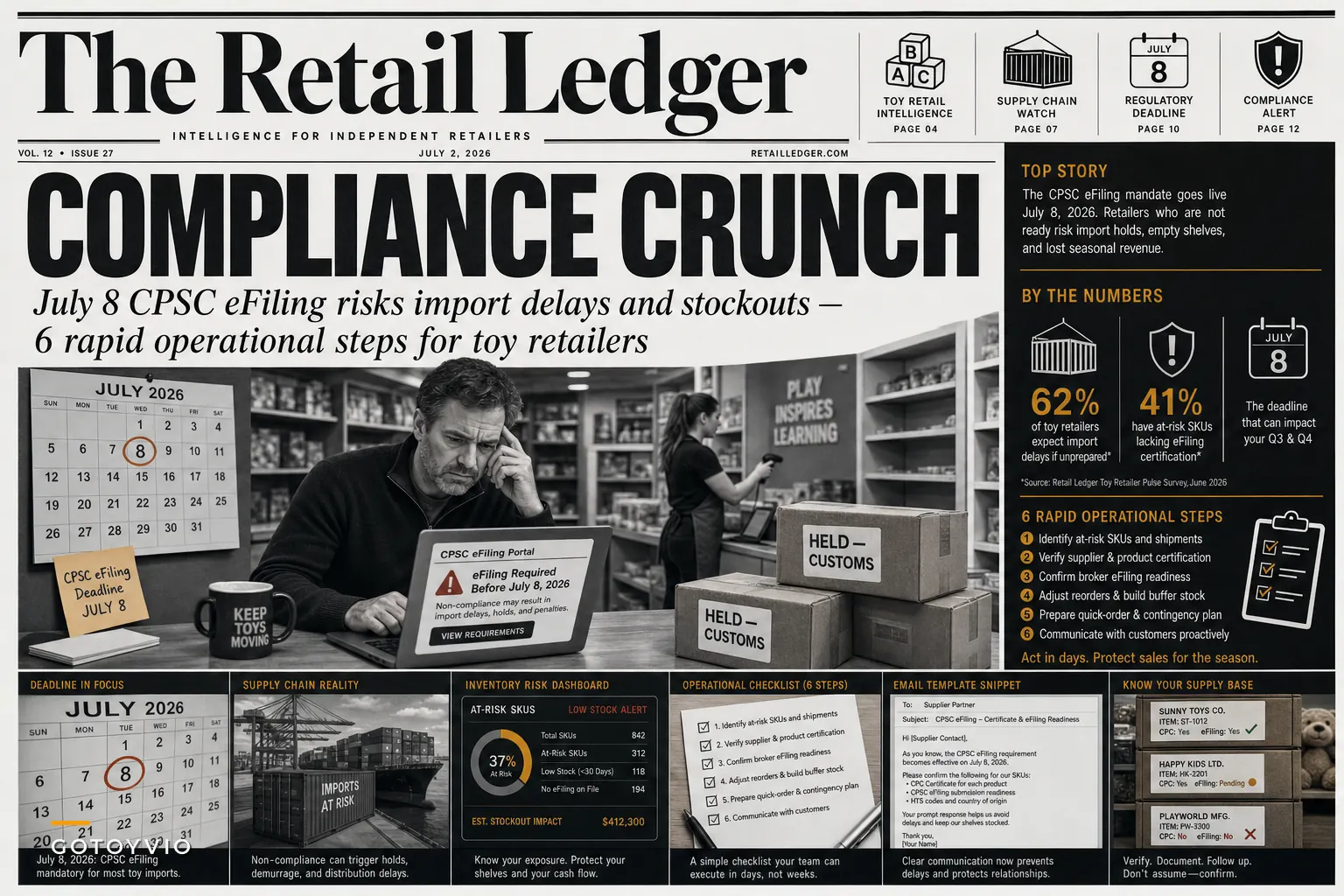

If you're running a toy store and haven't heard about CPSC eFiling yet, you're about to get blindsided. Starting July 8, any imported toy hitting U.S. ports needs electronic certificate data filed with customs—or it sits there. No exceptions.
This isn't some distant regulatory threat. The CPSC's eFiling mandate kicks in literally next week, and based on what we're seeing with retailers scrambling to verify their supply chains, most independent toy stores are nowhere near ready.
The brutal part: your fall inventory orders are probably already on the water. Those Pokemon TCG holiday tins, the LEGO advent calendars you pre-bought in March, the Squishmallows restock you're counting on for back-to-school—all of it could get stuck at port if your suppliers haven't sorted their Certificate of Compliance documentation.
What makes this particularly nasty for toy stores
Toy retail runs on imported products. Even "American" brands manufacture overseas—Mattel produces in Indonesia and Malaysia, Hasbro uses facilities in Vietnam and China, and virtually every plush, collectible, and electronic toy crosses an ocean before hitting your shelves.
The timing couldn't be worse. July-August receiving sets up your entire Q4. Miss these windows and you're either paying expedited freight that destroys margins or explaining to parents why you don't have the hot holiday items they saw on TikTok.
According to logistics provider Dimerco's recent advisory, entries lacking proper eFiled certificate data face immediate CBP holds. That means containers sitting at Long Beach while you burn through safety stock and watch competitors who sorted this out grab your sales.
What really stings is watching stores discover their suppliers don't even know what a Certificate of Compliance looks like. These overseas manufacturers have been shipping the same way for years—suddenly they need to provide machine-readable test data through specific portals, or your shipment doesn't move.
The operational mess this creates (and why most stores will handle it wrong)
Most toy stores treat compliance like insurance—something you think about once a year and hope never matters. But CPSC eFiling for toy store compliance isn't a back-office checkbox. It's an operational constraint that touches every part of your business.
Never run out of bestsellers again.
GoToyvio helps you monitor inventory and sales to keep your shelves stocked and customers happy.
- Real-time stock tracking
- Automated reorder alerts
- Sales and promotion analytics
No credit card required
Take a typical independent store with around 800 SKUs. You've got direct-import exclusives from Asian manufacturers, distributor inventory from domestic wholesalers who import themselves, and dropship arrangements with brands that handle their own importing. Each channel has different documentation flows, different responsible parties, and different failure points.
The knee-jerk reaction happening everywhere right now: panic-email all suppliers asking "are you eFiling compliant?" Then accept whatever vague reassurance comes back. That's how you end up with a container of fidget toys stuck in customs while your supplier insists they filed everything correctly and points fingers at the freight forwarder.
The smart stores are treating this as an inventory risk event and adjusting operations accordingly. Not just checking boxes—actually restructuring how they handle imported products through peak season.
Step 1: Triage your SKUs by actual import risk
Forget asking suppliers if they're "compliant." That gets you nowhere. Map every SKU to its actual import pathway and documentation owner.
Start with your reorder report from last Q4. Pull everything that moved more than 24 units between October and December. That's your critical holiday inventory. Now classify each item:
-
Direct import items (you're the importer of record)
-
Exclusive products from overseas manufacturers
-
Private label items
-
Direct factory purchases
-
Distributor import items (distributor is importer)
-
Products from U.S.-based wholesale suppliers
-
Items shipped from domestic warehouses
-
Standard catalog products from major distributors
-
Brand import items (brand handles importing)
-
Dropship arrangements
-
Direct-from-brand purchases
-
Marketplace fulfillment items
For direct imports, you own the eFiling problem completely. For distributor and brand imports, they technically own it—but their failure still creates your stockout.
Step 2: Get specific documentation commitments now
Generic compliance promises mean nothing. You need actual documentation or evidence of eFiling capability.
For your direct imports, contact your customs broker immediately. Ask specifically:
-
Are they registered in the CPSC eFiling system?
-
Can they show you a test filing?
-
What happens if documentation is incomplete?
-
What's their contingency process?
For distributor and brand imports, demand either:
-
Copy of their CBP eFiling registration
-
Written confirmation from their customs broker
-
Proof of successful eFiled entries from June (some were testing early)
-
Alternative sourcing commitment if delays occur
The responses tell you everything. Detailed answers mean they're prepared. Vague reassurances mean your holiday inventory is at risk.
Step 3: Build 30-day coverage for at-risk SKUs
Even prepared suppliers will have hiccups when this goes live. Systems fail, documentation gets rejected, interpretations vary between ports.
For any SKU where you can't verify solid eFiling preparation, you need 30 days of additional coverage. Not permanent safety stock—temporary buffer inventory to bridge potential delays.
Calculate it simply:
-
Average daily sales for that SKU in November
-
Multiply by 30
-
Subtract current on-hand
Yes, this ties up cash. But compare that to the alternative: expedited air freight at roughly 5x ocean rates, or worse, empty shelves during peak season.
Focus buffer building on:
-
High-margin collectibles and exclusives
-
Items with no domestic alternatives
-
Products with historically volatile supply
-
Anything sourced from smaller overseas suppliers
Here's a quick workflow to visualize the 30-day coverage process.
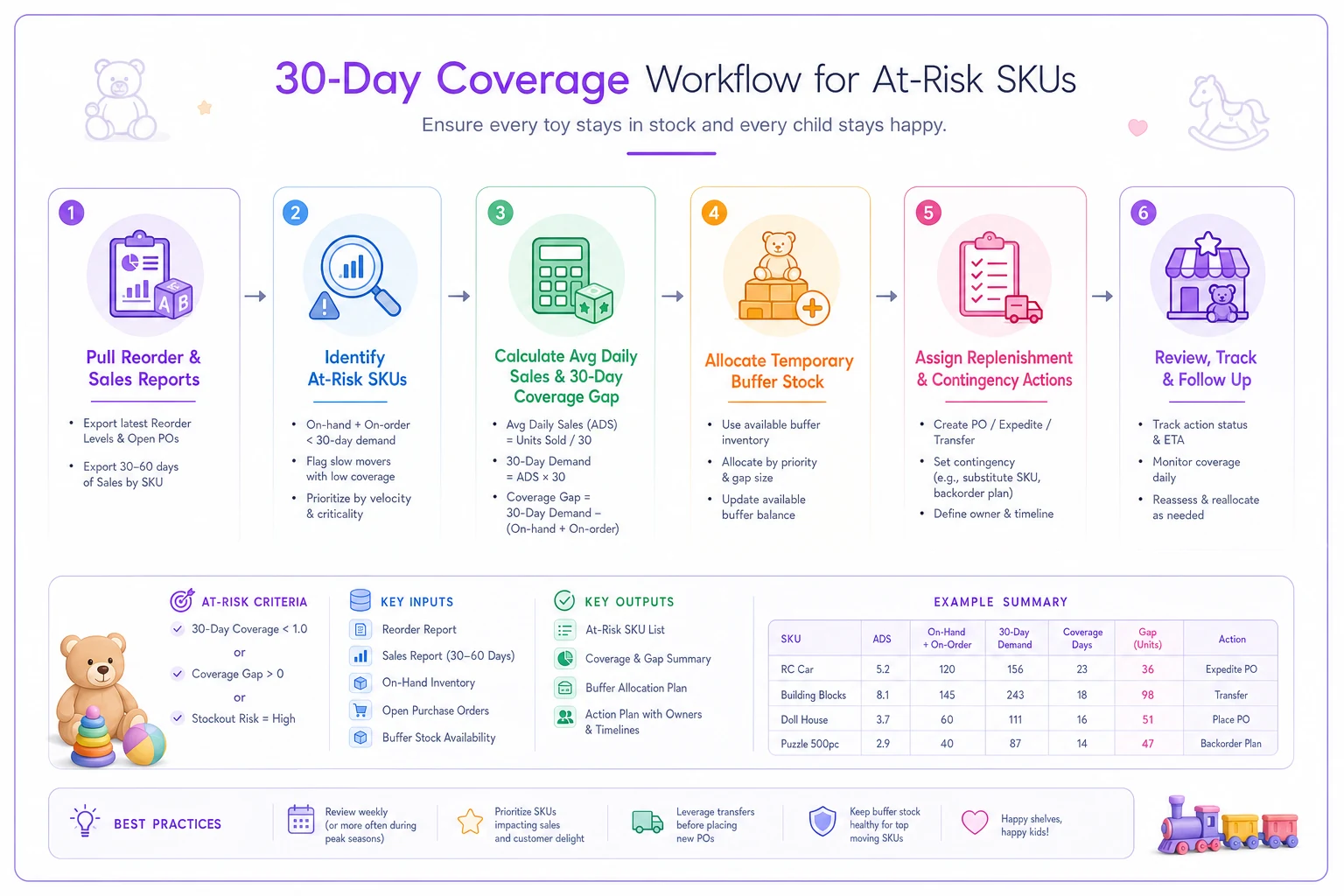
Use this flow to assign owners and deadlines.
Step 4: Retime your import windows
The first few weeks of eFiling will be rough. Customs brokers learning systems, CBP officers interpreting requirements differently, everyone pointing fingers when shipments stop moving.
If you have any control over shipment timing, avoid arriving at port between July 8–31. Either accelerate to arrive before July 8 (probably too late at this point) or delay until early August when the worst kinks are worked out.
For shipments you can't retime:
-
Budget 7–10 extra days for customs clearance
-
Arrange backup transportation from port to warehouse
-
Have your freight forwarder on standby for delays
-
Pre-authorize storage fees to avoid abandonment
This connects directly to your seasonal inventory system—those safety stock calculations and reorder points assume normal lead times. Add two weeks to every import-dependent SKU through August.
Step 5: Create customer communication templates
When (not if) you face stockouts from eFiling delays, how you communicate determines whether customers wait or walk.
Don't hide behind vague "supply chain issues." Parents and collectors are surprisingly understanding when you're specific. Create templates for:
Pre-arrival notification for hot items: "Our Pokemon Surging Sparks shipment is currently awaiting customs clearance due to new federal documentation requirements. Expected arrival has shifted from July 15 to approximately July 22. Would you like us to reserve your pre-order for the updated date?"
Substitution offers for delayed items: "The Squishmallow Halloween collection is delayed at port. While we wait for clearance, we have the exclusive Nightmare Before Christmas set available now, or we can reserve your Halloween items for arrival around July 25."
Reservation list for delayed shipments: "Due to new import procedures, our Bluey birthday party supplies are running 10 days behind schedule. Join our priority notification list to secure yours as soon as they clear customs—no payment required until arrival."
Be explicit in your templates about expected arrival dates and alternatives to keep customers informed and reduce cancellations.
Be specific about the cause, realistic about timing, and proactive with alternatives.
Step 6: Document everything for fee recovery
When shipments delay due to eFiling issues, costs pile up fast. Demurrage fees, storage charges, expedited transportation, cancelled customer orders. Document everything.
Create a simple tracker:
| Shipment | Expected Date | Actual Date | Delay Cause | Extra Costs | Recovery Status |
|---|---|---|---|---|---|
| LEGO City Wave 3 | July 10 | July 18 | Missing COC data | $450 storage | Claimed from supplier |
| Pokemon TCG Tins | July 12 | July 20 | eFiling rejection | $1,200 air freight | Pending |
| Jellycat Fall Plush | July 15 | TBD | Broker not registered | $325 demurrage/day | Documenting |
Suppliers who dropped the ball on eFiling preparation will often cover reasonable delay costs to preserve relationships—but only if you can prove the connection between their documentation failure and your losses. For direct imports where you're responsible, this documentation helps with insurance claims or freight forwarder negotiations.
The real problem: toy stores run on trust-based importing
CPSC eFiling for toy store compliance exposes something broken in toy retail operations: the industry has been running on handshake import agreements and assuming compliance just happens.
That worked when enforcement was sporadic. Now, with mandatory electronic filing creating instant visibility, every documentation gap becomes an operational failure.
Stores that are navigating this well have designated someone—even part-time—as an import coordinator. Not to handle logistics, but to own documentation and supplier verification. They're building simple databases of COC certificates, testing reports, and supplier commitments.
Some operators are also rethinking their supplier mix. That strong margin on direct-import wooden toys looks different once you factor in compliance complexity and delay risk. Some stores are consciously shifting toward domestic distributors for commodity items while keeping direct imports only for true exclusives.
What happens after July 8
The first month will be rough. Every customs broker will blame "eFiling issues" for any delay, whether related or not. Suppliers will claim they filed everything while shipments sit idle. Freight costs will spike as everyone rushes to move delayed cargo.
By September, there will be three categories of toy stores:
-
The prepared ones who verified documentation, built buffers, and communicated clearly. They'll capture market share from competitors facing stockouts.
-
The reactive ones scrambling to fix problems as they arise. They'll survive but eat significant costs and lose some customer trust.
-
The unprepared ones who assumed their suppliers would handle everything. They'll miss the crucial September–October selling window and enter holiday season behind on both cash and inventory.
Our industry looks simple from outside but runs on incredibly complex global supply chains. A single documentation requirement can cascade into stockouts, rushed freight, and lost sales that define your entire year. Stores building systematic approaches to import management—tracking documentation, verifying suppliers, maintaining compliance records—will find this eFiling requirement just becomes part of operations. Everyone else will lurch from crisis to crisis blaming "supply chain issues" while competitors grab their customers.
Your next 72 hours
Stop reading compliance guides and start operational triage:
-
Pull your July arrival report right now
-
Email every supplier with specific documentation requests (not "are you compliant?")
-
Calculate 30-day buffer requirements for critical SKUs
-
Call your customs broker for a real conversation about their eFiling readiness
-
Build that customer communication template before you need it
The July 8 deadline isn't moving. Most toy stores will wait, hope their suppliers sorted it out, and react when problems hit. The smart ones will treat this like the operational threat it is and adjust now.
Because what's really at stake is customer trust. When a mom comes in looking for the PAW Patrol Fire Truck her kid wants for their birthday, she doesn't care about eFiling or customs delays. She cares that you promised to have it and you don't. Every import delay becomes a customer relationship failure.
The operational software platforms we've built for toy retailers consistently show the same pattern: the retailers who win don't avoid problems, they prepare for them. They build buffers, create workflows, and document everything. They treat compliance as operations, not paperwork.
This eFiling requirement is just the latest test of that principle. Handle it right, and it becomes a competitive advantage as unprepared competitors struggle. Handle it wrong, and you'll spend Q4 explaining why you don't have what customers want.
The choice—and the deadline—are both pretty clear.
Ready to elevate your toy store operations?
Join 500+ toy retailers using GoToyvio to increase sales, reduce stockouts, and enhance customer loyalty.