

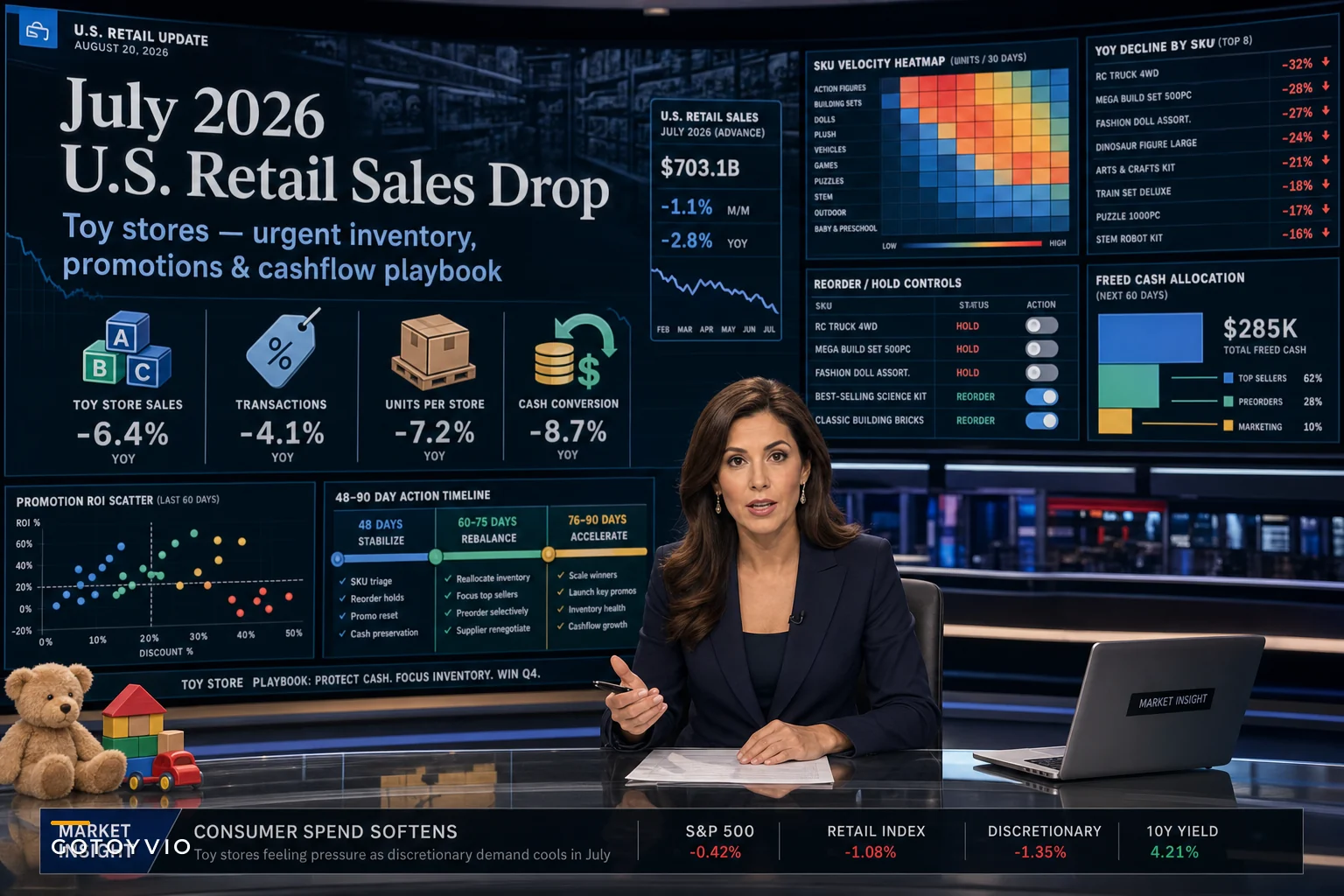

The numbers landed harder than most people expected. U.S. retail sales slipped 0.6% in July 2026, the first monthly decline in nine months, according to a Reuters report covering the latest Census figures. One down month isn't a crisis. But timing matters enormously in this business, and July sits right on top of two windows that tend to decide your year: back-to-school reorders and the first wave of holiday commitments.
If consumers are pulling back now, the real question isn't whether demand recovers by Q4. It's whether you're about to over-commit cash on assortment built around demand assumptions that just got quietly revised down. That's the trap. And most independents walk into it not because they're careless, but because their ordering calendar was locked months ago and nobody stopped to recheck it against fresh signals.
The real risk isn't slow sales — it's committed cash you can't unwind
A demand dip in mid-summer doesn't hurt you in July. Your July was probably fine or close to plan. It hurts you in November when you're sitting on 40% more licensed inventory than sell-through justifies, and every unit you discount to move is eating the margin you needed to carry through January.
The underlying problem a month like this exposes is that most independents order on momentum rather than confirmed velocity. A category moved well in spring, so the fall buy assumes that trend continues. When the macro signal shifts — like it just did — the momentum assumption breaks, but the purchase orders are already drafted or placed.
What separates stores that handle a slowdown from stores that get crushed usually comes down to one thing: how quickly they can tell the difference between committed spend they can't touch and flexible spend they still control. If you can't answer, off the top of your head, how much of your next 60 days of ordering is cancellable versus locked, you're flying blind.
| Spend Category | Flexibility | Action This Week |
|---|---|---|
| Placed POs, non-cancellable | Locked | Plan sell-through, not reorder |
| Placed POs with cancel windows | Partial | Confirm exact cancel dates |
| Drafted but unplaced orders | Full | Re-rank by velocity before sending |
| Auto-reorder / min-max triggers | Depends on settings | Pause noncore triggers now |
| Consignment / net-60 terms | Highest | Prioritize these for uncertain SKUs |
That bottom row matters more than usual right now. When demand is uncertain, terms that delay cash outflow or shift risk to the supplier are worth more than a slightly better unit cost. A 3% better price on prepaid inventory you might have to mark down 30% is a bad trade.
Re-rank your assortment by velocity, not by how much you like the product
The instinct when spending softens is to cut broadly — trim 10% across the board. That's usually the wrong move. Flat cuts protect your weakest SKUs at the same rate as your best ones, which is backwards.
Never run out of bestsellers again.
GoToyvio helps you monitor inventory and sales to keep your shelves stocked and customers happy.
- Real-time stock tracking
- Automated reorder alerts
- Sales and promotion analytics
No credit card required
A velocity re-rank works better. Pull your last 8–10 weeks of unit sales by SKU and sort ruthlessly. The shape almost never changes even when the total drops: a small group of items carries most of your turns, a wide middle plods along, and a long tail barely moves. In a softening market, you defend the top, hold the productive middle, and stop feeding the tail.
Worth noting: the tail is where owners emotionally over-invest. The quirky specialty items, the "this is what makes us different" products, the stuff a distributor rep talked you into. Some of it genuinely builds your store's identity. Most of it just sits. When cash gets tight, the tail is the first place to stop reordering — not the first place to discount, just the first place to stop replenishing.
-
Export unit sales by SKU for the trailing 8 weeks and the same 8 weeks last year.
-
Flag anything down more than 20% year-over-year that isn't clearly seasonal.
-
Separate "soft because of the market" from "soft because it's a bad SKU." A whole category dipping is market. One item dipping while its category holds is a product problem.
-
Cancel or reduce drafted orders for the bad-SKU group first.
-
Redirect that freed-up cash into your top velocity items and anything with strong preorder demand.
-
Leave auto-reorder ON only for your proven top sellers — turn it off everywhere else until you see two or three cleaner weeks.
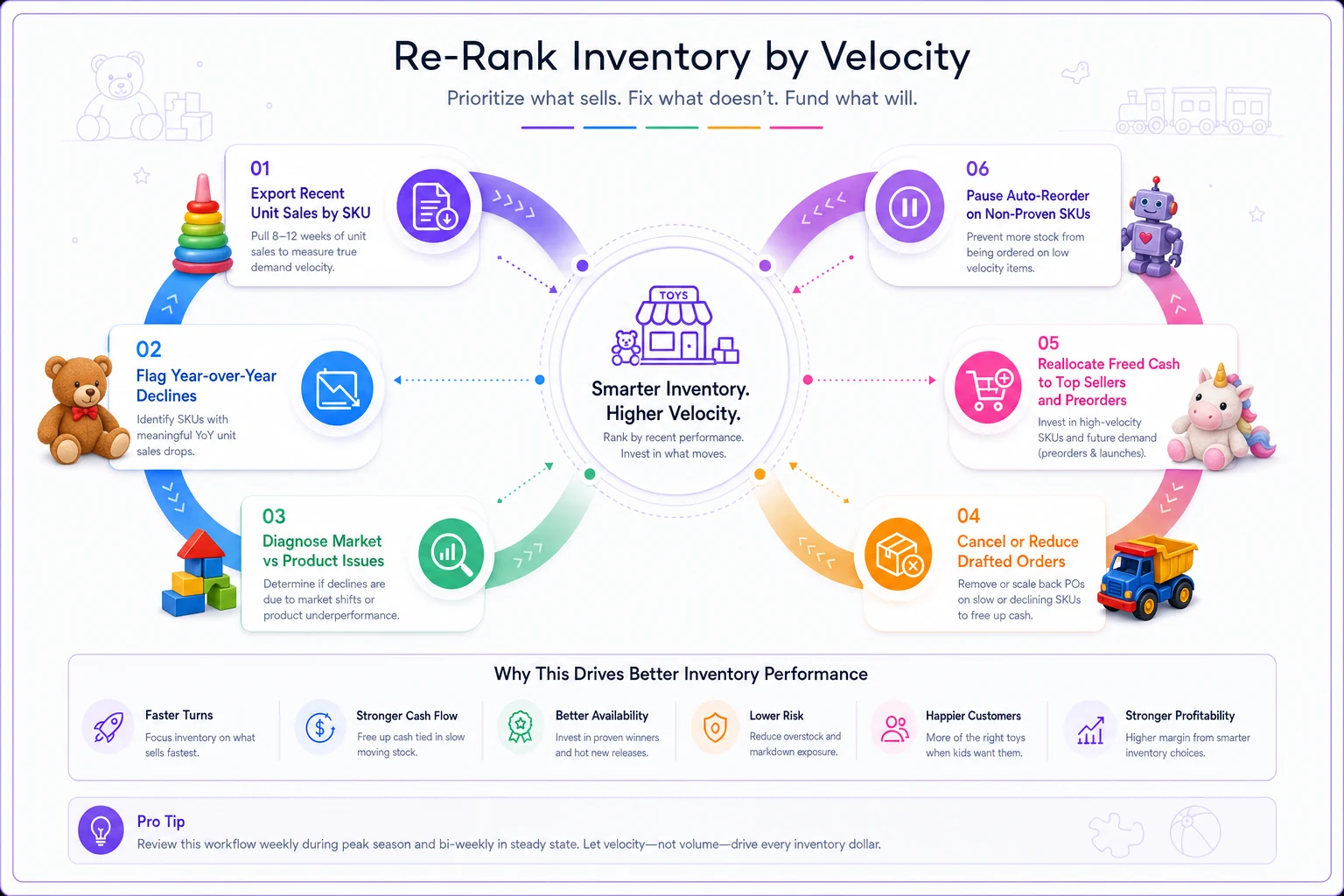
Here's a quick visual of that re-ranking workflow.
Step five is the part people skip. Cutting isn't the goal. Moving cash from dead weight into proven turns is the goal. A slowdown is actually a decent moment to concentrate your inventory into what works — your competitors are often panicking and thinning everything evenly, which leaves gaps you can fill.
Promotions: tighten the gate, don't open the floodgates
The reflex when sales dip is to run a sale. Sometimes that's right. Often it just trains customers to wait for discounts and burns margin at the exact moment you can least afford it.
The distinction that matters: are you promoting to move specific dead stock or promoting to stimulate general traffic? Those are completely different plays.
Dead-stock clearance is healthy. You've got aging inventory, cash is tight, you mark it down to convert it back into working capital. Set a floor, move it, done. The mistake here is discounting too shallow and too slowly — a 15% cut on stuck inventory usually does nothing but delay the inevitable 40% cut while it ages further.
Traffic-stimulation promos are where independents bleed money in a soft market. A store-wide 20% off might lift transaction count, but if it bleeds into your best sellers — the stuff that would've sold anyway — you just gave away margin for zero incremental revenue. Those units were leaving the shelf at full price regardless.
Before running anything, put it through a basic ROI gate:
-
Does this promo target slow-movers specifically, or does it pull in full-price sellers?
-
What's the breakeven — how many extra units do I need to sell just to net the same dollars as no promo?
-
Is there a way to add value instead of cutting price? (Free gift wrap, bundle a slow item with a fast one, loyalty points instead of a straight discount.)
-
Does it have a hard end date, or does it drift into a permanent "we're always on sale" position?
Bundle slow SKUs with proven top sellers to move dead stock without discounting the winner.
The bundling approach is underused. Pairing a slow SKU with a proven top seller at a combined price moves dead stock without discounting the winner on its own. Margin stays healthier and the fast item does the work of pulling the slow one off the shelf.
For the deeper mechanics of setting promo ROI thresholds, ordering windows, and cashflow rules that hold up when revenue wobbles, the profit-first cashflow playbook for independent toy stores covers the actual numbers worth setting before you run any discount.
A real scenario: what a two-week reset looked like
A single-location store — mostly wooden toys, some licensed goods, a strong birthday-party customer base — noticed their July run rate come in soft, roughly 8% under the prior month with no obvious local explanation. Instead of waiting to see if August recovered, the owner ran the velocity re-rank and looked hard at what was already committed.
They had close to $22k in drafted fall orders not yet placed. After the re-rank, about $6k of that was heading toward slow tail items — specialty products that had been reordered mostly out of habit. They canceled or shrank those, kept the top-velocity buys intact, and pushed roughly half the freed cash into a licensed line that was still turning cleanly plus their preorder-heavy holiday items.
They didn't run a store-wide sale. Instead they bundled a batch of slow craft kits with a popular game and cleared most of it over three weeks at a margin that still made sense. By early fall they were carrying noticeably leaner inventory in the weak categories and hadn't touched their line of credit. Nothing dramatic — no revenue miracle — just a cleaner cash position heading into the season that actually matters. The difference was catching it in weeks, not months.
When to cut hard, and when to hold your nerve
Not every soft month deserves the same response, and overreacting has its own cost. Gut your assortment on one down print and then demand snaps back — you've created your own stockouts right when Q4 matters most.
Cut and tighten aggressively when:
-
Softness spans multiple categories, not just one line
-
You're carrying more than around 8–10 weeks of supply on noncore items
-
Your cash cushion is thin and a slow fall would force emergency discounting
-
The dip lines up with broader signals — you can cross-check the //www.census.gov/retail/sales.html" target="_blank" rel="noopener noreferrer">Census retail trade data against your own numbers to see if you're moving with the market or against it
Hold steady when:
-
Only one or two categories dipped and the rest held
-
You have committed noncancellable POs anyway — cutting elsewhere just starves your good SKUs
-
Your preorder and reservation pipeline for fall releases still looks healthy
-
The softness has a clear local or temporary explanation
The worst position is the middle — reacting emotionally without actually checking whether you're seeing a market shift or noise. One soft month is a signal to look harder, not automatically a signal to slash.
The checklist for the next 14 days
Run through this before your next round of ordering decisions:
-
[ ] Pull trailing 8-week unit sales by SKU and sort by velocity
-
[ ] Identify every PO with a cancellation window and note the exact dates
-
[ ] Flag noncancellable committed spend so you plan sell-through, not reorders
-
[ ] Turn off auto-reorder on everything except proven top sellers
-
[ ] Cancel or reduce drafted orders for slow-tail SKUs
-
[ ] Reallocate freed cash into top velocity items and strong preorders
-
[ ] Separate dead-stock clearance from traffic promos — apply different rules to each
-
[ ] Set a hard end date on any promotion before you launch it
-
[ ] Cross-check your dip against broader retail data to gauge if it's market or local
-
[ ] Re-forecast cash through January under a slightly-soft-fall assumption
Running through this list once — even in an hour with a spreadsheet open — gives you a clearer picture of what's actually at risk versus what you're just worrying about. Most owners find at least one or two ordering decisions they can still adjust once they look.
Pulling it together
The stores that come through a demand wobble in decent shape usually aren't the ones with the sharpest forecasts. They're the ones who keep clean visibility into what cash is committed, what's still flexible, and which SKUs are actually earning their shelf space — and who recheck those things when the signal changes instead of running on last quarter's assumptions.
A single soft month doesn't decide your year. What you do with your flexible spend in the next couple of weeks does. Re-rank honestly, protect your winners, be surgical with discounts, and keep enough dry powder to buy back into the fall if demand firms up. That's a far better position than either panicking into flat cuts or ignoring the signal entirely and hoping November bails you out.
Ready to elevate your toy store operations?
Join 500+ toy retailers using GoToyvio to increase sales, reduce stockouts, and enhance customer loyalty.