

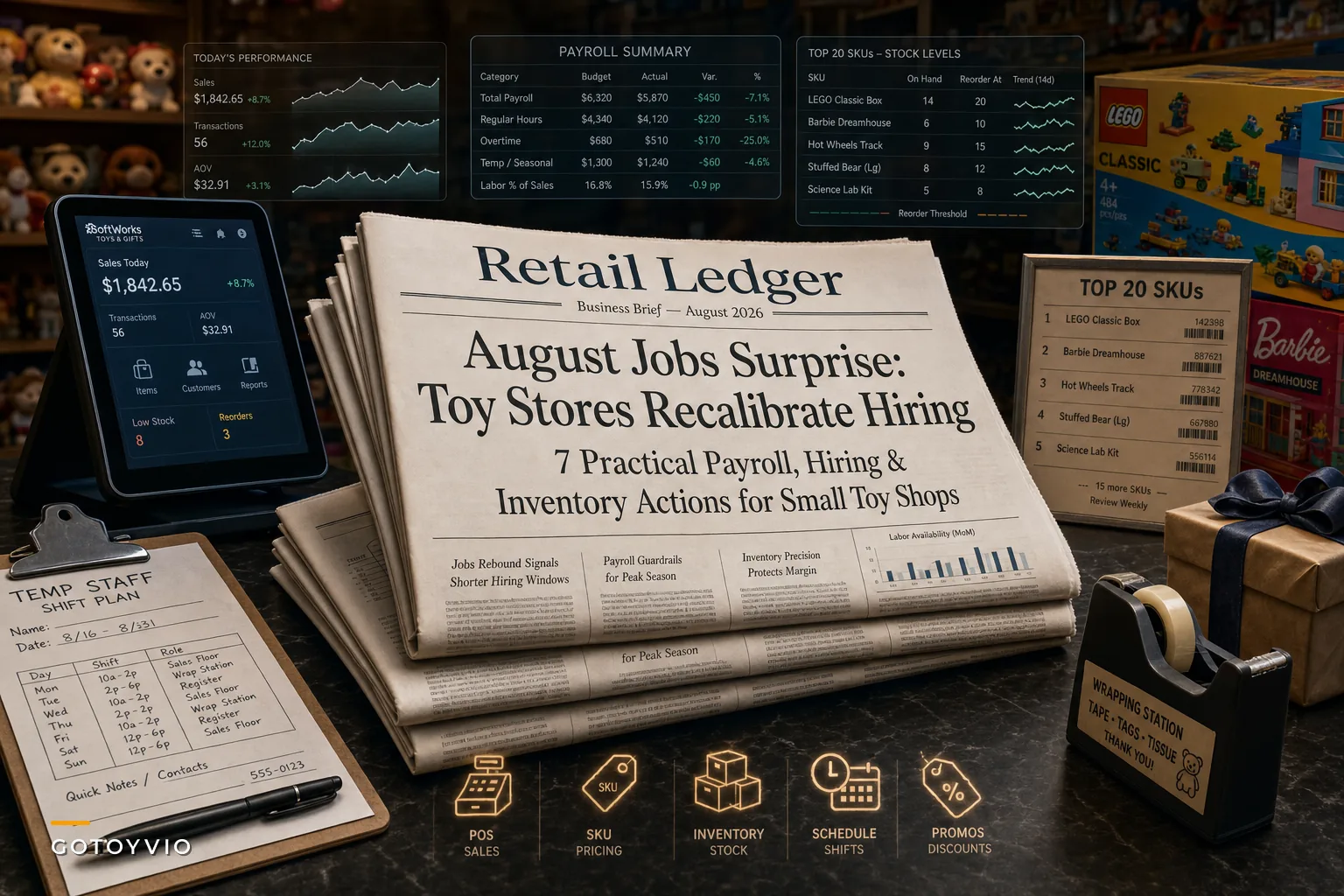

The August numbers landed heavier than most retailers expected. Nonfarm payrolls climbed 162,000 and unemployment held at 4.1%, which CNBC described as a stronger-than-forecast signal that the labor market still has heat in it. For most people that's a macro headline and nothing more. For an independent toy store staring down the busiest ten weeks of the year, it's a concrete problem: the seasonal help you're about to hire just got more expensive and harder to find.
This isn't about interest rate predictions or where the Fed goes next. When the job market stays tight this late in the year, your part-time applicants have real options — the pizza place, the mall kiosk, the fulfillment warehouse two exits down. They're all bidding for the same people you need behind your register on December 21st. That competition shows up in your labor line whether you plan for it or not.
So skip the economics lecture. Here's what actually changes in your operation this quarter.
Start With the Real Constraint: Cash Split Between Wages and Inventory
Every toy store owner already knows Q4 is a cashflow tightrope. What a hot labor market does is quietly shift the ratio. If your seasonal wage bill creeps up 8–12% versus last year — which is realistic when you're competing against warehouse and logistics jobs — that money has to come from somewhere. Usually it gets pulled from inventory depth, and that's exactly the wrong place to cut when a hot toy sells out on December 10th.
The mistake that keeps coming up: owners treat payroll and inventory as separate budgets managed by separate gut feelings. Payroll gets set in October when the hiring ad goes up. Inventory gets spread across a dozen supplier POs over several weeks. They never get reconciled against the same cash pool until January, when there's nothing left to do but stare at the number.
Build a single spreadsheet tab showing committed inventory spend and projected wage burn to see the real tradeoffs before you post jobs.
Before you post a single job listing, build one combined view. How much cash do you have to deploy between now and the last week of December? What percentage is already committed to inventory? What's left for wages? If wages need to grow, you've got three levers — fewer total hours, higher pay per hour, or fewer people working smarter — and you can't pull all three simultaneously without something breaking.
This is the tension the profit-first cashflow playbook is built around, and a firmer labor market makes those ordering windows and payroll rules more important, not less. If you haven't set hard gates between the two budgets, now's the time.
The Seven Actions
Some of these you can do this week. A couple need a bit of setup but pay off across the whole season.
Never run out of bestsellers again.
GoToyvio helps you monitor inventory and sales to keep your shelves stocked and customers happy.
- Real-time stock tracking
- Automated reorder alerts
- Sales and promotion analytics
No credit card required
1. Lock your seasonal pay rate before your competitors set the market
The biggest hiring mistake in a tight market is waiting. When you post in mid-November, you're pricing against everyone who already panicked in October. Set your rate now, benchmark it against the two or three employers physically closest to you — not national averages, local ones — and pay slightly above the median for the reliable weekend hours you actually need.
A quick example: if last year you paid $15/hr and the local warehouse is now offering $18 plus a signing bonus, you don't necessarily need to match that. But posting at $15 will get you ghosted applications and no-shows. Something like $16.50 with a clearly stated end-of-season completion bonus of $200 often out-recruits a higher base rate, because it filters for people who actually intend to stay through the 24th.
2. Compress your hiring-to-productive timeline
In a loose labor market you can afford sloppy onboarding — plenty of applicants, easy enough to replace someone who doesn't work out. In a tight one, every hire is expensive to acquire, so every hire needs to be useful fast. The bottleneck usually isn't the interview. It's the gap between "hired" and "actually functional on the floor without shadowing a full-timer."
Build a one-page, one-shift onboarding: register basics, where the top 20 gift SKUs live, wrapping station protocol, and the three questions to ask a confused grandparent ("What age? Do they already have a lot of this? What's the budget?"). If a new hire can run a real transaction unsupervised by the end of shift two instead of shift five, you've recovered a meaningful chunk of the labor premium you're paying.
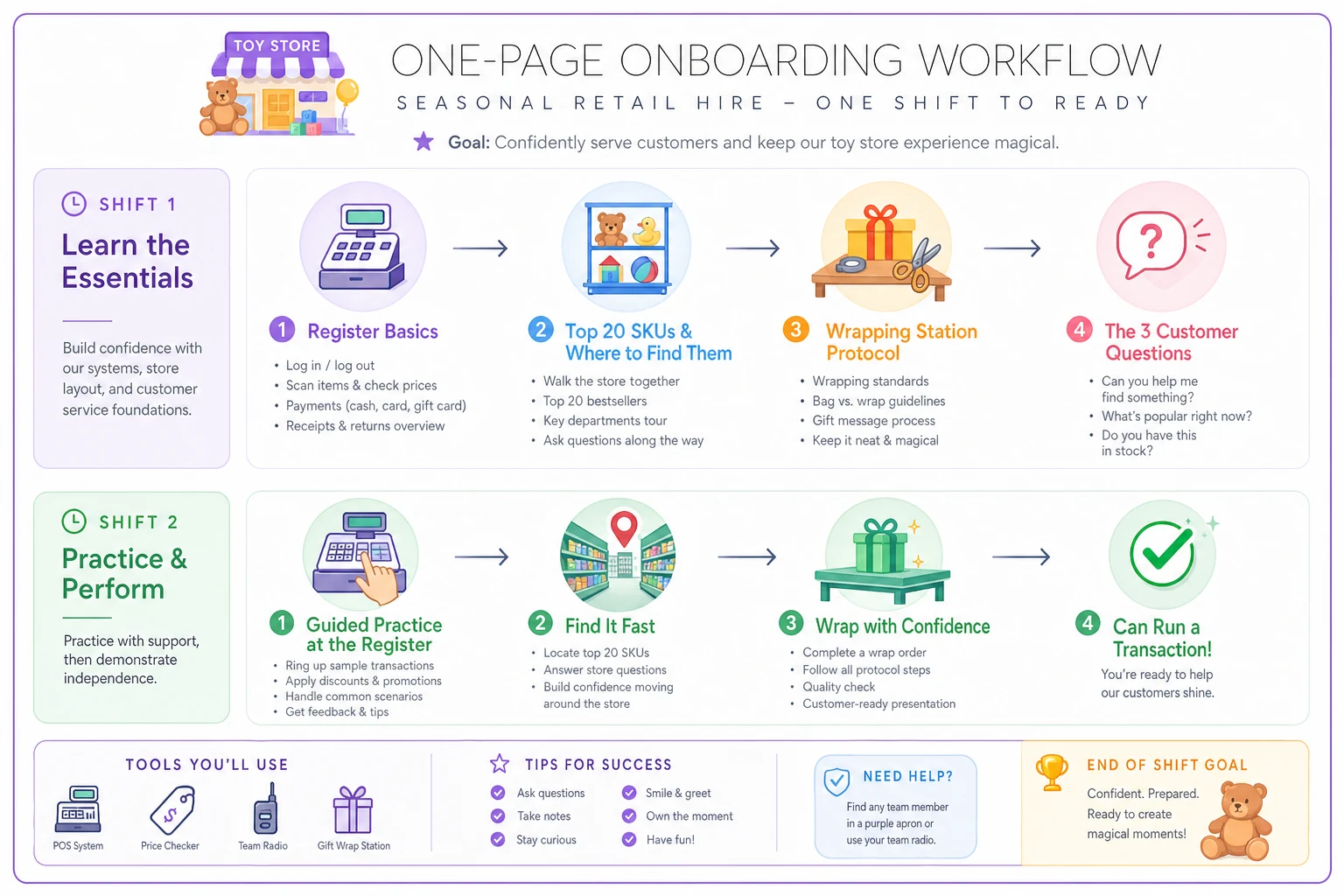
Here's a simple visual you can use to align a hire's first two shifts.
3. Schedule against your actual traffic curve, not a flat coverage grid
Most small stores overstaff slow morning hours and understaff the 4–7pm after-work rush because scheduling gets done as "who's available" rather than "when do we actually sell things." Pull last year's hourly sales from your POS and overlay it on the schedule. You'll almost always find a handful of hours a day where you're paying for coverage that generates almost nothing.
When wages are up, trimming even 6–8 low-value labor hours a week across the season adds up — often enough to fund one extra reliable person during the windows that actually matter.
4. Tighten your promo ROI gates so labor cost doesn't get buried
A discount promotion that "works" on revenue can quietly lose money once you factor in the extra staffed hours it demands. A doorbuster drives traffic, but it also forces more scheduled people, and if the average basket on those transactions is thin, you're paying premium seasonal wages to move low-margin items.
Set a simple rule before Q4: any promotion has to clear its own incremental labor cost plus a margin floor. If it can't, it's a traffic play, not a profit play — run fewer of them.
5. Rebalance safety stock toward proven velocity, away from hopeful bets
With cash under pressure from wages, this is not the year to go deep on unproven SKUs. Shift your safety stock weighting toward items with real sell-through history and pull back on the speculative orders. A firm economy can support consumer spending generally, but that doesn't mean your specific 40-unit bet on a new brand pays off.
6. Cross-train so you're not hostage to a single call-out
Tight markets mean fewer backups. If a key seasonal hire quits on December 5th, replacing them at that point is nearly impossible. Cross-training your existing crew — so anyone can cover register, floor, or wrapping — turns a staffing crisis into an annoyance instead of a disaster.
7. Pre-write your reorder triggers for the top 30 SKUs
Decision fatigue is real when you're understaffed and slammed. Set the reorder point now for your critical items so a stressed manager on a Saturday isn't guessing. This removes a whole category of expensive mistakes — both the oversell and the panic overbuy.
A Quick Comparison: Where Your Q4 Dollar Does the Most Work
When cash is tight, not every dollar buys the same protection. Here's a rough breakdown of how owners tend to think about it versus where the return actually shows up.
| Where the dollar goes | Feels urgent? | Actual Q4 payoff | Notes |
|---|---|---|---|
| Higher base seasonal wage | Yes | Medium | Attracts applicants but not necessarily reliable ones |
| Completion/retention bonus | No | High | Filters for people who stay through peak |
| Faster onboarding setup | No | High | Cheap to build, compounds across every hire |
| Deep speculative inventory | Yes | Low–Medium | High risk when cash is constrained |
| Depth on proven SKUs | Yes | High | Protects your best sell-through days |
| Extra doorbuster promos | Yes | Low | Often eaten by incremental labor cost |
The pattern is consistent: the "feels urgent" items and the "actually pays off" items don't line up. That gap is where a lot of Q4 profit quietly disappears.
A Real Scenario: The 8-Hour Weekend Store
Picture a single-location store, somewhere around $600k–$700k in annual revenue, that normally brings on three seasonal part-timers. Last year they posted their listing the first week of November at their usual rate, scrambled through two weeks of no-shows, and ended up with two hires and a lot of owner overtime through December.
This year they did three things differently: set the rate in late September with a $150 completion bonus, built a two-shift onboarding document, and pulled their POS traffic curve to cut the dead 10am–noon coverage on weekdays. The results weren't dramatic on paper — they filled all three roles by mid-October, the owner worked fewer floor hours during peak, and the trimmed weekday coverage roughly offset the bonus cost.
Nothing revolutionary. They stopped reacting and started sequencing. In a tight labor year, that sequencing is the actual advantage.
When Paying Up for Staff Actually Makes Sense — and When It Doesn't
Not every store should chase the wage bidding war. A few honest filters:
-
Pay up if your peak-week sales genuinely depend on floor coverage — big gift-buying traffic, first-time customers who need guidance, a wrapping service you promote.
-
Pay up if the owner is already maxed and can't absorb more hours without quality dropping.
-
Don't pay up if your Q4 lift is modest and your existing crew plus smarter scheduling can realistically cover it.
-
Don't pay up if you're funding wages by gutting inventory depth on proven sellers — that's borrowing from your best revenue days to fix a coverage problem you might not actually have.
The worst outcome is splitting the difference: paying a premium, running short-staffed, and thin on inventory because you never committed to a direction. Pick a lane.
Your Pre-Season Checklist
Run through this before the end of the month:
-
Combined cash view built — wages and inventory against the same pool
-
Local wage benchmark done (nearest 2–3 employers, not national data)
-
Seasonal rate + completion bonus set and posted
-
One-page, two-shift onboarding sheet written
-
Last year's hourly POS traffic pulled and overlaid on the schedule
-
Low-value coverage hours identified and trimmed
-
Promo ROI gate defined (must clear incremental labor + margin floor)
-
Safety stock rebalanced toward proven velocity
-
Reorder triggers pre-set for top 30 SKUs
-
Existing crew cross-trained across register, floor, wrapping
Run through this before the end of the month:
Where This Nets Out
The August jobs report isn't a reason to panic, but it's not background noise either. The Bureau of Labor Statistics data confirms what most owners are already feeling — hiring is competitive and it's staying that way through the season.
What separates stores that come out of Q4 with cash intact from the ones that don't usually isn't luck with applicants. It's whether payroll and inventory decisions got made against the same budget, early, with clear rules. The tight market punishes improvisation. Do the planning now, in September, while you still have levers to pull. By the time the December rush hits, your job should be running the plan — not scrambling to build one.
The August jobs report isn't a reason to panic, but it's not background noise either. The Bureau of Labor Statistics data confirms what most owners are already feeling — hiring is competitive and it's staying that way through the season.
What separates stores that come out of Q4 with cash intact from the ones that don't usually isn't luck with applicants. It's whether payroll and inventory decisions got made against the same budget, early, with clear rules. The tight market punishes improvisation. Do the planning now, in September, while you still have levers to pull. By the time the December rush hits, your job should be running the plan — not scrambling to build one.
Ready to elevate your toy store operations?
Join 500+ toy retailers using GoToyvio to increase sales, reduce stockouts, and enhance customer loyalty.