

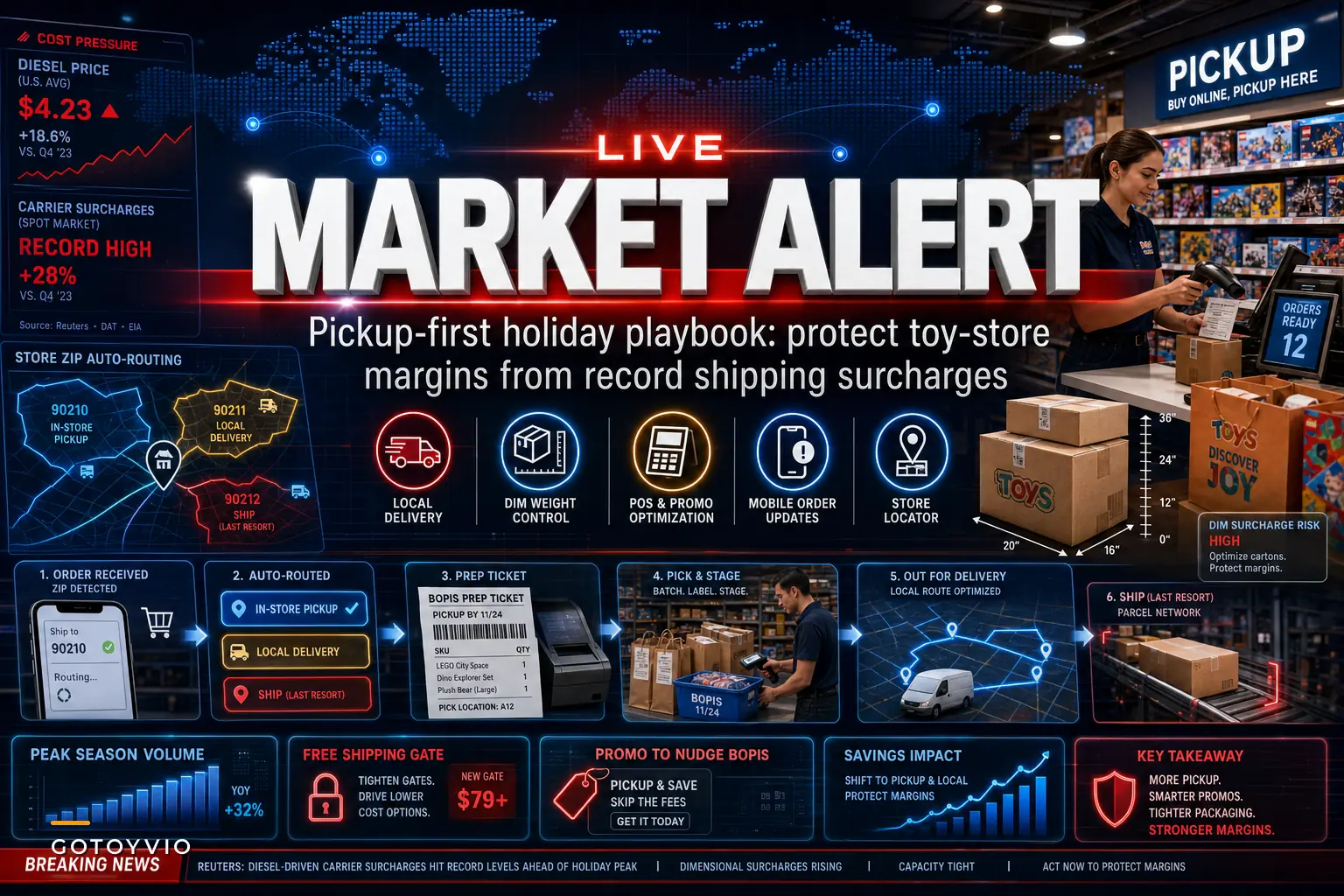

Diesel prices climbed hard this fall, and the carriers did exactly what you'd expect — they tacked the cost straight onto peak-season parcel rates. Reuters reported in late October that U.S. retailers are now staring down record holiday delivery prices driven by fuel-linked surcharges, and a separate Reuters piece noted that global diesel is expected to stay elevated well past the gift-buying window. This isn't a one-week spike you can wait out. It's the cost environment you're operating in for all of Q4.
For a toy store, this hits harder than most retail. Your products are bulky and light — a big molded playset, a dollhouse, a 1,000-piece puzzle — which means dimensional weight pricing wrecks you. You're not shipping dense, small, high-margin goods. You're shipping air inside cardboard, and now that air costs significantly more to move.
So instead of eating the surcharge or quietly raising shipping fees until your cart conversion tanks, the smarter play this season is to move volume off parcel entirely. Pickup-first. Below is how that actually works operationally, because "just do more pickup" is useless advice without the mechanics behind it.
The real problem surcharges expose: you've been subsidizing shipping without knowing it
Most independent toy stores never calculated their true per-order shipping cost. They set a flat rate or a free-shipping threshold back when fuel was cheaper and never revisited it.
Here's what that does during a surcharge spike. Say your average online order is $52 and qualifies for free shipping. The box is a 14×12×10 bulky toy. Pre-surcharge, maybe that cost you $11–$13 to ship. With peak demand surcharges and fuel added, you're now looking at $16–$19 on the same box. Your blended margin on that order might have been 38%. After the real shipping cost, you're down into the low 20s — and that's before packaging, labor, and the card processing fee.
The surcharge didn't create this problem. It just made a hidden leak impossible to ignore. You were already losing on a chunk of your free-shipping orders. Now you're losing more, on more of them.
That's the reframe worth holding onto: the goal isn't to win the shipping game, it's to stop playing it on orders that don't need to ship. A large share of toy-store online orders come from people who live within a 20-minute drive. They're buying online because it's convenient, not because they need it mailed.
The pickup-first model, in plain terms
Pickup-first means you restructure your checkout and your promotions so the default, cheapest, fastest option is "buy online, pick up in store" (BOPIS) or local delivery — and parcel shipping becomes the fallback for people who genuinely can't come in.
Never run out of bestsellers again.
GoToyvio helps you monitor inventory and sales to keep your shelves stocked and customers happy.
- Real-time stock tracking
- Automated reorder alerts
- Sales and promotion analytics
No credit card required
The order flow looks roughly like this:
-
Customer adds items to cart online.
-
At checkout, the store auto-detects whether they're in your local radius (by zip code).
-
If they're local, pickup is presented first — free, with a "ready in 2 hours" promise.
-
Local delivery is offered second at a flat fee that covers your actual cost, not the carrier's surcharge.
-
Parcel shipping is shown last, with the real cost, clearly labeled.
-
Pickup orders fire a prep ticket to your floor staff, who pull and stage the order.
-
Customer gets a "ready for pickup" text and grabs it at a dedicated counter.
The entire point is to shift the behavioral default. When pickup is the first thing people see and it's free and fast, a meaningful percentage take it — especially parents already running errands with kids in the car.
What this actually saves you — a worked example
Let's make this concrete with a mid-sized independent during December.
Before (parcel-default):
-
~420 online orders in December
-
~75% shipped via parcel = roughly 315 shipped orders
-
Average loaded shipping cost during surcharge season
~$15.50/order
-
Total shipping spend
around $4,880
After (pickup-first):
-
Same ~420 orders
-
Pickup shifts to ~55% of online orders = roughly 230 pickups
-
Remaining ~190 orders split between local delivery (~90) and parcel (~100)
-
Local delivery runs cost you ~$4–$6/order internally (batched routes) = ~$450
-
Parcel on the remaining 100 bulky orders
~$1,550
-
Total fulfillment spend
around $2,000
That's roughly $2,800 kept in a single peak month, and it scales with your volume. The pickups also generate in-store foot traffic, which is where impulse add-ons happen — a parent grabbing a $14 stocking-stuffer at the counter while collecting their order. That upsell doesn't exist on a shipped box.
A quick comparison of your fulfillment options this season
Different fulfillment methods carry very different cost profiles during peak season, and most stores aren't pricing or routing orders in a way that reflects those differences. Here's how they stack up:
| Fulfillment method | Your cost per order (peak) | Speed to customer | Margin impact | Best for |
|---|---|---|---|---|
| Parcel (carrier) | $15–$19 (bulky toys) | 2–6 days | Worst — surcharge-exposed | Out-of-area customers only |
| Local delivery (batched) | $4–$6 | Same/next day | Moderate | Nearby, can't come in |
| In-store pickup (BOPIS) | ~$0 (labor only) | 2 hours | Best + drives upsell | Anyone in your radius |
| Ship-from-nearest-store (multi-location) | Lower zone cost | Faster | Better than single-origin | Micro-chains |
Every order you move away from parcel and toward pickup is money back in your pocket. The job this season is to engineer that shift at checkout, not hope customers choose it on their own.
Setting up pickup-first without chaos on the floor
A lot of stores avoid leaning into pickup because they're worried it'll create a mess — staff hunting for orders, customers waiting at the register, holiday crowds backing up. Fair concern. The operational checklist below addresses that directly:
-
Dedicate a pickup zone. Not the main register. A separate counter or shelf, clearly signed, so pickup customers don't queue behind the checkout line.
-
Stage orders by first initial or order number on labeled shelves so any staffer can grab one in seconds.
-
Set a realistic prep SLA. "Ready in 2 hours" during peak is honest. Don't promise 15 minutes you can't hit on a Saturday.
-
Batch your local deliveries into one or two daily runs, not on-demand. On-demand delivery kills your economics fast.
-
Print or display a clear prep ticket for every pickup order so nothing gets missed during a rush.
-
Have a single text/notification trigger that tells the customer their order is ready — this alone cuts the "is it done yet?" phone calls that eat staff time.
-
Pre-stage your most popular SKUs near the pickup counter in the two weeks before Christmas.
Label shelves by order number range so any staffer can quickly locate a pickup without scrolling through a list.
Stores that run pickup well treat it as its own mini-workflow with its own space and a designated person on each shift. The ones that bolt it onto the main register are the ones who end up resenting the whole thing by week two of December.
Where tooling quietly matters
The zip-code detection, the prep tickets, the ready-for-pickup texts, the batching of delivery routes — doing all of that manually across hundreds of December orders is where small teams start to break down. Someone forgets to pull an order, a customer gets notified their pickup is ready when it isn't, a batch delivery goes out without one of the stops.
Here's a quick workflow visualization:
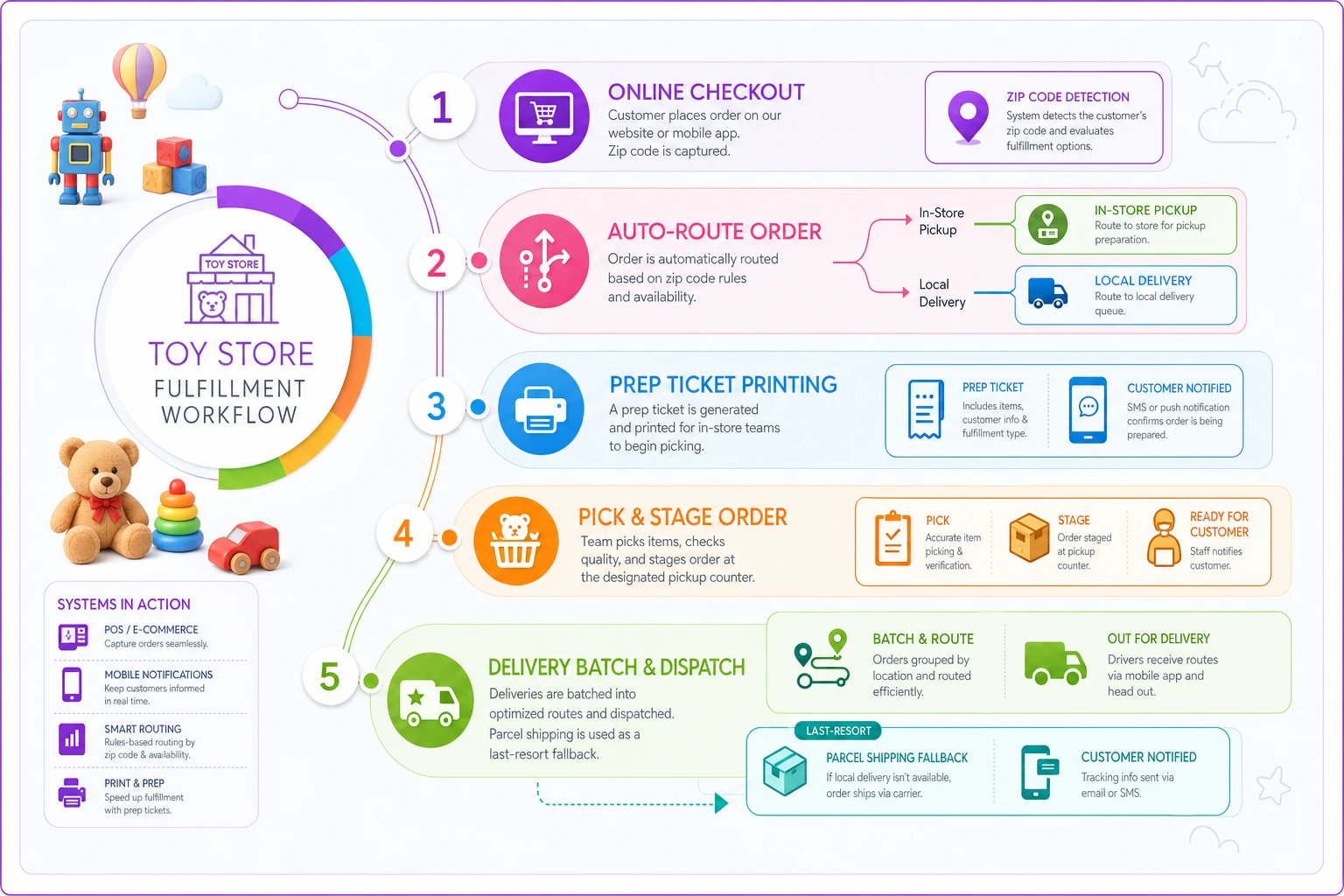
A connected operational platform that ties your POS, online orders, and fulfillment routing together can auto-route each order to the cheapest valid method and generate the pickup ticket without anyone having to think about it. AI-assisted routing can factor in the customer's location, item dimensions, and your current staffing, then surface pickup or local delivery before parcel even shows as an option. The value isn't the technology itself — it's that nobody on your floor has to manually decide "should this ship or be picked up?" hundreds of times during your busiest month. That decision fatigue is real, and it leads to mistakes.
If you want the mechanics on squeezing cost out of the parcel orders you do still ship — right-sizing boxes, standardizing pack dimensions, carrier negotiation — that's covered in detail in our guide on cutting fulfillment costs with standardized pack sizes and carrier negotiation. Pickup-first and packaging discipline work together: the first removes orders from the parcel stream, the second makes the remaining ones cheaper.
When pickup-first is the right call — and when it isn't
This makes sense when:
-
A meaningful share of your online customers live within ~20–25 minutes.
-
You sell bulky, dimensional-weight-heavy toys that get hit hard by parcel pricing.
-
You have floor space for even a small dedicated pickup zone.
-
Your foot traffic benefits from the add-on sales pickups naturally generate.
This is a bad idea when:
-
Most of your online demand is genuinely out-of-region (you've built a national niche brand around collectibles, for example).
-
You're short-staffed enough that reliably prepping orders within a day during peak is already a stretch.
-
Your store layout can't physically separate pickup from the main register, and your lines are already brutal.
If your online identity is built around shipping rare collectibles nationwide, pushing pickup on customers who were never local doesn't make sense. For that kind of operation, tight packaging standards and surcharge-aware shipping fees matter more.
A short real scenario
A two-person-plus-weekend-staff toy shop near a suburban main street was offering free shipping over $45 and shipping around 80% of its online orders. When the fuel surcharges hit, their December shipping line jumped nearly $1,900 over the prior year before they'd even gotten through the first two weeks.
They flipped to pickup-first in mid-November: zip-detection at checkout, pickup shown first and free, a card table turned into a labeled pickup shelf near the front door, and a single daily delivery run for nearby customers. Within three weeks, pickup was handling a little over half their online orders. Parcel volume dropped enough that the surcharges barely moved the needle. The owner mentioned the pickup counter was also quietly becoming an upsell spot — people grabbing one more thing on the way out. They didn't raise a single shipping price and didn't lose cart conversion to a scary shipping number.
Bottom line for this season
Surcharges aren't going away before the holidays, and with diesel expected to stay elevated, this is the new baseline. You can't out-negotiate a fuel surcharge on a dollhouse. What you can do is stop shipping the orders that never needed to ship.
Make pickup the obvious, cheapest, fastest default. Batch your local deliveries. Reserve parcel for customers who are genuinely out of reach, and make sure those boxes are right-sized. Do that over the next couple of weeks and you'll protect your margin through the exact window where most independents quietly give it away.
Ready to elevate your toy store operations?
Join 500+ toy retailers using GoToyvio to increase sales, reduce stockouts, and enhance customer loyalty.