

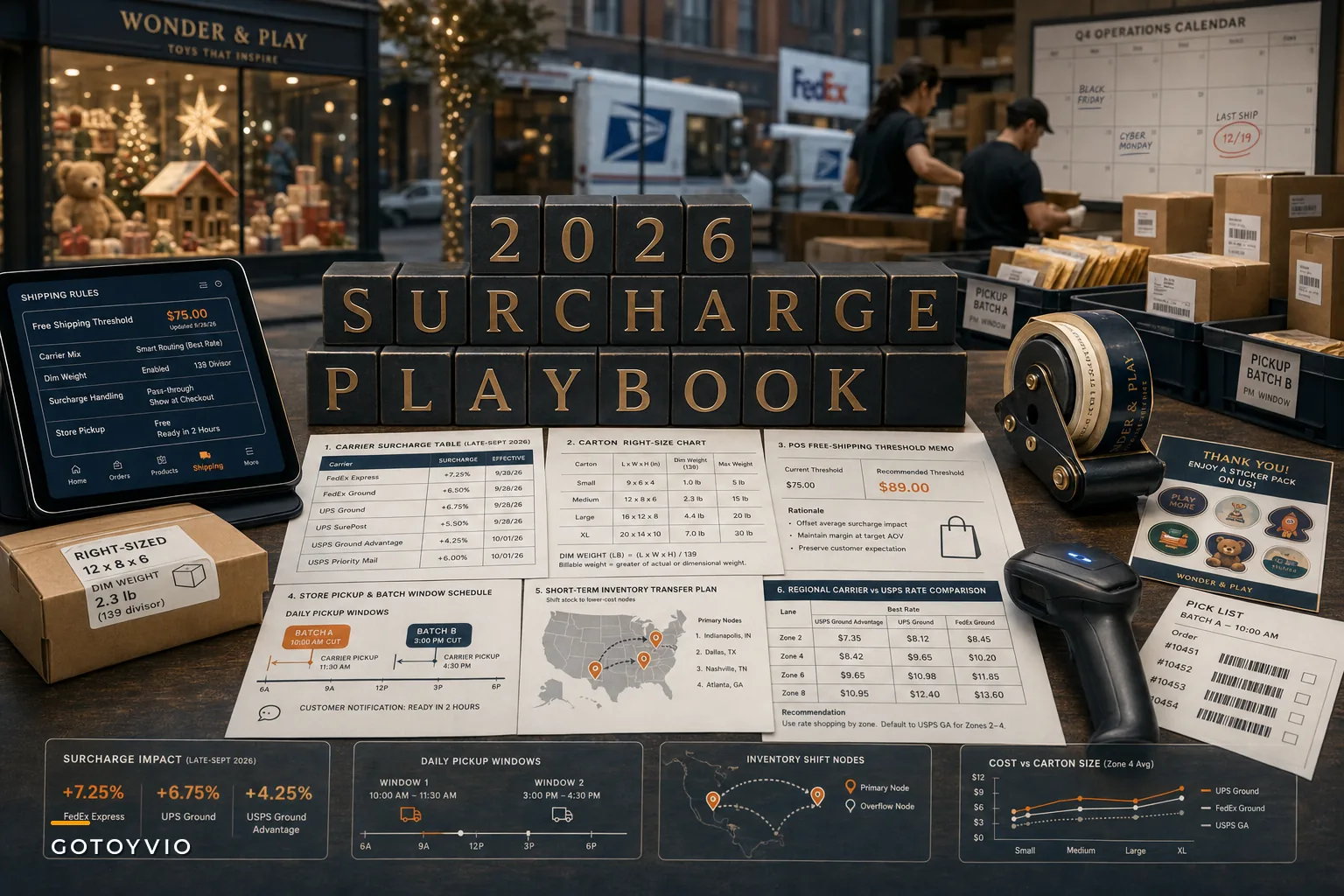

The carriers didn't waste any time this year. By the last week of September, FedEx, UPS, USPS, and Amazon Shipping had all published their 2026 peak demand surcharge schedules — and the windows run deep into January 2027, covering every holiday shipping week that actually matters. The 2026 Peak Demand Surcharge Guide from Reveel Group has the full breakdown, but the short version: per-package residential fees went up, additional-handling charges got steeper, and oversize penalties are now punishing enough to wreck the margin on a single large playset order.
For a shop with one to three people juggling receiving, floor coverage, register, and online fulfillment simultaneously, this isn't something you quietly absorb. It changes the math on free-shipping thresholds, promo codes, bundle pricing, and whether certain SKUs are even worth selling online during peak. So rather than rehashing surcharge tables — plenty of logistics blogs already did that — here's what you actually do between now and Black Friday.
The real problem these surcharges expose
Surcharges aren't really the issue. They're a stress test. What they expose is that most small toy stores priced their online shipping once — usually when they launched the webstore — and never revisited it against what carriers actually charge per package type.
Here's the pattern that bites people. A store sets a flat $7.99 shipping fee or a "free over $50" threshold. That felt fine in a normal month. Peak hits, residential and additional-handling surcharges stack on top of base rates, and suddenly a $54 order that qualified for free shipping costs $14–$18 to deliver. You're not making margin on that order anymore — you're paying for the privilege of fulfilling it.
The deeper problem is that the cost of shipping a toy has almost nothing to do with its price and almost everything to do with its box. A $120 collectible figure ships cheap and small. A $34 ride-on or a bulky dollhouse triggers oversize and additional-handling fees that can exceed its gross margin. If your pricing and promo rules treat all orders the same, peak surcharges quietly turn your best-selling big items into loss leaders you never meant to create.
The moves below aren't about shaving pennies. They're about making sure your fulfillment, pricing, and promos all understand the difference between a small box and a big one — before the surcharge clock starts ticking.
Move 1: Re-score your online SKUs by "ship cost to margin" ratio, not by popularity
Before touching anything else, pull your online catalog and sort it by one number: estimated peak shipping cost divided by gross margin per unit.
Never run out of bestsellers again.
GoToyvio helps you monitor inventory and sales to keep your shelves stocked and customers happy.
- Real-time stock tracking
- Automated reorder alerts
- Sales and promotion analytics
No credit card required
| Tier | Ship cost vs. margin | Peak-season action |
|---|---|---|
| Green | Ship cost under ~25% of margin | Keep online, eligible for free-ship promos |
| Yellow | Ship cost 25–50% of margin | Online with capped or paid shipping only |
| Red | Ship cost over 50% of margin | In-store / local pickup only during peak |
The insight most owners miss: the Red tier is almost always your physically largest items, and those are exactly what customers want delivered because they're a pain to carry. That tension is fine. You're not banning them — you're steering those orders toward pickup or in-store, where the surcharge doesn't apply at all.
Move 2: Raise and segment your free-shipping threshold (don't just kill it)
Killing free shipping during peak is tempting but usually the wrong call — it tanks conversion right when traffic is highest. The better move is to segment it.
-
Small-parcel items (figures, games, books, craft kits)
free shipping threshold stays reasonable, maybe nudged up 10–15%.
-
Bulky or oversize items
excluded from free shipping entirely, or they carry a visible "oversize delivery" fee that reflects the actual additional-handling charge.
A toy shop doing somewhere around 300–450 online orders through Q4 can lose four figures in margin just from large-item free shipping that was set and forgotten. Segmenting the threshold recovers most of that without the conversion hit of pulling free shipping across the board.
One practical note: communicate the oversize fee before checkout, on the product page. Customers tolerate a delivery surcharge on a giant item. They don't tolerate discovering it at the last step — that's where you get abandoned carts and angry emails.
Move 3: Push local pickup hard, and make it the obvious choice
Every order that converts to pickup is an order with zero surcharge exposure. For a neighborhood toy store, this is your single strongest lever, and it's weirdly underused.
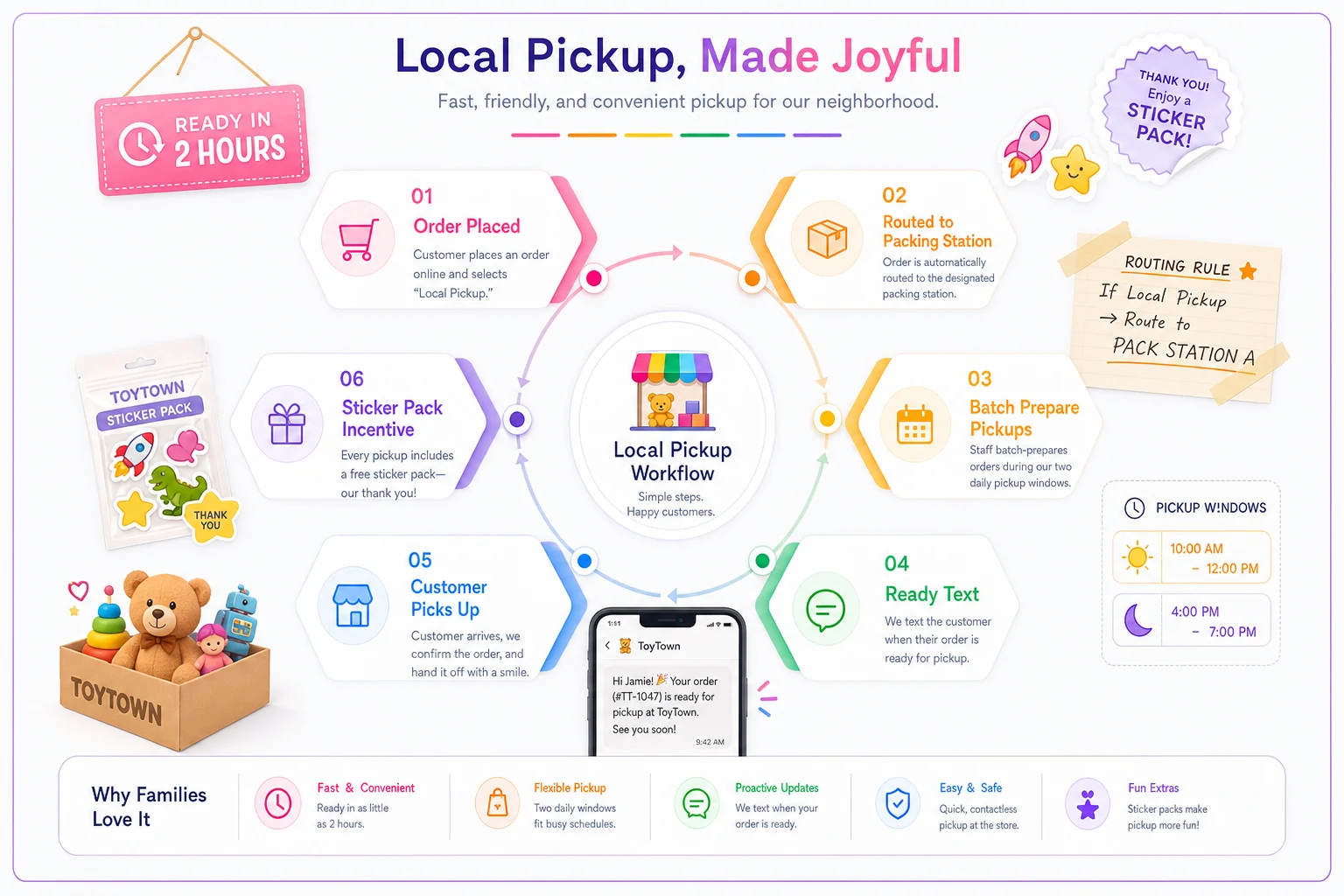
The problem is usually presentation. Pickup is buried as a radio button at checkout, so maybe 8–12% of local customers use it. Stores that lead with pickup — banner it, offer a small incentive, show a "ready in 2 hours" promise — routinely push that to 30–40% during peak.
-
Offer a small pickup perk — a bonus sticker pack, a gift-wrap upgrade, or 5% off — framed as "skip shipping, grab it today."
-
Set a tight, honest ready-time window and actually hit it. Reliability is what makes pickup a habit.
-
Batch pickup prep into two daily windows so your tiny team isn't interrupted every 20 minutes.
-
Text the customer the moment it's ready, with a clear pickup location and hours.
The margin math is simple and brutal in your favor: a pickup order shifted away from a surcharged residential delivery can swing $8–$16 per order straight back into your pocket during peak weeks.
A simple pickup workflow to implement quickly:
The margin math is simple and brutal in your favor: a pickup order shifted away from a surcharged residential delivery can swing $8–$16 per order straight back into your pocket during peak weeks.
Move 4: Right-size packaging before the oversize penalties hit
This is where the current moment ties directly back to the fundamentals. The Atomix Logistics breakdown of how UPS, FedEx, and USPS surcharges hit margins makes the point clearly: dimensional and additional-handling fees are where small shippers bleed the most, because one oddly-sized box can trip multiple fees at once.
If you haven't standardized your pack sizes and packing station yet, peak season is the most expensive possible time to be improvising with whatever boxes you have on hand. We've covered the full approach — standardized pack sizes, carrier negotiation, and packing-station layout — in this guide on cutting fulfillment costs, and the surcharge environment makes every one of those moves pay off harder than usual.
Keep a laminated cheat-sheet of carrier dimensional thresholds at the packing station so packers can quickly right-size boxes.
The specific peak-season tweak: audit your three or four most-shipped box sizes against the carriers' dimensional thresholds. A box that's one inch over an additional-handling cutoff costs the same whether it's packed tight or half-empty with void fill. Dropping to the next size down — or switching a rigid item to a right-sized mailer — can take an order from "surcharge triggered" to "clean base rate." Multiply that across a few hundred Q4 orders and it's real money.
Move 5: Rebuild promo codes so shipping subsidies don't stack into losses
A quiet killer during peak: a free-shipping promo stacked on top of a percentage-off code on top of a bulky item. Each discount made sense alone. Together, on a large box during surcharge season, you've shipped a product below cost.
This almost always happens when promo rules were built in slower months and never pressure-tested against stacking. The fix is guardrails:
-
Exclude oversize/Red-tier SKUs from free-shipping promos entirely.
-
Prevent free-shipping codes from stacking with percentage-off codes on the same order.
-
Set a minimum post-discount order value for any free-shipping offer, calculated so even a surcharged small parcel still clears margin.
A good gut-check before launching any peak promo: run the worst-case order through it. Biggest eligible box, maximum stacked discount, peak surcharge applied. If that order still makes money, the promo is safe. If it doesn't, close the leak before it goes live.
Move 6: Diversify your carrier mix by package type
Most small stores default to a single carrier out of habit. During peak, that leaves money on the table, because surcharge structures differ meaningfully by carrier and by package profile.
No single carrier is cheapest across all package types once peak surcharges apply. One may be better for small lightweight parcels, another for ground within your region, and a regional or postal option may win for specific zones or oversize items. The point isn't to become a logistics analyst — it's to know your two or three highest-volume package profiles and route each to its cheapest option.
-
Identify your 3 most common package profiles (e.g., "small game box," "medium multi-item," "oversize ride-on").
-
Get the real peak-adjusted rate for each profile from two carriers.
-
Write a one-line routing rule per profile and tape it to the packing station.
Even a rough carrier split across package types can meaningfully soften the blended surcharge hit over a few hundred orders.
When carrier diversification isn't worth it
If you're shipping fewer than roughly 150–200 orders across all of Q4, the time cost of managing two carrier accounts probably outweighs the savings. In that case, lean harder on pickup (Move 3) and packaging (Move 4), and keep your single carrier. Complexity has a cost, and for a two-person shop that cost is often higher than the surcharge you're trying to dodge.
Move 7: Pre-position inventory and set a ship-by cutoff you'll actually honor
The last surcharge trap is time pressure. When customers order late and expect delivery by a specific date, you get pushed into expedited service levels — and expedited is where surcharges are heaviest. A late-ordering customer who needs Christmas delivery can turn a clean ground order into a surcharged air shipment that eats the entire margin.
Two defenses worth putting in place now.
First, publish honest ship-by cutoff dates prominently and enforce them. After the ground cutoff, switch storefront messaging to "order now for pickup" rather than quietly accepting orders you'll have to rush at a loss.
Second, pre-position your known peak sellers. If you can forecast even roughly which items will spike — hot releases, repeat holiday staples, collector drops — having them in stock and pre-picked means you ship on the cheapest viable service every time instead of scrambling.
This is also where a tight connection between your POS, online inventory, and order queue stops being a nice-to-have. When your team can see real-time stock, pickup-ready orders, and ship-by status in one place, you stop making expensive last-minute shipping decisions out of panic. The stores that handle peak calmly aren't the ones with more staff — they're the ones where information is centralized enough that a two-person team can route every order to its cheapest correct path without overthinking it.
A quick real scenario
Take a small two-person toy shop doing most of its online volume in Q4 — roughly 380 online orders across the season. Their setup going in: flat $6.99 shipping, free over $50, one carrier, no pickup incentive, promos that stacked freely.
When they mapped ship-cost-to-margin, they found about a dozen bulky SKUs — ride-ons, large building sets, a couple of dollhouses — quietly losing $3–$9 each once peak surcharges applied, because they qualified for free shipping and shipped oversize.
The changes were unglamorous: Red-tier items moved to pickup-or-paid-shipping only, free shipping segmented by box size, promo stacking disabled on oversize items, pickup pushed to the front with a small sticker-pack incentive, and a second carrier added just for small parcels. Pickup adoption went from roughly 10% to a little over a third of local orders. The dozen bleeding SKUs stopped bleeding.
The net effect wasn't a dramatic revenue jump — it was margin protection. Blended shipping cost per order dropped noticeably, and the oversize losses essentially disappeared. On a season that size, that's the difference between a genuinely profitable Q4 and one that just looks busy.
Your pre-peak checklist
Run through this before surcharges fully bite:
-
[ ] Scored top online SKUs by ship-cost-to-margin and tagged them Green / Yellow / Red
-
[ ] Segmented free-shipping threshold by box size or category
-
[ ] Excluded oversize items from free-shipping promos
-
[ ] Disabled risky promo stacking and stress-tested worst-case orders
-
[ ] Moved local pickup to a front-and-center, incentivized option
-
[ ] Audited top box sizes against carrier dimensional and handling thresholds
-
[ ] Set carrier routing rules for your 2–3 main package profiles
-
[ ] Published and committed to honest ship-by cutoff dates
-
[ ] Pre-positioned known peak sellers in stock and pre-picked
Run through this before surcharges fully bite:
The takeaway
Peak season surcharges feel like something happening to you, but most of the damage is self-inflicted — it comes from pricing and promo rules written in calmer months that can't tell a small box from a big one. The carriers just turned the dial up enough that those blind spots finally hurt.
You don't need to out-negotiate FedEx or match Amazon's logistics. You need your fulfillment, pricing, and promos to all understand package size, steer the expensive stuff toward pickup, and refuse to ship anything below cost. Do that in the next couple of weeks, and the surcharge schedule becomes a number you planned around instead of a surprise on your December P&L.
You don't need to out-negotiate FedEx or match Amazon's logistics. You need your fulfillment, pricing, and promos to all understand package size, steer the expensive stuff toward pickup, and refuse to ship anything below cost. Do that in the next couple of weeks, and the surcharge schedule becomes a number you planned around instead of a surprise on your December P&L.
Ready to elevate your toy store operations?
Join 500+ toy retailers using GoToyvio to increase sales, reduce stockouts, and enhance customer loyalty.